- Place
- Zarasai District Municipality
- Region
- Aukštaitija
- Type
- stone Neo-Romanesque church with Neo-Gothic features
- Address
- Bažnyčios g. 28, Salakas, Zarasai District
- Coordinates
- 55.58400, 26.14040
Salakas Church
A stone church and 72 m tower
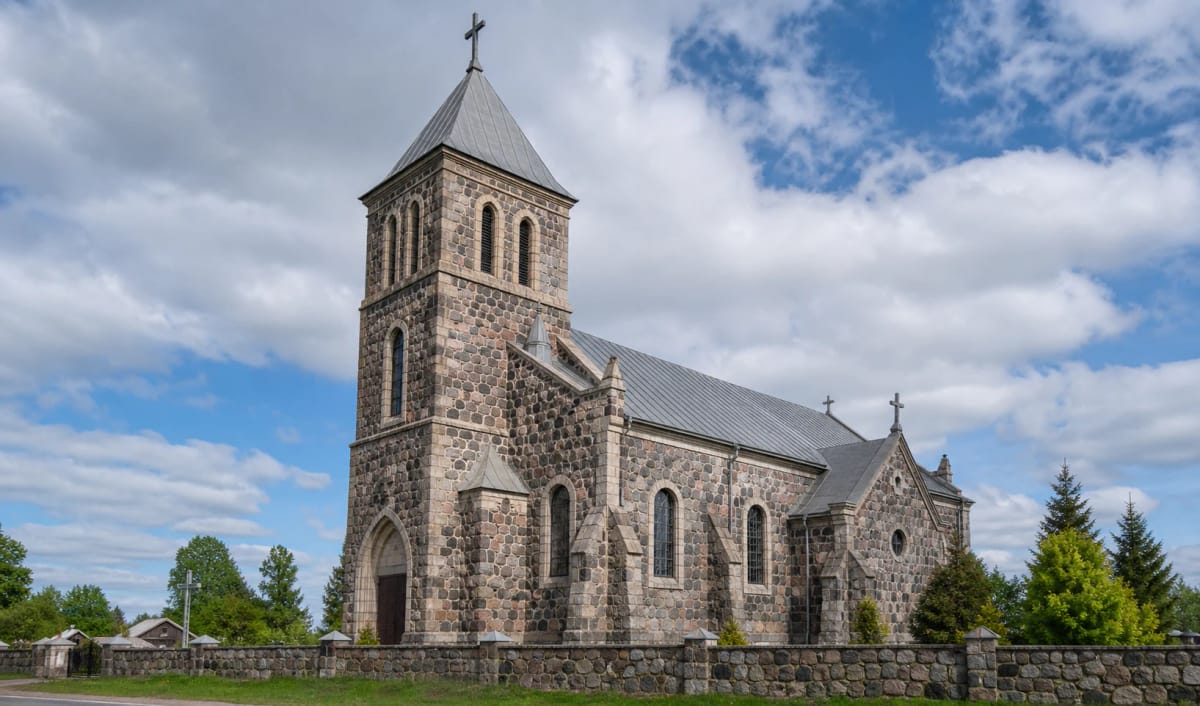
Salakas Church of Our Lady of Sorrows stands out because it is built from split and dressed fieldstones and brick. The Cultural Heritage Register describes three-layer walls, so the building's force comes not only from height but also from the mass of its masonry. According to sources, the church is about 64 m long, 22 m wide, and its tower reaches roughly 72 m, making it one of the tallest stone churches in Lithuania and a strong landmark for Salakas and the wider Zarasai area.
The Diocese of Panevėžys describes its architecture as Neo-Romanesque with Neo-Gothic features. It would therefore be inaccurate to call it simply Neo-Gothic: the Romanesque sense of mass and the sharper vertical Neo-Gothic accents both matter.
Built in 1906-1911 from a design by Ignotas Morgulcas
The present church was built in 1906-1911 on the site of an older church that burned in 1905. The design was prepared by Riga engineer-architect Ignotas Morgulcas, and construction was led by Nikolajus Andrejevas. The foundations were blessed on 8 August 1906, and services began in the new church on 14 August 1911.
Bishop Pranciškus Karevičius consecrated the church in 1915. These dates place Salakas church within the early twentieth-century wave of Lithuanian sacred construction, when even small towns built large and ambitious stone churches.
Organ and interior layers
The church contains a 1914 organ made in Königsberg by the firm of Bruno Goebel and restored in 1997-1998. This detail matters because Goebel organs are noted in several Lithuanian churches, placing Salakas on a broader organ-heritage map.
The interior should be read with war damage and later repairs in mind. Not every element belongs to one period or original condition, so it is more accurate to speak of surviving, repaired, and restored layers.
War damage and the 1989 tower restoration
In 1944 the church was badly damaged. The roof was repaired in 1947, while the damaged tower spire was restored only in 1989, following a design by architect A. Panavas with V. Bagočiūnas as structural designer. These dates show that the present appearance combines original construction with post-war and later restoration.
When visiting, look at the church as an enduring sign of the town. The stone masonry, high tower, and restoration history all speak of community efforts to preserve the church through very different periods.
Services and visiting
During research, the Diocese of Panevėžys listed services on Saturdays and Sundays at 12:00. As in any active church, interior visits should respect the service schedule and prayer time.
No ticket was found during research. If you want to see the interior quietly, check parish information or choose a time outside liturgy, unless you intend to attend the service.