- Genre
- Chronicle place legend
- Source status
- chronicle tradition
- Motifs
- Šventaragis, Vilnius, fire, rulers' cremation, valley, Neris and Vilnia
Šventaragis, Legend of Šventaragis Valley, Valley of Vilnius rulers' cremation
The legend
The legend of Šventaragis Valley tells of a place in Vilnius, by the confluence of the Neris and Vilnia, where Lithuanian rulers and nobles were said to have been cremated. It is not presented as an ordinary fire but as a centre of power and memory.
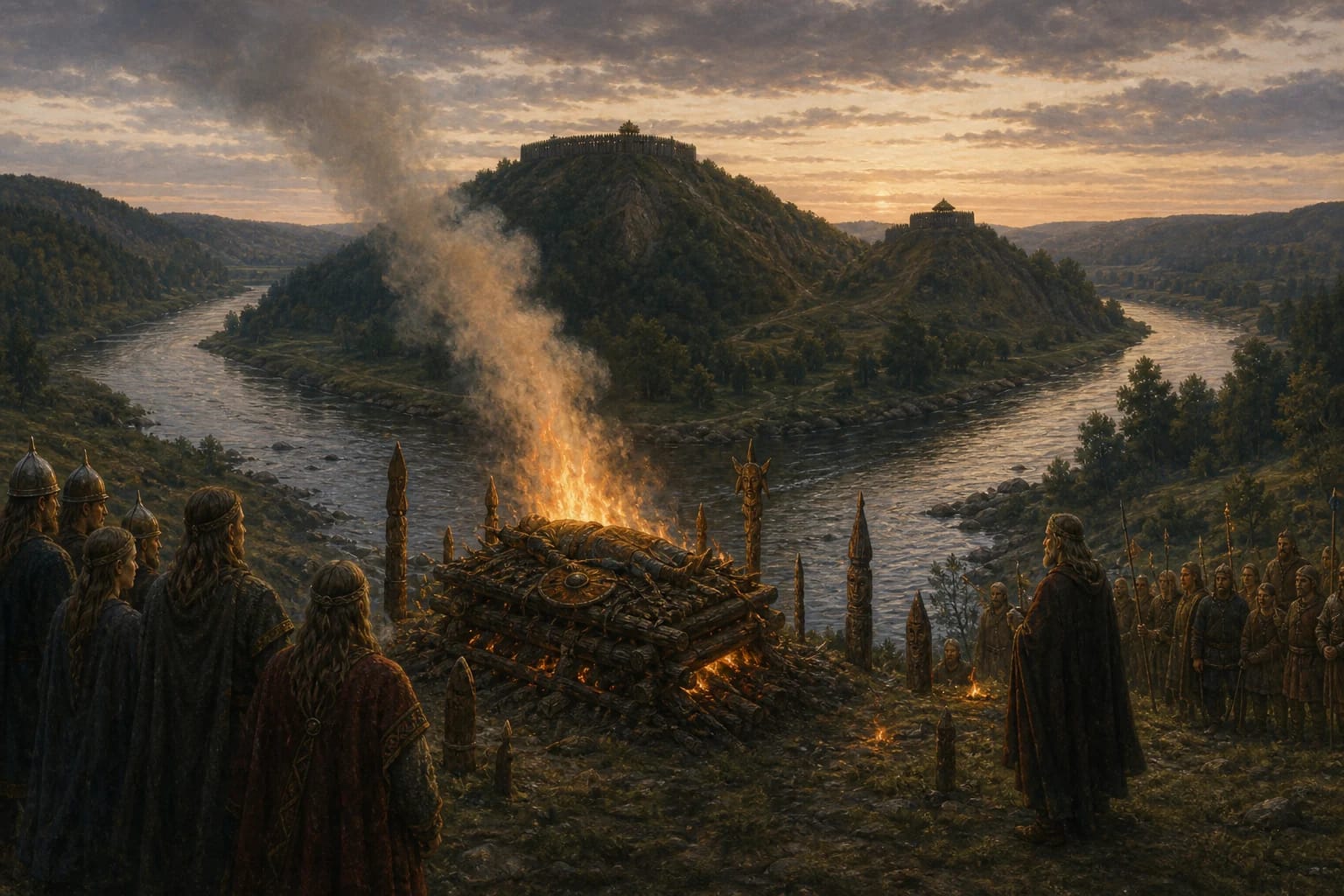
In the story, Šventaragis asks his son Skirmantas to burn his body in this valley after death and orders that future grand dukes and notable nobles be cremated there as well. According to the chronicle, his horse, slave, greyhound, and falcon were cremated together with Šventaragis. One funeral command becomes the beginning of a rulers' cremation tradition.
Because of Vilnius' topography, the legend joins the Gediminas' Dream story. Gediminas hunts and sleeps in a landscape already marked by Šventaragis memory.
Interpretation: what does Šventaragis Valley mean?
Šventaragis Valley speaks about continuity of rule. The beginning of the city is tied not only to a castle and living rulers but to the dead. The capital rises where memory already burns.
Fire in the legend is not only destruction. It carries the ruler from life into memory and turns the valley into a threshold between the city of the living and the authority of the dead.
The confluence, valley, hills, and castle space create a landscape in which every element can be read as a sign. The legend gives Vilnius a beginning deeper than a construction date.
History, sources, and research
The Šventaragis story is linked with the Lithuanian chronicles and the chain of Vilnius origin legends. It is often read beside Gediminas' Dream.
VLE presents Šventaragis as a legendary Lithuanian duke mentioned in the Bychowiec Chronicle and in Maciej Stryjkowski's chronicle (printed in 1582). This requires a careful tone: the subject is sixteenth-century chronicle tradition, not a securely documented ruler's biography. According to many researchers, the legend explained and centralized the custom of cremating rulers: earlier the remains were burned where the person died, while the legend moves this rite to a single sacred place.
The legend of Šventaragis Valley was studied by W. Mannhardt, Jonas Basanavičius, Petras Klimas, Vladimir Toporov (who linked it with the Sovijus myth), Norbertas Vėlius (who examined Šventaragis's connections with Lizdeika and the rise of the Perkūnas cult), and Gintaras Beresnevičius. Such interpretations open deeper religious and structural layers, but they must be read as researchers' explanations supplementing the chronicle material.
In present-day Vilnius, the name Šventaragis Valley is associated with the area of Cathedral Square, the castle territory, and the mouth of the Vilnia. This shows that the legend survived not only in texts but also on the map of the city's place-names and cultural memory.
Why this legend matters
Without Šventaragis Valley, the Vilnius founding story would be only dream and castle. Šventaragis adds the layer of dead rulers and ritual place.
Read with Gediminas' Dream, it shows two beginnings of Vilnius: one looking to the city's future fame, the other to a deeper memory marked by fire.