- Place
- Klaipėda District Municipality
- Region
- Samogitia
- Type
- one of the oldest wooden churches in Samogitia
- Address
- Samališkės g. 8, Vėžaičiai, Klaipėda District
- Coordinates
- 55.71280, 21.46660
Vėžaičiai Church
St Casimir's Church in Vėžaičiai: an Old Wooden Shrine
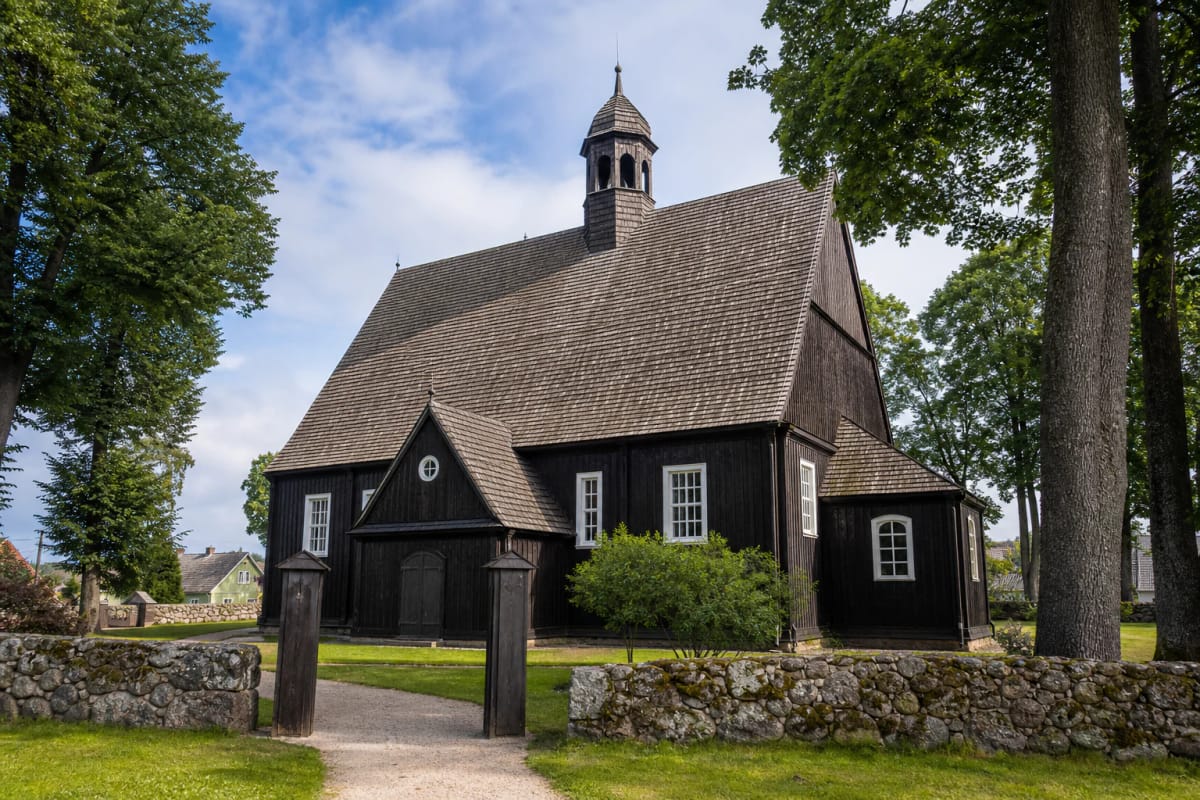
St Casimir's Church in Vėžaičiai is one of the oldest wooden churches in Samogitia and in the Telšiai Diocese. It was built in 1784 at the expense of Kazimieras Volmeris, count and owner of Vėžaičiai Manor, to mark the 300th anniversary of St Casimir's canonization, which is why the church was dedicated to St Casimir. The Register of Cultural Values protects the whole church building complex (code 37591): the church, belfry, and 1816 bell.
The church matters as an example of wooden sacred architecture and as a long-lived parish and pilgrimage place. It is considered the oldest and most beautiful of Lithuania's churches dedicated to St Casimir. In the small Klaipėda District town, it is the main historical landmark.
Architecture: Folk Forms with Baroque Features
The church has folk-architecture forms with Baroque features. It is rectangular in plan, about 13.6 x 24.8 m, three-naved, with sacristies on both sides of the presbytery and a high pitched roof. A small tower stands on the ridge above the main facade and a smaller one above the apse; in 1938-1939 the Baroque towers were rebuilt in a more modest form.
Inside, the 10-stop organ made by Vilnius masters in 1804 stands out with an ornate Baroque case. This form is characteristic of 18th-century wooden churches in Samogitia; visitors should note the timber construction, proportions, and the way a modest exterior volume works with a richer interior.
Altars and Church Decoration
The church has five altars. It is said that Count Leonardas Volmeris (1808-1883) decorated the church, and that the altars were consecrated at different times by bishops of Samogitia: Juozapas Arnulfas Giedraitis, bishop in 1802-1838, and later Motiejus Valančius, bishop from 1850. This shows the church's importance in regional religious life.
Other well-known Samogitian bishops are also linked with visits to Vėžaičiai. For that reason the church matters not only as architecture but also as an object of Samogitian church history.
Indulgence Feasts and Living Tradition
Vėžaičiai is known for its indulgence feasts: St Casimir on 4 March and 26 August, and St Anne on 26 July, moved to the nearest Sunday. On feast days the church becomes a place of large gatherings and pilgrimage, so that is the most interesting time to visit.
The shrine remains an active parish church of the Telšiai Diocese, so it is best visited respectfully and in line with service arrangements.
Vėžaičiai Around the Church
Vėžaičiai is a town in Klaipėda District, about 5 km east of Gargždai. Vėžaičiai Manor is mentioned here in 1567 and belonged to the Volmer family until the first half of the 20th century, so the histories of the church and manor are closely connected.
The Skinija stream flows nearby, Vėžaičiai pond has been created, and a branch of the Lithuanian Research Centre for Agriculture and Forestry operates here. The church is easy to combine with other Klaipėda District and Samogitian sites.
How to Visit
Allow 30-45 minutes for the church; during St Casimir indulgence feasts, plan more time. As an active shrine, it should be visited respectfully.
Check current service and feast times in Telšiai Diocese or parish information before travelling. Vėžaičiai fits well into a Kretinga or Klaipėda-region route.