- Place
- Varniai, Telšiai District Municipality
- Region
- Samogitia
- Type
- former cathedral of the Samogitian Diocese
- Address
- M. Valančiaus g. 4, Varniai, 88319 Telšiai District
- Coordinates
- 55.74380, 22.37000
Varniai Church of Saints Peter and Paul, Former Varniai Cathedral
Varniai Cathedral: former centre of the Samogitian Diocese
Varniai Cathedral is one of Samogitia's most important sacred landmarks. Today it functions as the parish Church of Saints Peter and Paul, but its name and place recall that in 1417-1864 Varniai, earlier called Medininkai, was the centre of the Samogitian Diocese, one of Christian Samogitia's most important sites.
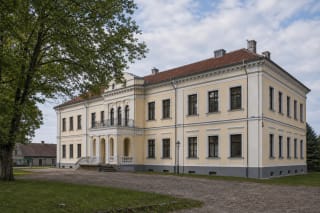
In Varniai, the cathedral should be seen together with the Museum of the Samogitian Diocese, housed in the former priest seminary building of 1770. Between these two places, a story forms about the diocese, the seminary that operated in 1622-1628 and 1740-1864, clergy, the Lithuanian book, and Samogitian cultural memory. Mikalojus Daukša and Motiejus Stryjkowski lived and worked here.
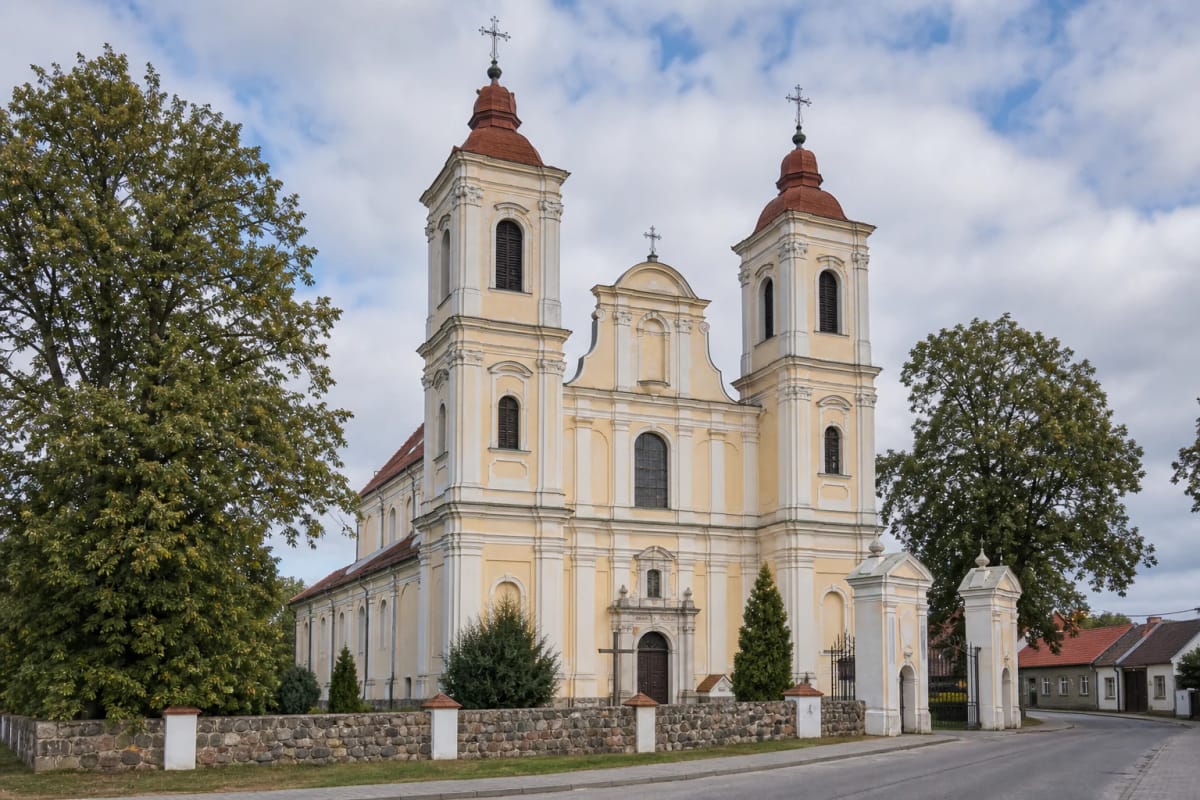
A Baroque twin-towered church from 1680-1691
The first cathedral in Medininkai was built in 1417, burned by rebelling peasants in 1418, and rebuilt in 1421. After the fire of 1680 it was rebuilt in another place: according to VLE, the present Baroque Church of Saints Peter and Paul was built in 1680-1691, while the Telšiai Diocese gives 1681-1691. It is a basilican, cruciform, twin-towered church with an 1870 churchyard fence and gates.
The interior is valuable for Baroque art: four altars, pulpit, Baroque bishop's chair, all from the 18th century, an 1821 organ restored in 2007-2011, and many 18th- and 19th-century paintings and bishops' portraits, including founder Kristupas Pacas and Bishop Motiejus Valančius. Beneath the church is a crypt where 13 Samogitian bishops are buried.
Fires, Motiejus Valančius, and the transfer of the diocesan centre
Varniai burned many times over the centuries, including in 1535, 1620, 1662, 1680, 1817, and 1863. After the 1817 fire, funds from Bishop Juozapas Arnulfas Giedraitis helped rebuild the cathedral. In the mid-19th century, from 1850 to 1864, Bishop Motiejus Valančius lived in Varniai and made the town a centre of Lithuanian culture, the temperance movement, and books.
In 1864, after the 1863 uprising, the Samogitian Diocese centre and the priest seminary were moved to Kaunas, so Varniai Cathedral lost its former administrative role and became a parish church. Even so, the historical importance of the place did not disappear: Varniai remained a symbol of Samogitia's spiritual history.
What to see in and around Varniai Cathedral
If the church is open, look at the interior space, Baroque altars, pulpit, bishop's chair, organ, and bishops' portraits. Outside, note the twin-towered silhouette and the cathedral's position on M. Valančiaus Street, in the centre of a radial-plan town. It is not only a church but also a sign of the former ecclesiastical centre.
The cathedral setting is best understood by walking slowly through Varniai. Nearby are the monument to M. Valančius, created in 1925 and restored in 1990, and the 1999 monument to Bishop Merkelis Giedraitis and Canon Mikalojus Daukša by the museum. The town is small, so the cathedral, museum, and monuments can be joined into a short but substantial route.
Mass, tickets, and planning
During research, official parish and diocesan sources listed Masses on Sundays at 10:00 and 12:00, weekdays at 18:00, and Saturdays at 12:00. Because Mass times can change, check the official parish page before travel.
No church ticket was listed in official sources. If you plan an interior visit outside Mass, behave as in an active sacred space and check whether entry is possible at that time.