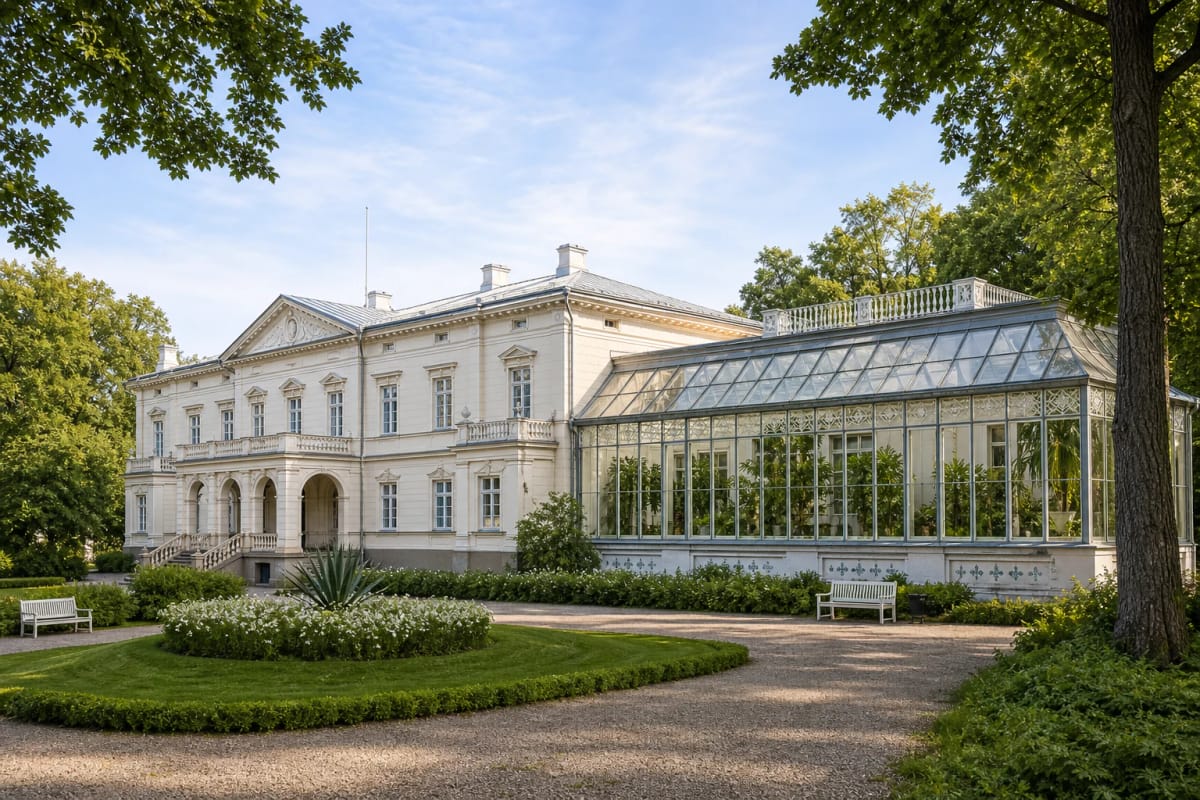
- Place
- Kretinga District Municipality
- Region
- Samogitia
- Type
- manor estate, museum, park, and historic winter garden
- Address
- Vilniaus g. 43, Kretinga
- Coordinates
- 55.89994, 21.24882
Kretinga Museum, Kretinga Manor Estate
Kretinga Manor: not just a palace, but a whole estate
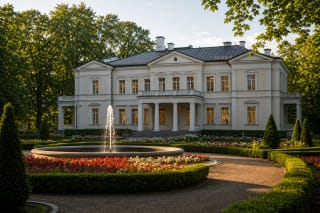
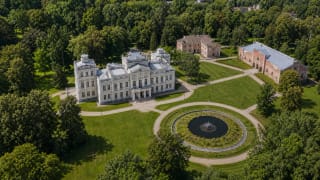
Kretinga Manor and Winter Garden is a place where visitors receive more than a facade. In the territory of Kretinga Museum, the manor palace with its orangery, park, half-timbered watermill, steward's house, and museum exhibitions come together. It is easy to spend several hours here even if you planned only a short stop.
The estate is a valuable heritage complex. According to encyclopedic data, the eighteenth- to early-twentieth-century manor estate retains the palace with orangery from the mid-nineteenth century, a half-timbered watermill from the late eighteenth century, a stone brewery from 1836, a smithy from the second half of the nineteenth century, and a park established in the eighteenth century. The palace with Winter Garden was entered in the Register of Cultural Values in 1997 and recognized as a state-protected cultural property in 2005, unique code 1430.
From the Chodkevičiai to the Tiškevičiai
Kretinga Manor is first mentioned in the second half of the sixteenth century. It belonged to the Grand Duke, then to the Chodkevičiai, Sapiehas, Zubovs, and finally the counts Tiškevičiai. After the Battle of Kircholm (Salaspils), Jonas Karolis Chodkevičius built a masonry church and Bernardine monastery here in 1610-1617, while in 1609 Kretinga received Magdeburg rights and a coat of arms.
The manor is most strongly associated with the Tiškevičiai counts, who shaped the cultural landscape of Kretinga and Palanga in the late nineteenth and early twentieth centuries. This link connects Kretinga Manor with Palanga Amber Museum, Birutė Park, and the history of the seaside resort as parts of one family heritage.
The Winter Garden: a major private orangery
The Winter Garden is the main highlight of Kretinga Manor. Exotic plants are thought to have begun with Duke Ignotas Jokūbas Masalskis, who acquired the manor in 1770. Around 1875 Count Juozapas Tiškevičius planned to connect two separate palace wings with an orangery and create a winter garden inside it. In 1880 the design was prepared by Johann Larass (1820-1893), one of Prussia's leading park architects of the period.
The orangery had three floors and was about 16 m high, similar to a two-and-a-half-storey house. It held fan palms, agaves, banana plants, citrus trees, and dracaenas; two fountains and a waterfall flowed among pools with ornamental fish; walls were decorated with living corals brought from the Red Sea. Contemporary testimony described it as the largest winter garden among European private-estate orangeries of the time.
Damage and restoration of the Winter Garden
In 1910-1912 Aleksandras Tiškevičius reconstructed the Winter Garden, introducing Kretinga's first electric lighting and central heating. In 1940 Red Army soldiers stationed in the palace destroyed the plants; after the war the orangery became a fertiliser warehouse, gym, and greenhouse, and the coral walls were irreparably damaged.
In 1972-1988 Klaipėda restorers restored the building according to a project by architect J. Zibuolis (Zibolis), recreating the orangery image from late-nineteenth-century photographs by Paulina Mongirdaitė. In 1991 the palace and Winter Garden were transferred to Kretinga Museum. Today 170 plant species, about 5,000 plants, grow in 693.16 sq m, and the oldest include a ficus from 1982 and an Australian araucaria from 1989 that reaches the orangery ceiling.
Kretinga Museum and manor buildings
Kretinga Museum has operated in the manor palace since 1992. Exhibition themes naturally cover manor culture, Kretinga regional history, ethnography, archaeology, and local heritage. In the museum territory visitors find the central palace, Winter Garden, half-timbered watermill, steward's house, park, the Pas grafą cafe, operating since 1993 as Lithuania's first cafe in museum premises, and the manor sweet shop.
If time is limited, choose the palace and Winter Garden first. If you have longer, add the watermill exhibition, park, and the Tiškevičiai chapel-mausoleum in the new cemetery, because these show how the manor functioned as a single economic and cultural unit.
Manor park by the Akmena
Kretinga Manor Park, established in the eighteenth century, is an important part of the estate experience. Paths, mature trees, ponds, and the placement of buildings in the Akmena River setting help explain how representative and everyday manor environments were planned. Water from the manor pond still flows to the waterfalls in the Winter Garden pools.
The park lets you extend the route with a calm walk before or after the museum. It is worth making a circuit through the whole territory rather than stopping at one room; only then does the scale of the manor become clear.
How to visit Kretinga Manor
Plan 1.5-3 hours. A short route covers the palace, Winter Garden, and a brief park walk. A wider route includes museum exhibitions, the orangery, watermill, park, and cafe stop. The Winter Garden and central palace are usually open daily, while the watermill and palace exhibitions operate Wednesday to Sunday, so check hours before travelling.
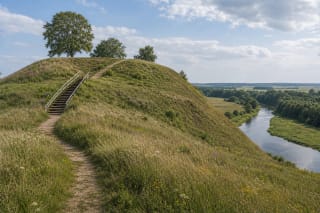
If you combine it with Palanga, Kretinga Manor is a strong contrast to the seaside: less noise, more manor and regional history. In Kretinga District it combines well with Kartena Hillfort, Palanga Amber Museum, and other Tiškevičiai heritage sites.