- Place
- Vilnius City Municipality
- Region
- Vilnius
- Type
- Classical manor estate, park, and regional park visitor centre
- Address
- Žaliųjų Ežerų g. 53, Vilnius
- Coordinates
- 54.74800, 25.29300
Verkiai Palace, Verkiai Manor, Verkiai Park
Verkiai: manor, park, and landscape
Verkiai Manor Estate should be visited differently from a typical palace. This is not a place where the whole story fits into one restored representative building. At Verkiai, the ensemble matters most: surviving outbuildings, a pavilion, remains of the central palace, an old park, ponds, slopes, and viewpoints over the Neris valley.
VLE calls Verkiai Manor Estate one of the most valuable Classical estates in Lithuania. Saugoma.lt presents it as a manor ensemble on the edge of Vilnius, with one side touching the Neris and the others bordering Jeruzalė, Naujieji Verkiai, and Verkiai forest.
What is called Verkiai Palace today
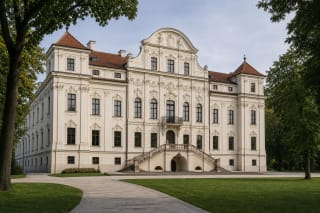
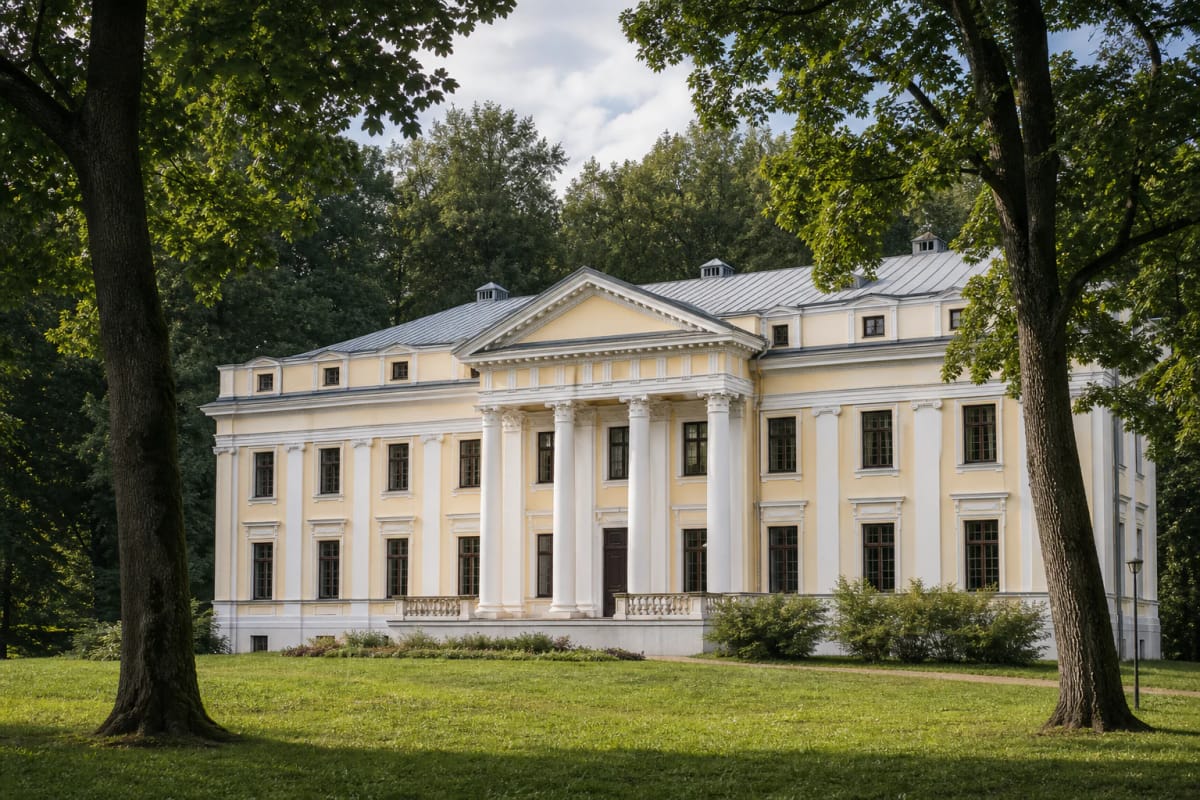
Visitors often say Verkiai Palace, but historically the situation is more complex. The main volume of the central palace no longer survives above ground, so today's view of the place is shaped mostly by the eastern and western outbuildings, the pavilion, the administrative building, and the remains of the central palace.
VLE states that the eastern and western outbuildings were built in the late eighteenth century and are associated with architect Martynas Knakfusas, while the pavilion, remains of the central palace, and administrative building are thought to have been built according to designs by Laurynas Gucevičius. These surviving buildings now form the recognizable Classical face of Verkiai.
From grand-ducal manor to bishops' residence
Verkiai has been known since the early fourteenth century and was a grand-ducal manor. VLE writes that on the occasion of Lithuania's baptism in 1387, Jogaila gave Verkiai to the bishops of Vilnius, and wooden palaces built here became the bishops' summer residence.
Saugoma.lt emphasizes the same line: the estate was first the bishops' summer place but over time became the permanent residence of the bishops of Vilnius. Verkiai history therefore connects not only architecture, but also Lithuania's baptism, the Vilnius bishopric, and the development of the city's northern area.
Masalskis and the Classical period
An important turning point at Verkiai came in the late eighteenth century. VLE states that in 1779 Verkiai became the personal property of Bishop Ignacas Jokūbas Masalskis; palace buildings were constructed in the upper park, and ponds and water supply were arranged.
This period is linked with Martynas Knakfusas and Laurynas Gucevičius. Through them, Verkiai became not only the centre of a large manor but also a site in the history of Lithuanian Classicism. The surviving outbuildings and pavilion let visitors sense how the representative space of the upper terrace was organized.
The central palace: what is gone
Visitors to Verkiai should know that the greatest loss is not immediately visible. In the reviewed Register of Cultural Property research summary, the central palace cellars are dated to 1781-1788; the palace was damaged in 1812, and in 1842-1845 it was demolished down to the cellars.
That is why Verkiai Manor Estate today is not an incompletely restored castle. It is a historic place where part of the ensemble is deliberately read through what survives and what has been lost: the outbuildings show the sides of the composition, the pavilion and cellars testify to the lost centre, and the park preserves the overall landscape logic.
The Wittgensteins, industry, and nineteenth-century modernization
In the nineteenth century, Verkiai became part of both industrial history and the story of a modernizing manor. VLE states that the Verkiai paper factory, founded in 1834 by the Riešė stream, was the largest paper-production enterprise in the western part of the Russian Empire in the second half of the nineteenth century.
The Wittgensteins, who controlled Verkiai from 1842 to 1887, rebuilt the palace, created a menagerie and winter garden, installed gas lighting, and operated a school, telegraph, post office, photography workshop, and roads. This shows that the manor was not only a romantic park but also an intensively used nineteenth-century economic and technological centre.
English-style park and old trees
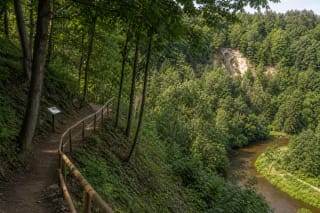
VLE describes Verkiai Park as an approximately 36 ha English-style park laid out on two terraces, with connected ponds. Saugoma.lt emphasizes that the park was created in the late eighteenth century on a high terrace on the right bank of the Neris and partly on the slopes.
The park's value is not only its walking comfort. Saugoma.lt mentions old lindens, larches, eastern white pine, northern white cedar, Norway maples, green ashes, Berlin poplars, grey walnuts, as well as local pines, oaks, European white elms, elms, and other trees. Register of Cultural Property notes also mention the significance of old oaks for protected species.
Visitor centre and guided tours
The most practical starting point is the Verkiai and Pavilniai Regional Parks Visitor Centre at Žaliųjų Ežerų g. 53. Saugoma.lt states that its exhibition presents the natural and cultural values of Verkiai Regional Park, the flourishing periods of Verkiai Manor Estate, and Pavilniai Regional Park.
The Pavilniai and Verkiai Regional Parks Directorate offers a 1-hour tour of the visitor centre, a 1-hour tour of the Verkiai Manor Estate territory, and longer interpretive hikes in the Verkiai Landscape Reserve. This matters because some building interiors are not a standard open palace museum, so the best historical explanation often comes through a guided tour.
The Calvary Way of the Cross near Verkiai
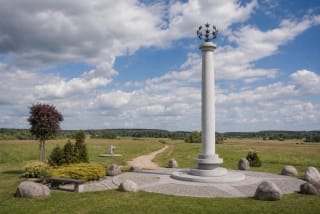
The Verkiai area is closely connected with the Vilnius Calvary. VLE states that a Way of the Cross was arranged in the Verkiai surroundings, consisting of 20 masonry chapels, a bridge over the Kedronas stream with a wooden chapel, gates, and stations in the Church of the Discovery of the Holy Cross.
The Vilnius Calvary Way of the Cross is considered one of the largest Way of the Cross complexes in Europe, and its ensemble consists of masonry chapels and stations of Christ's Passion. It is not the same site as the manor estate, but when planning a day in Verkiai it is a natural nearby historical continuation.