- Place
- Vilnius City Municipality
- Region
- Vilnius
- Type
- pilgrimage Way of the Cross and Verkiai landscape route
- Address
- Kalvarijų g. 327, Vilnius (Šv. Kryžiaus Atradimo bažnyčia)
- Coordinates
- 54.74050, 25.27980
Vilnius Calvaries, Verkiai Calvaries
A Way of the Cross in Verkiai
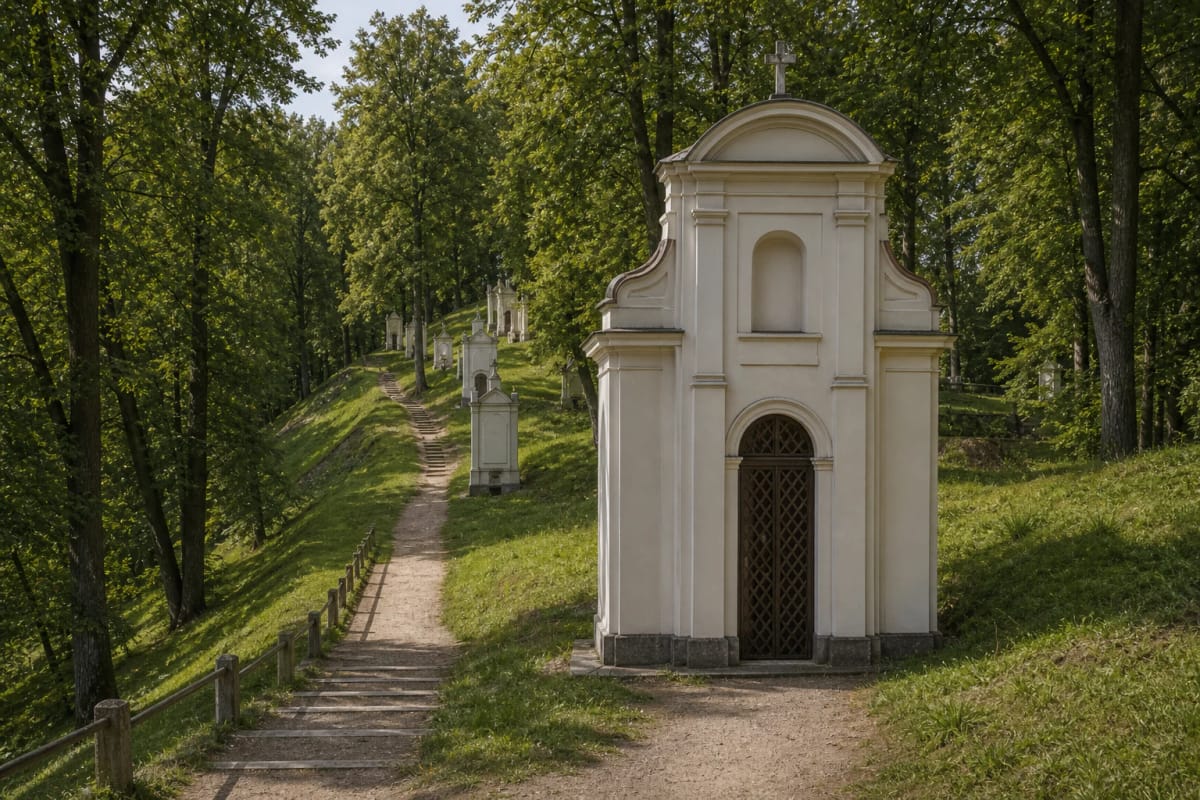
The Vilnius Calvary Way of the Cross is not simply a trail with chapels. It is a pilgrimage system in the Verkiai landscape, where prayer, terrain, trees, the stream valley, and architectural markers form one route. Calvaries are usually created in hilly terrain that evokes Jerusalem, and Verkiai suited this purpose especially well.
Visitors should decide whether they are coming as pilgrims or as heritage visitors. Both approaches are possible, but the rhythm of the place and respect for others should remain the same, especially during indulgence days.
1664-1669: how the Vilnius Calvaries began
The idea of a Way of the Cross in Verkiai arose in the seventeenth century as thanksgiving to God for victory in the 1655-1661 war with Moscow. In 1662 Vilnius bishop Jurgis Bialozoras allocated land in the Verkiai estate, about seven valakai, for a church and Way of the Cross stations. His successor, Bishop Aleksandras Sapiega, continued the work. In 1664-1669, the 35-station Vilnius Calvary was laid out in the Verkiai area.
In 1668, care of the Calvaries and pilgrims was entrusted to the Dominicans of the Vilnius Holy Spirit monastery, and later the entire complex passed to the Dominican order. Over time, the masonry Church of the Discovery of the Holy Cross, completed around 1700, chapels, gates, and a bridge over the Cedron stream were built, turning Verkiai into the capital's New Jerusalem.
A system of 35 stations
The Vilnius Calvaries are valuable not as isolated chapels but as a sequence of stations. The route has two parts: the first 20 stations mark Jesus' way from the House of the Last Supper to the fourth gate of Jerusalem, while the next 15 mark the Way of the Cross from Pontius Pilate's palace to Calvary Hill. Stations are marked by masonry chapels, the bridge over the Cedron, masonry and wooden gates, and stations inside the church itself.
The Cultural Heritage Register protects the Calvaries as a complex. This matters because the chapels, gates, bridge, church, and landscape function together, not as random points in a forest. The Way of the Cross was created so that a person would physically move from one place to another.
Destruction in 1962 and reconstruction
In 1962, by order of the Soviet authorities, the Calvary chapels were blown up, except for several closest to the church; the remaining ones were soon demolished. It is one of the most painful episodes in the destruction of Vilnius sacred heritage.
After Lithuania restored independence, the Calvaries were rebuilt. In 2002, the chapels and gates were restored and consecrated again. Today the route again functions as a complete pilgrimage way, so visitors see both historical continuity and the mark of the twentieth-century rupture.
Indulgence days and living tradition
The Calvaries are not only historic heritage. At Pentecost and during organized prayers, pilgrims gather here, so the place remains a living religious practice. Processions follow the station sequence, hymns are sung, and people stop at the chapels for prayer.
If you come at such a time, act as you would in an active shrine: keep quiet, do not block processions, and do not photograph people intrusively. The Church of the Discovery of the Holy Cross is also an active parish church.
Practical planning in Verkiai
The Vilnius Calvaries are in Verkiai Regional Park, so the route passes through a green, hilly area and requires more physical readiness than a short city landmark. Allow 2-4 hours for the full Way of the Cross, depending on pace and whether you walk it as a prayer route.
There is no general ticket for the public landscape route. Before going, check the official Vilnius Calvaries page for church services, indulgence days, and pilgrimage rites. Wear comfortable shoes and bring water.