- Place
- Vainežeris village, Kapčiamiestis Eldership, Lazdijai District Municipality
- Region
- Dzūkija
- Type
- dendrologically valuable former manor park with a walking trail, Lake Vainežeris, the Emilia Plater memorial, and nearby Okopka fortification
- Address
- Veisiejai Regional Park, Vainežeris village, Kapčiamiestis Eldership, Lazdijai District
- Coordinates
- 54.07862, 23.67142
- Visit duration
- 1.5-2.5 hours for the park trail, avenues, and lakeshore; 2.5-3.5 hours including the separate route to Okopka
- Best time
- a dry spring or autumn morning for the structure and colour of the old trees; arrive early in summer and make a first visit only in daylight
Vainežeris Manor Park, Justinavas Manor Park, Former Vainežeris Manor Park
The 4.8 Google listing marks the north of the park, but the practical entrance is in the south-west
Two map listings must be kept separate. On 15 July 2026, the exact Google listing named Vainežerio parkas, categorised as a park, showed 4.8 out of 5 from 16 reviews. Its place ID is ChIJGx_nLbCT4EYRyqX8QRAlQRE, and its marker at 54.07862, 23.67142 lies by the northern part of the broad park, near the direction of Okopka. This page therefore labels that point honestly as representative, not as the only entrance.
A separate listing, Vainežerio buvusio dvaro sodybos fragmentai, or the fragments of the former Vainežeris manor estate, stands at 54.0735103, 23.6693968. On the same date it showed 4.4 from 154 reviews, so this second listing does not meet the 4.5 threshold. Both refer to related parts of one historic landscape, but their ratings and coordinates cannot be combined.
For a first visit, the south-west entrance is the better landmark. Information for an official 2026 directorate event placed the Vainežeris Manor Park car park at 54.073210, 23.668208, almost the same point as Saugoma.lt's object marker at 54.073, 23.668. Paths and an information board begin here, making the park's layout easier to read; use the 4.8 Google listing primarily to find the broader destination.
The lake divides the park, and a 2 km walking trail was recorded in the 2022 plan
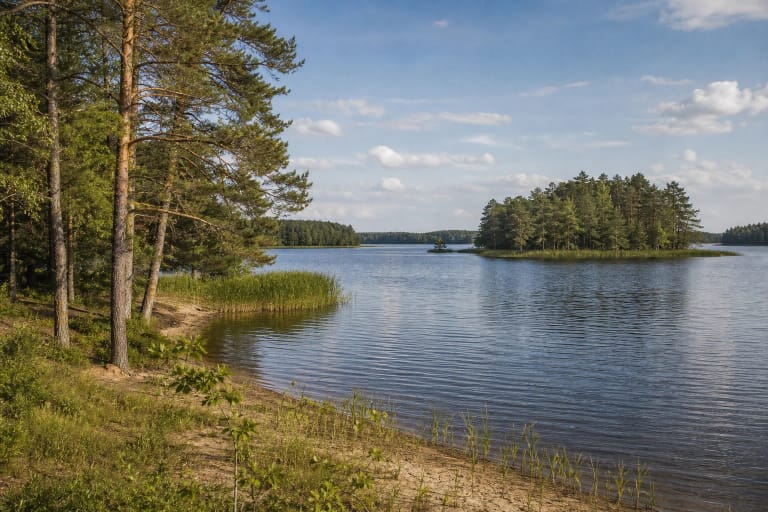
Saugoma.lt says the park was established about 200 years ago. Lake Vainežeris divides it in two, yet a natural belt of shoreline vegetation connects both sides into one landscape. In the west, groups of trees and shrubs break up open ground. The municipal visitor description identifies the south-west as the entrance, path, and parking area, the centre as the lake and shore vegetation, and the east as greenery, meadow, and the area locally called the Tree Museum.
Public documents give different areas because they do not appear to measure the same boundary. The 2022 Veisiejai Regional Park maintenance table assigned 9.5 ha to Vainežeris Manor Park, while the municipal visitor description calls it a 12 ha park. It is reasonable to infer that one is a maintained area and the other a wider visitor landscape, but neither source supplies a boundary drawing that proves the explanation. No single figure should therefore be presented as an undisputed area for the entire landscape.
In the same 2022 plan, the recreation-infrastructure table recorded a 2 km walking trail in Vainežeris Manor Park and a separate 1 km route to the Vainežeris defensive earthwork. These are reliable maintenance-period benchmarks, not a fresh 2026 trail audit. Follow current signs, do not force a loop through private or overgrown ground, and allow extra time after heavy rain.
An oval meadow is enclosed by century-old lindens, maples, and hornbeams
Lithuania's State Service for Protected Areas lists Vainežeris Manor Park among the botanical natural-heritage objects of Lazdijai District. Its main compositional feature is an oval avenue of century-old lindens, maples, and hornbeams. A 2026 directorate hike notice also names elm avenues, while the municipal vegetation account mentions ashes among native trees and singles out grey fir and European larch among introduced species.
Hollows and decay in the veteran trunks are not merely signs of neglect. Saugoma.lt explains that different birds nest in them, with bats and honeybee swarms settling there in summer. No particular animal is guaranteed during one visit, and a hollow must never be touched, cleaned, or illuminated at close range with a phone.
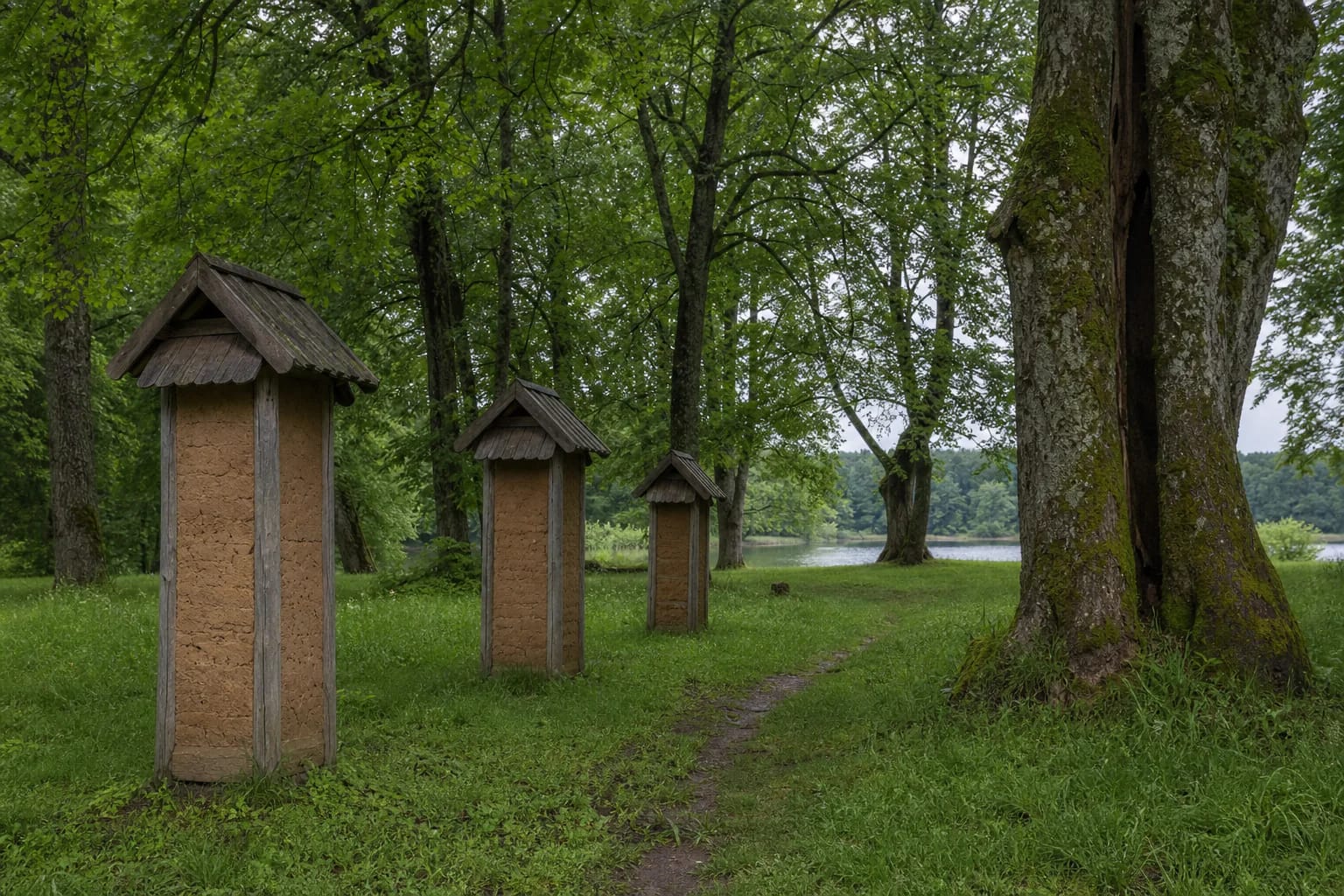
Narrow clay panels framed in timber and protected by small pitched roofs stand in the open meadow for wild bees. The small nesting holes make clear that these are neither ornamental manor pillars nor honey-production hives. View them from the path, do not insert anything into the holes, and leave an unobstructed flight corridor in spring and summer.
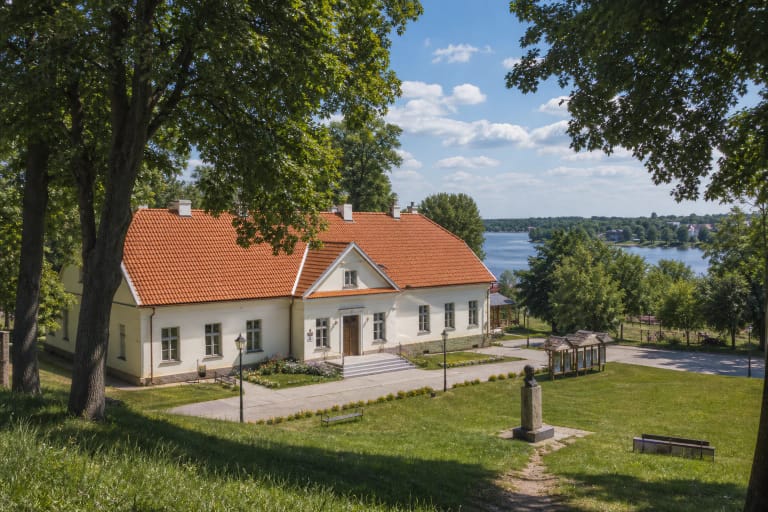
The manor house is gone, but Emilia Plater's place of death is documented here
A 2025 directorate history traces the Vainežeris estate to the sixteenth century, when Sigismund the Old granted the land to his clerk V. Kapočius. Saugoma.lt dates the first residence on the eastern lake shore broadly to the seventeenth or eighteenth century, while the directorate more cautiously says the first residence, orchard, and nursery may have appeared in the eighteenth century. The Ablamavičius and Murauskas families later held the estate.
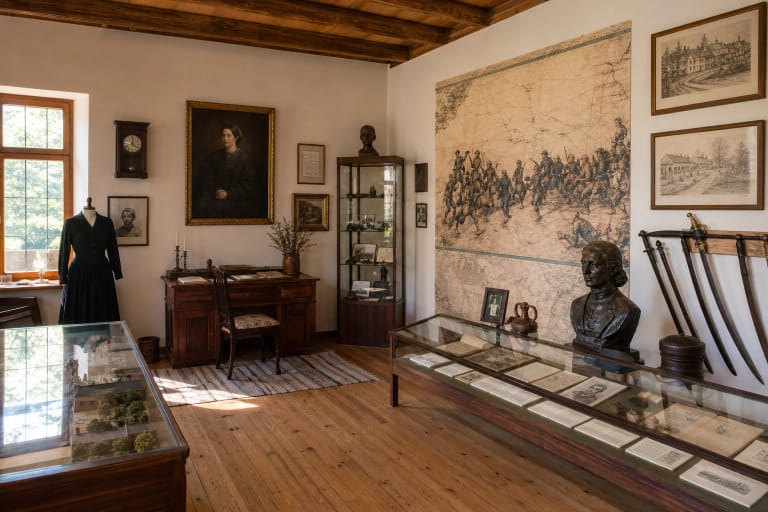
The most important precisely dated event is the death of Emilia Plater, known in Lithuanian as Emilija Pliaterytė. VLE records that the Vilnius-born countess became an activist in the 1830-1831 uprising and a captain of the 25th Infantry Regiment. As the insurgent army withdrew towards Prussia, she tried to reach the Kingdom of Poland, became ill, and died at Justinavas Manor near Kapčiamiestis on 23 December 1831. She was buried in Kapčiamiestis.
A kneeling figure by sculptor Evaldas Pauza commemorates Plater beside the former estate site. It is a memorial, not a surviving piece of palace decoration. The central residence and service buildings have disappeared, so visitors encounter topography, planting, estate fragments, and signs of memory rather than an open manor building or interior exhibition.
Okopka's wartime history and the 1812 story do not have the same evidential status
About 0.3 km north of Lake Vainežeris is a separate site, the old defensive fortification called Okopka. Saugoma.lt says landowners probably built it in the seventeenth or eighteenth century and that it was used during the 1701-1721 war involving Sweden and Russia. Directorate material identifies it as an unusual cultural-heritage feature of Veisiejai Regional Park.
Another part of the account is explicitly local tradition. Residents told that French trenches, called okopkos, occupied the hill in 1812 and gave Okopka Hill its name. Saugoma.lt also records that insurgents hid here in 1863. The 1812 version should not be presented as an archaeologically proven construction date.
The 2022 maintenance plan recorded a 1 km path to the fortification. Earthworks, slopes, and forest relief are clearest in early spring or late autumn, when the ground can also be wet. Do not walk along rampart edges on unmarked shortcuts or dig into the soil: this is a heritage site, not an adventure playground.
No mandatory separate ticket was found, but the full route is not adapted for reduced mobility
The official park and trail pages publish no gate, ticket office, or separate opening schedule, and the research found no mandatory entry charge for this outdoor site. In 2026, VSTT listed a voluntary protected-areas visitor ticket at EUR 1 for one day in one area, EUR 5 for 30 days in one area, and EUR 25 for a year across all protected areas; the total SMS price was EUR 1.35. Check the official page before travelling because prices and conditions can change.
Saugoma.lt explicitly marks both the park and Okopka as not adapted for visitors with reduced mobility. Natural grass and earth paths, roots, slopes, damp shoreline ground, and the earthwork relief can also obstruct a pushchair. The existence of a south-west car park does not mean that an uninterrupted step-free route begins there.
Allow 1.5-2.5 hours for the principal park walk and up to 3.5 hours with Okopka. Arrive in daylight, wear closed non-slip footwear, and carry water and tick protection. Do not drive across the meadow towards the Google marker, park on the trail, climb into hollow trees, or touch the clay bee structures.