- Place
- Kretinga District Municipality
- Region
- Samogitia
- Type
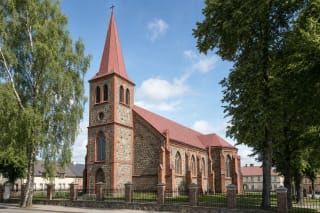
- Neo-Gothic cemetery chapel built in 1893 above the Tiškevičiai family mausoleum, now housing a museum exhibition
- Address
- 8A Vilniaus Street, Kretinga
- Coordinates
- 55.89420, 21.24506
Grafų Tiškevičių šeimos koplyčia-mauzoliejus, Kretinga Tiškevičiai Chapel, Tyszkiewicz Chapel-Mausoleum
The mausoleum stands in a cemetery, but its exhibition is not open around the clock
The chapel stands in what was Kretinga Parish's New Cemetery, now usually called the Second Old Cemetery, beside Vilniaus Street. The museum's official address is 8A Vilniaus Street, and the precise coordinates are 55.8942018, 21.2450642. It is only a few hundred metres on foot from Kretinga Lourdes and approximately one kilometre from the Tiškevičiai manor palace.
Google Maps labelled the place open 24 hours in July 2026, but this can only describe access to the cemetery and exterior, not the locked museum exhibition. For the 2026 summer season, from 1 May to 30 September, Kretinga Museum published chapel hours of 10:00-20:00 daily. Ticket sales end 30 minutes before closing, and opening hours are shortened by one hour on the eve of a public holiday.
In July 2026, a separate ticket cost EUR 2 for an adult and EUR 1 for a school pupil, student, or pensioner. Tickets were sold at Kretinga Museum's staffed desk from Wednesday to Sunday, 10:00-17:30, or at the central palace ticket machine daily from 10:00 to 20:00. Prices, off-season hours, and entry procedures can change, so check the official museum page or call +370 445 77612 before travelling.
Karl Eduard Strandmann designed the family burial place in 1893
Count Józef Tyszkiewicz died in 1891, before a permanent family burial place existed. His embalmed remains and sarcophagus were temporarily kept in St George's Chapel in the old parish cemetery. In 1893, his widow Zofia and son Aleksander built the chapel-mausoleum in the new cemetery and transferred Józef's remains into its crypt.
The architect was Swedish-born Karl Eduard Strandmann, then working in the Courland Governorate. It was among his earliest projects in Lithuania, preceding Neo-Gothic churches at Palanga, Švėkšna, Kelmė, and elsewhere. The small Kretinga building already displays his characteristic pointed windows, tracery, stepped buttresses, and expressive brick ornament.
The chapel was more than a marker above graves. Services took place on All Souls' Day, at funerals of Tiškevičiai relatives and estate servants, and on death anniversaries. The building therefore united three functions: family crypt, private place of worship, and a representative memorial to an aristocratic house.
A single-nave red-brick chapel rises above the underground crypt
The building has two legible parts. Below is a crypt-mausoleum built from dressed stone and red brick, enclosed on three sides by an artificial earth mound; ornate double metal doors open in its exposed west front. Above it stands a compact single-nave chapel with a porch, narrower presbytery, and the burial chamber beneath its floor.
Most bricks came from the Kretinga manor brickworks, while complex moulded pieces were imported from Insterburg in East Prussia. Stepped buttresses and tall pointed windows with tracery establish the rhythm of the side walls. Plain glazing in the central window has replaced the stained glass with figures of saints still visible in a photograph from 1928.
A timber Neo-Gothic altar made in a Warsaw workshop was installed in the apse in 1894 with sculptures of the four Evangelists. Aleksander Tyszkiewicz brought a crucifix from Oberammergau in Germany. The Evangelists disappeared in the Soviet period and the crucifix was stolen in 1989, so today's sacred-art display also records what the original interior has lost.
Six people are buried in the crypt, but one woman's identity remains a hypothesis
Józef Tyszkiewicz, who had died two years earlier, became the first person placed in the crypt in 1893. He was followed by his five-year-old granddaughter Maria, who died in 1896; his wife Zofia, who died in 1919; his daughter-in-law Jadwiga, who died in 1939; and his grandson Kazimierz, who was killed in 1941.
The chapel also contains the remains of an unidentified woman. Kretinga Museum's current account cautiously suggests that she may be the governess Stefanija Sofija Šostakaitė-Tiškevičienė, who died in 1931. An older theory identified her as the Scottish Jemima-Margareta Evart StClair, but StClair's grave was located in Palanga, ruling that attribution out.
The visible sarcophagi should not be treated as a simple family tree. The crypt was looted during the war and early post-war years, coffins were damaged, and remains were desecrated and mixed. Historical and anthropological research identified several individuals, but the unknown woman's name is properly retained as a possibility rather than a fact.
Four concealed metal sarcophagi were found inside concrete platforms in 2014
After the Second World War, the chapel passed to the municipal service. Kretinga Museum later stored old sculptures upstairs while cemetery workers used the basement. The building suffered repeated theft. The local-history museum took responsibility in 1975 and conservators worked here in 1976, yet moisture, weak waterproofing, and insufficient ventilation continued to damage the interior.
In 2014, researchers examined three reinforced-concrete platforms in the crypt that had long been understood merely as plinths for coffins. A camera inserted through drilled openings revealed ornate metal sarcophagi hidden within. Opening the structures that October disclosed four sarcophagi, including burials of Józef, Zofia, and the young Maria; most had already been looted or otherwise damaged.
The chapel was restored in 2001-2004 and comprehensively renewed for museum use in 2017-2018. Old concrete structures were removed, the crypt was repaired, and the conserved sarcophagi of Józef and Zofia returned in 2018. The basement now presents sarcophagi, grave goods, and historical material, while the upper level explains the building, those buried here, and devotional objects from the nineteenth and first half of the twentieth century.
An hour is sufficient for a focused visit, and the Google rating is 4.8
Begin the exterior view from the cemetery path, where the unusual section is easiest to read: a green mound hides the crypt while a tall red-brick volume rises above it. From the permitted route, notice the separate mausoleum entrance, buttresses, window tracery, ornamental band below the eaves, and Neo-Gothic gates belonging to the wider cemetery complex.
Allow 35-60 minutes for the complete exhibition. The approach has gradients, and the crypt and upper chapel occupy different levels, so visitors with reduced mobility should ask the museum in advance which entrance and assistance are available that day. This remains a burial place in an active cemetery: speak quietly, do not touch the sarcophagi, and never photograph mourners.
On 13 July 2026, Google Maps rated the attraction 4.8 out of 5 from 24 reviews. That exceeds this catalogue's 4.5 threshold, although both score and review count can change. The strongest extended route pairs the chapel with the Tiškevičiai manor and Winter Garden: the palace explains the family's life, while the mausoleum preserves its memory and burial culture.