- Place
- Kretinga District Municipality
- Region
- Samogitia
- Type
- free outdoor sculpture display and working horizontal sundial in Kretinga Manor Park
- Address
- 20 Vilniaus St, Kretinga Manor Park, Kretinga
- Coordinates
- 55.89676, 21.25106
Kretinga Manor Park Astronomical Calendar, Kretinga Manor Park Sundial, Astronominis kalendorius su Saulės laikrodžiu
Not one clock but a half-hectare diagram of the year
The Astronomical Calendar with Sundial occupies the southern part of Kretinga's 23-hectare manor park, on the site of a former orchard, at 55.896761, 21.251055. The museum's official address is 20 Vilniaus Street, although Google Maps may label the pin 4 Žemaitės Avenue. Both point to the same edge of the park.
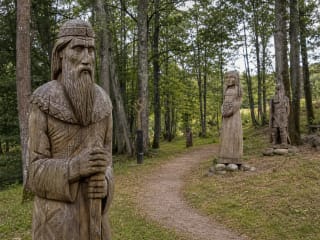
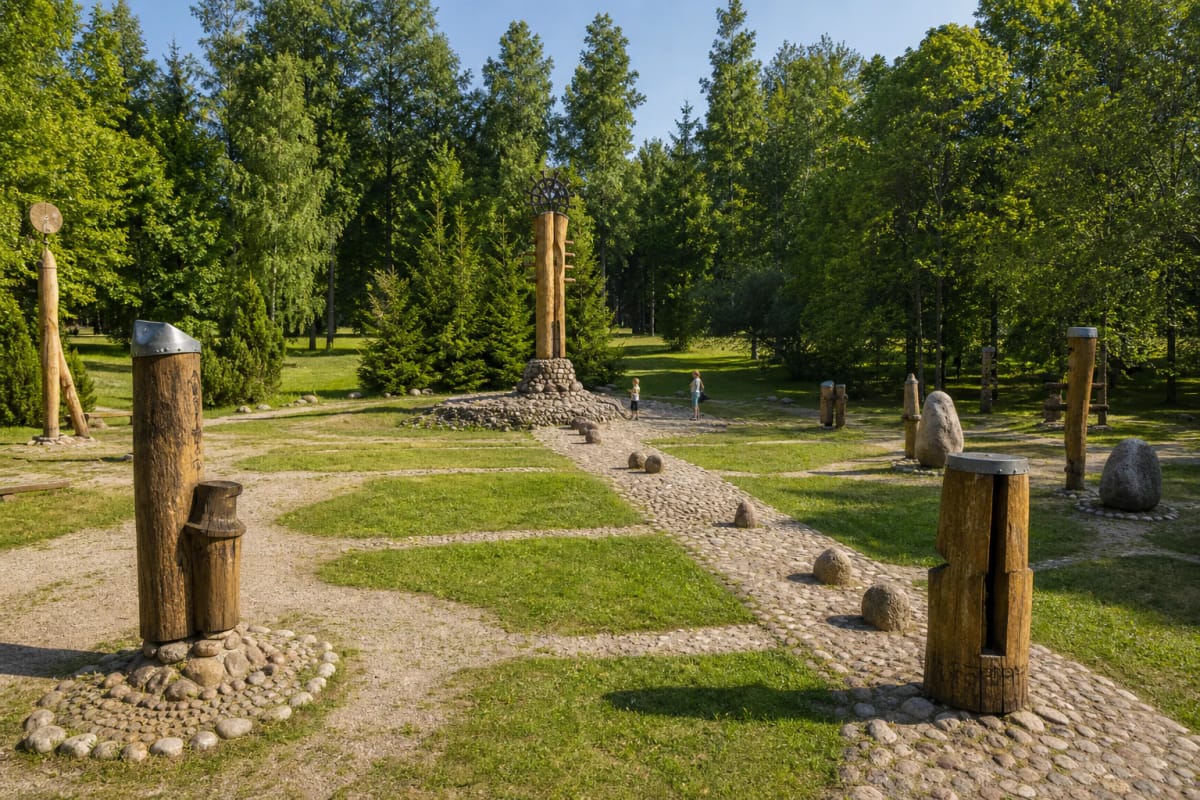
The composition covers approximately half a hectare. It combines a precisely oriented network of stones and paths, thirteen monumental oak sculptures, granite elements, iron details, and a six-metre oak sundial gnomon on a fieldstone base. The openwork sun at its summit is also interpreted as the Rėdos ratas, the wheel of the year's cyclical transformations.
The place cannot be understood by looking only at the central post. Stand beside it, find the stone meridian running north to south, then walk around the hour stones and separate sculptural groups. The calendar's logic emerges only from these relationships.
From a degree project to the 2002 Manor Festival
Architect and designer Rita Gorodeckienė began developing the calendar in 1994 as her Vilnius Academy of Arts degree project, which received the highest mark. Architect and associate professor Gytis Tiškus supervised it. Kretinga Museum director and Kretingos krašto ainiai club chair Vida Kanapkienė organised construction, assisted by architect Edmundas Giedrimas.
The ensemble was built in stages from 2000 to 2002. During creative camps in 2001 and 2002, Feliksas Lukauskas, Tadas Šorys, Adolfas Viluckis, Raimondas Puškorius, Steponas Žiubrys, and other local makers worked in oak, granite, and iron. Antanas Šeputis completed smithwork and Leonas Beniušis worked the stone. Sources record about 15 cubic metres of oak and 50 cubic metres of crushed stone.
The calendar was unveiled during the Manor Festival on 10 August 2002. A construction charter signed by district and town officials, artists, and supporters was sealed in a capsule under the foundations. At the time, it was the first astronomical calendar of its kind in the Baltic states.
How the gnomon, shadow, and slit work
The main axis runs north to south and acts as the local meridian line. Stones bearing Roman hour numerals lie around the central gnomon, so its shadow changes direction as the Sun crosses the sky and gives an approximate indication of time of day.
A second mechanism addresses the season. A slit is cut into the central post. When the Sun reaches the local meridian, a ray passing through it lands in a different zone of dated stones along the axis depending on solar altitude. The high summer Sun corresponds to the Midsummer stone; the low winter Sun and longest shadow reach the Christmas Eve and Christmas marker.
Kretinga's regional encyclopedia gives 12.43 as the designed moment when the shadow aligns with the meridian, but this should not be treated as a daily signal for a modern watch. A sundial shows apparent local solar time, while civil time is affected by the time zone, daylight saving, and the seasonally changing equation of time. In practice, watch the shadow during a sunny midday period.
From Midsummer to 16 February: what the stones mark
The stones and sculptures combine the natural cycle, motifs from Baltic culture, Christian feasts, and the memory of the modern state. Markers include Midsummer or Rasos, the Assumption or Žolinė, the equinoxes, All Souls or Ilgės, Advent, Christmas Eve, Christmas, New Year, Epiphany, and Saint George's Day.
Historical dates include Statehood Day on 6 July, the Battle of Grunwald on 15 July, Restoration of the State Day on 16 February, and a Kretinga foundation marker on 23 January. Their presence does not prove that ancient Balts used this single integrated calendar. The installation is a late-twentieth-century artistic and educational interpretation of Lithuania's cycle of the year.
The source calls the month signs carved on the meridian stones runes, but they should not be presented as an attested writing system of ancient Lithuanians. Look instead for specific imagery. A carved handprint on the All Souls stone recalls folklore about marked boulders, while letters elsewhere identify the cardinal directions.
How to visit and read the installation
The outdoor display is free and has no ticket office or separate museum opening time. It is reached by manor-park paths during the day, but a sunny visit is best. Under cloud, the sculptures, materials, and plan remain visible, yet neither the moving shadow nor the ray through the slit can be observed.
Allow at least 20-40 minutes. Read the information panel first, then locate the central gnomon, the meridian, the festival stone closest to the date of your visit, and the sculptures arranged around it. Do not climb the oak works or central base. Ageing timber and the geometry of the instrument belong to a cultural display, not playground equipment.
Park paths reach the site, but surfaces within the installation vary between gravel, grass, rounded cobbles, separate boulders, and raised ground. Part of the ensemble can be viewed without using steps, but no fully level step-free chain to every marker is officially confirmed. Discuss mobility requirements with Kretinga Museum in advance.