- Place
- Telšiai District Municipality
- Region
- Samogitia
- Type
- historic Jewish higher religious school and museum branch
- Address
- Iždinės g. 11, Telšiai
- Coordinates
- 55.98491, 22.25113
Telz Yeshiva, Telšiai Yeshiva building
Telšiai Yeshiva: small building, large history
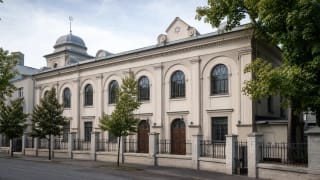
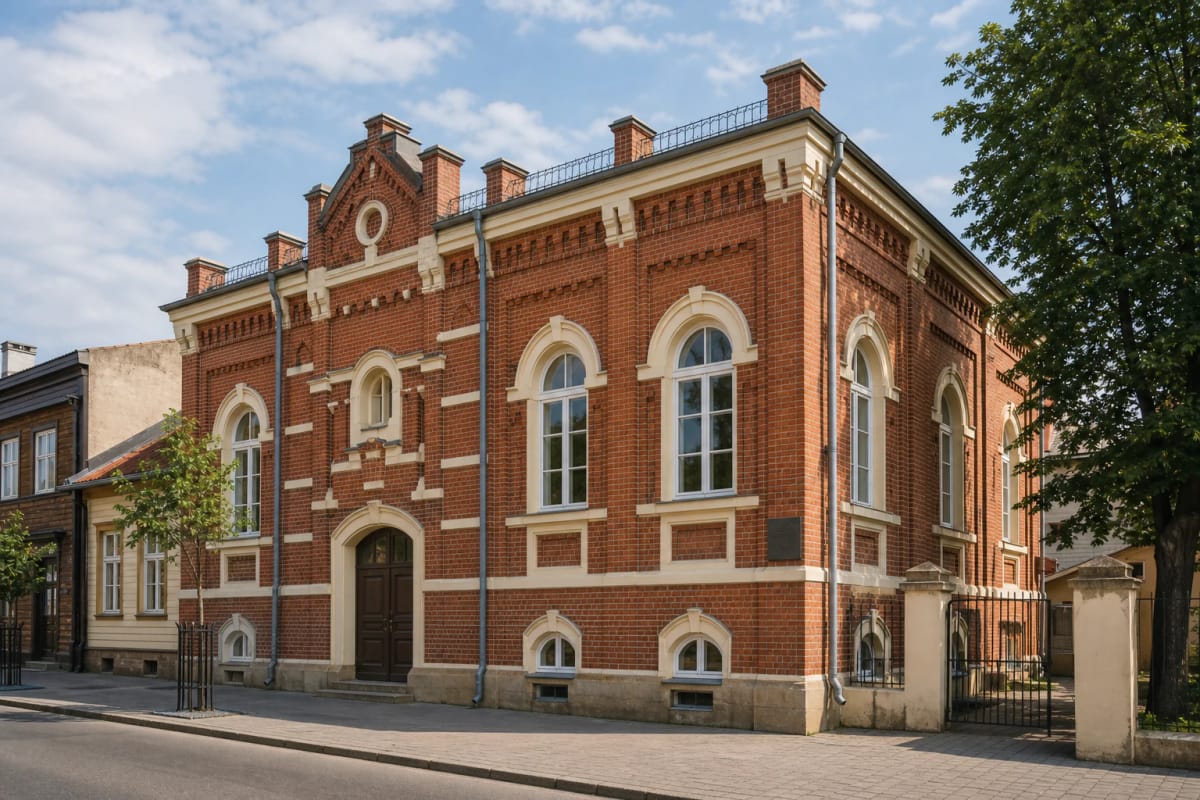
Telšiai Yeshiva is one of the most important Jewish-history sites in Telšiai. From outside it is a restored red-brick building on Iždinės Street, but its meaning is much wider: one of the most famous Jewish higher religious schools in Eastern Europe operated here. Today the building is a branch of Žemaičių Museum Alka, where the history of the yeshiva and Telšiai Jews is told through the memories of Telšiai Holocaust survivors.
The yeshiva was not an ordinary school. It was a high-level institution for Talmudic study, training rabbis, teachers, and intellectuals, and placing the name of Telšiai on the wider Litvak world map. The exhibition presents the scarce but highly significant surviving Judaica heritage: household objects, religious items, and documentary material.
A school founded in 1875
Telšiai Yeshiva was founded in 1875 and, according to VLE, operated until 1940. This was a period when Telšiai was an important regional town and the Jewish community had a strong religious and cultural life, with synagogues, schools, and communal institutions.
The yeshiva's history lets visitors see Telšiai not only as the capital of Samogitia but also as a multicultural town. Alongside Catholic, Samogitian, and urban-history layers, an intense Jewish world of learning and community life existed here. It is said that students debated not only inside the building but also in the streets and by Lake Mastis, so the whole town seemed to become one large yeshiva.
Rabbi Eliezer Gordon and a modern teaching system
The yeshiva's success is linked with Rabbi Eliezer Gordon, who became its head in 1884. He was the first in Lithuania to apply modern teaching methods: students had to take entrance exams and were divided into groups by knowledge level, while for an entire semester each group analysed the same Talmud passage. Telšiai Yeshiva also introduced regular knowledge testing for the first time, which other yeshivas had not used before.
Because of these innovations, Telšiai Yeshiva quickly became one of the most important Jewish education centres in Eastern Europe. In Telšiai, the visitor sees not only a local heritage object but the trace of an institution whose authority extended beyond the city and Lithuania.
Lithuanian yeshiva network and the continuity of Telz
From the second half of the 19th century, the yeshivas of Telšiai, Kaunas-Vilijampolė, and Panevėžys were famous across the Jewish diaspora. Together they formed a unique Lithuanian yeshiva network attracting Jewish students from around the world. Each yeshiva had its own teaching spirit, and the Telšiai school was known specifically as the Telz Yeshiva, Telz being the form of the Telšiai name widely used in Jewish religious-education history.
After the Second World War, the Telšiai yeshiva tradition in Lithuania was broken because the community was destroyed in the Holocaust. Yet the Telz name survived: in 1942 a yeshiva of the same name was re-established in Cleveland, United States, where the teaching system formed in Telšiai continues. This is one of the clearest Litvak heritage links between Lithuania and the diaspora.
How to visit Telšiai Yeshiva
Telšiai Yeshiva is at Iždinės g. 11, so it is easy to include in an old-town walk. The exhibition offers guided tours in Lithuanian, English, and Russian and educational programmes. Before visiting, check Žemaičių Museum Alka information for opening hours and closure days during state and religious holidays.
When visiting, allow time not only for the building but for the wider city map. Telšiai Jewish history was part of daily urban life, so the yeshiva is best combined with an old-town walk, the Lake Mastis shore, and Žemaičių Museum Alka.
Why this place matters today
Telšiai Yeshiva reminds visitors that the history of Lithuanian towns is not single-voiced. Samogitian, Lithuanian, Jewish, religious, and educational histories intersected in Telšiai, and the yeshiva building makes that many-layered past visible in one place.
This is not a quick-impression object. Its value appears when the visitor understands that an institution of international authority operated here, and that after catastrophe its memory and teaching tradition moved beyond Lithuania.