- Place
- Pilies I village, Jurbarkas District Municipality
- Region
- Jurbarkas District
- Type
- Renaissance residential castle, park, and museum
- Address
- Vytėnų g. 53, Pilies I village, LT-74464, Jurbarkas District
- Coordinates
- 55.09750, 22.98810
Gelgaudai Castle, Vytėnai Castle
A Renaissance Castle on the Panemunė Road
Panemunė Castle stands in Jurbarkas District, in Pilies I village, beside the road along the right bank of the Nemunas. VLE describes it as an early seventeenth- to eighteenth-century castle and stresses that it was intended not only for defence but above all for representation.
It is one of Lithuania's clearest examples of a Renaissance residential castle. On a Panemunė-road trip it naturally connects with Raudonė Castle, Veliuona, Seredžius, and the viewpoint stops of the Nemunas valley.
The Eperješas Beginning and Nonhart's Trace
VLE states that Panemunė Castle was built around 1604-1610 by Jonušas Eperješas, the Hungarian-born owner of Panemunė Manor. The probable architect was Petras Nonhartas, one of the most prominent architects working in Lithuania at the time.
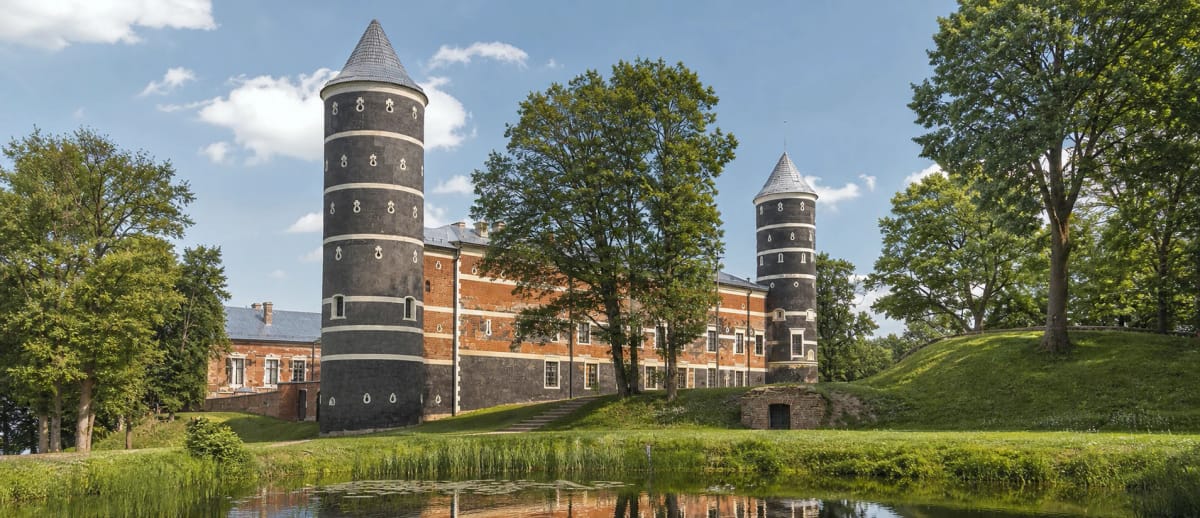
The official castle history adds that Eperješas acquired Panemunė in 1597, demolished the old masonry castle or manor buildings, and began a new Renaissance residence. The early castle had an enclosed trapezoid courtyard, residential and service wings, defensive walls, and cylindrical towers.
The Gelgaudai Period
Panemunė is also called Gelgaudai Castle because Antanas Gelgaudas, a nobleman from Samogitia, bought it in 1759. Later Gelgaudai reconstructions strongly changed the interior plan and representative spaces.
VLE writes that after 1783 the castle was reconstructed in Classicist style: the enclosed courtyard became a U-shaped palace, the northern wing was demolished, and stoves, friezes of antique figures, and frescoes appeared inside. The unique frescoes that decorated six castle halls covered about 600 square metres; restoration began in the late twentieth century, making the surviving wall-painting fragments an important interior theme. Earlier still, in the mid-seventeenth century, the Renaissance castle reconstructed by Jonušas Eperješas' son Kristupas had acquired Baroque features.
Uprising, Decline, and Return
The 1830-1831 uprising marked a sharp break in Panemunė's history. VLE notes that Russian soldiers looted the castle, destroyed its furnishings and wall decoration, removed the library, and that in 1832 the tsarist authorities confiscated it because General Antanas Gelgaudas had been the uprising's commander-in-chief.
In the nineteenth and early twentieth centuries the castle was poorly maintained and decayed; during the First World War it suffered from fires, and in 1925 the Lithuanian Government took it over. Since 1982 Panemunė Castle has belonged to the Vilnius Academy of Arts, which has turned it into a restored cultural, exhibition, and teaching site.
What to See Today
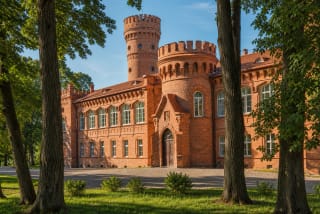
VLE notes that the western wing with two towers, the southern wing, and part of the eastern wing survive. The castle's appearance brings together Renaissance, Baroque, and Classicist layers, so it is worth looking not only at the towers but also at the courtyard, window rhythm, roofline, and restored interior exhibitions.
After the 2012-2015 reconstruction, the castle contains a museum, tourist information centre, hotel, restaurant, and conference centre. The official website presents Panemunė as a castle open to curious minds, with exhibitions, concerts, fairs, and other events.
Park, Ponds, and the Vytenis Tradition
Panemunė Castle is surrounded by a historic park. VLE mentions a park of about 15-16 ha and five ponds, while a new stage of park-management work began in 2020. The park and water bodies are what let you see the castle as a residential ensemble rather than an isolated masonry building.
The name Vytėnai Castle belongs to a local tradition: the area preserves memories of Vytenis' yard, a hillfort, and Vytėnai village, while in the interwar period park hillocks were called the graves of Vytenis and his wife Vikinda. This is an interesting narrative layer, but it should be kept separate from the documented seventeenth- to nineteenth-century castle history.
How to Visit Panemunė Castle
The official address is Vytėnų g. 53, Pilies I village, Jurbarkas District. By car, it is easiest to plan a Panemunė-road route: Panemunė Castle combines well with Raudonė, Veliuona, Seredžius, or a continuation toward Jurbarkas.
Allow at least 1.5-2.5 hours for the castle interior, courtyard, park, and pond area. If you are travelling for an exhibition, event, restaurant visit, or overnight stay, check the official website before departure because opening hours and access to spaces can change.