- Place
- Šventoji, Palanga City Municipality
- Region
- Palanga
- Type
- Stone Age settlement complex and archaeological site
- Address
- Left bank of the Šventoji River and seashore, Šventoji, Palanga
- Coordinates
- 56.02460, 21.08350
Šventoji settlements, Šventoji Stone Age settlements
The oldest layer of Šventoji
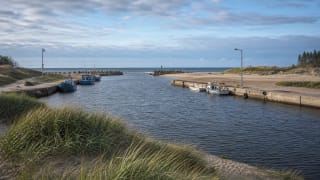
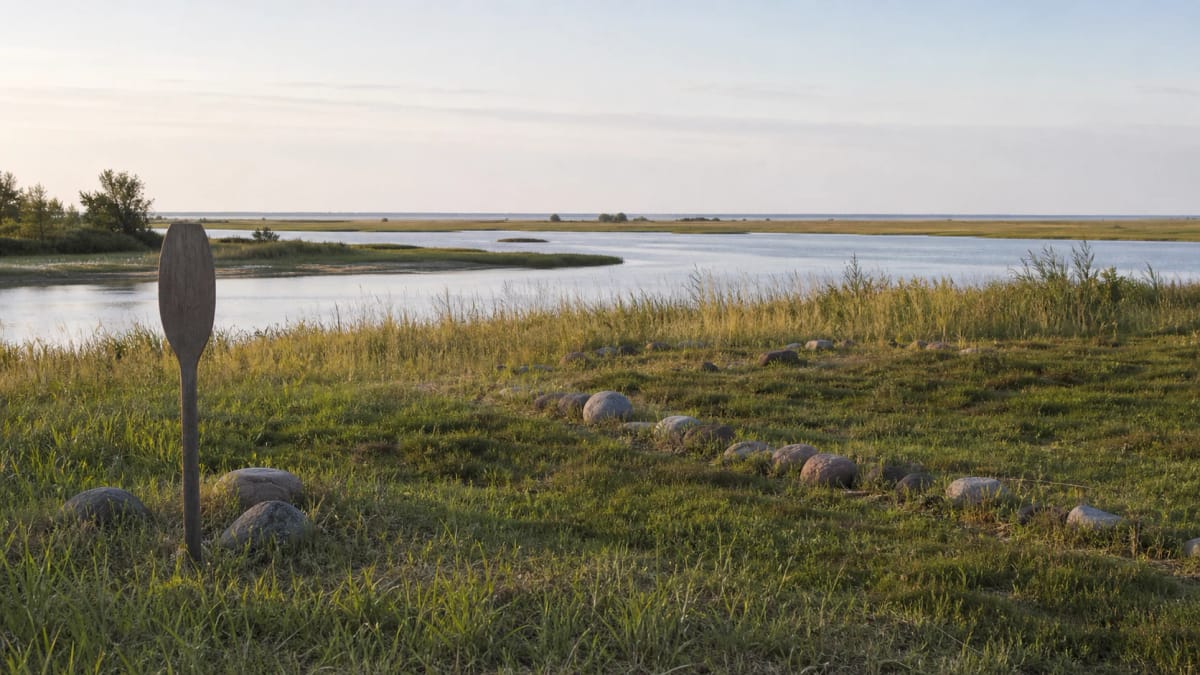
Šventoji Ancient Settlement lets you see the resort at a very different scale. Beneath today's holiday houses, harbour history, and seaside paths lies a Stone Age settlement complex connected with a former Palanga lagoon, a shallow lake, and the lower reach of the Šventoji River.
In the Cultural Heritage Register the object is protected as a state-protected, nationally significant archaeological site (code 1813), and the protected territory is very large - over 560 ha. This is not a usual open-air museum: what matters here is not visible buildings but knowing what ancient fishers' world this low shore preserves.
When it was inhabited: fifth to second millennium BC
The Universal Lithuanian Encyclopedia dates the Šventoji settlements to the fifth-second millennium BC, while the Cultural Heritage Register gives the object's chronology as roughly 4000 to 500 BC. Either way, this was not a brief camp but more than three millennia of human activity along a changing shoreline.
At that time a lagoon and a shallow lake stretched across the site of present-day Šventoji, cut off from the sea by a sand bar. It was the wet, oxygen-poor shore and peat layer that preserved what usually rots - wood, bark, and plant fibres - making Šventoji one of the most informative sites of Baltic coastal prehistory.
Research: Rimutė Rimantienė and about 40 settlements
Systematic research was led in 1967-1995 by the Institute of Lithuanian History under the archaeologist Rimutė Rimantienė (1920-2023), in 2000-2005 by a mixed expedition (led by Vygandas Juodagalvis), and in 2006 by expeditions of Klaipėda University (Gytis Piličiauskas) and Darius Brazaitis. In all, more than 11,000 sq. m have been investigated and about 40 separate settlements identified.
In the cultural layer, up to 2.5 m thick, remains of rectangular post-built dwellings were found. Rimutė Rimantienė summarised the finds in her book "Stone Age Fishers by the Coastal Lagoon: Investigations of Šventoji and Butingė" (2005), still regarded as the fundamental source on this place.
Finds: a ritual post, amber, and fishing
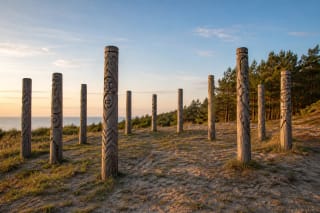
The most striking find is a ritual wooden post carved with a human head, one of the oldest such wooden sculptures in the region. Nearby were wooden oars, beaters, birch-bark boxes and buckets, troughs, spoons, and ritual staffs - objects that almost never survive elsewhere.
There is abundant evidence of fishing and hunting: fragments of dugout boats and nets, fish traps, net weights and floats, arrow- and spearheads. Amber was worked into buttons, pendants, beads, and amulets, and a separate amber hoard was found. Bones show that people hunted elk, aurochs, bison, seals, and beavers and caught both freshwater and marine fish.
Narva and later Stone Age cultures
The earliest Šventoji layer was formed by the Narva (Narva-Nemunas) culture - a Neolithic and Early Bronze Age culture that existed in the Eastern Baltic lands around 5300-1700 BC. Its people lived by fishing, hunting, and gathering, and made pottery from clay tempered with organic material.
The later Neolithic at Šventoji also reflects traces of the Globular Amphora, Corded Ware, and Pamariai (Coastal) cultures. These names mean that by the same lagoon, groups of people, trade contacts, and material culture changed over a long time.
How to visit an archaeological site
Šventoji Ancient Settlement is not a ticketed attraction with an exhibition. It is a protected territory where digging, collecting finds, disturbing the relief, or independently searching for archaeological objects is not allowed. The settlement itself is best understood as an interpretive stop while walking along the river and harbour.
Šventoji's finds are kept in the National Museum of Lithuania and the Kretinga, Palanga Amber, and Lithuanian Sea museums, so it is there that the objects themselves are worth seeing. It is important to distinguish the prehistoric settlement from the interwar-planned Šventoji resort - two entirely different times in the same place.