- Place
- Palanga City Municipality
- Region
- Palanga
- Type
- mythological dune, burial ground, and archaeological site
- Address
- Naglio Avenue, Palanga
- Coordinates
- 55.93266, 21.06222
Palanga Cemetery IV, Palanga Cemetery IV, called Naglis Hill
Naglis Hill - a mythological dune in Palanga
Naglis Hill is one of those Palanga places where natural form, archaeology, and legend merge into a single site. The Register of Cultural Property identifies the object as Palanga Cemetery IV, called Naglis Hill (code 1810), and protects it as a national-significance value.
Notably, the Register lists the object's mythological value as one of the qualities that determine its significance, alongside the archaeological and landscape values. In other words, at Naglis Hill the legend is not merely an addition to the facts - it is officially recognised as part of the site's worth.
The relief and landscape of the seaside dune
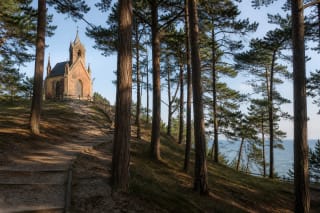
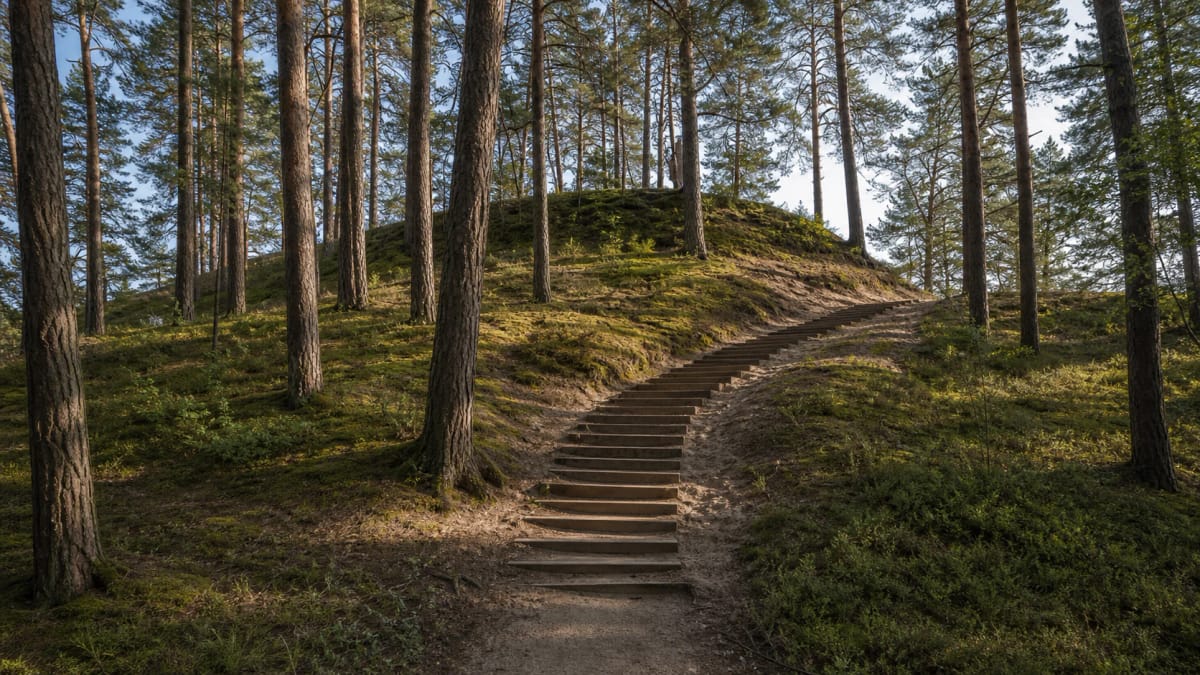
This is not a high mountain in the inland sense, but a seaside dune about 7 m high in the northern part of Palanga, by Naglio Avenue, north of the pier. The slopes are gentle, with only the northern one steeper; a flat oval platform of about 25 x 15 m survives at the top, oriented west-east.
It is the dune relief, the trees, and the separation from the central resort noise that help create the site's quiet gravity. The platform opens onto the seaside space, and the place itself is part of the chain of Palanga's seaside dunes and shrines.
The burial ground and the 1978 archaeological research
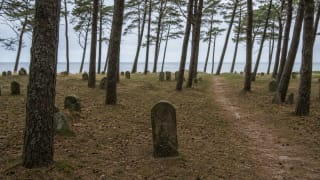
According to the Register, the burial ground is dated to the sixteenth-nineteenth centuries, while beneath the wind-blown sand lies an older horizon marked by hearths and linked to a pre-Christian ritual site - an alka. The cultural layer reaches up to 2 m in places and consists of two horizons separated by sand.
The 1978 research was carried out by the archaeologist Vladas Žulkus; 33 graves were investigated, some of them disturbed, with finds of pottery and metal artefacts. The research rejected the hillfort hypothesis: the hearths beneath the sand are close to the shrine layer of Birutė Hill, so Naglis Hill is understood as an old sacred site that later became a burial ground.
The legend of Duke Naglis
The legends of Duke Naglis were recorded in the late twentieth century by the archaeologist Vykintas Vaitkevičius (Ancient Sacred Sites of Lithuania: Samogitia, 1998), who is also named in the Register entry. The story tells that the warrior Naglis fell in battle, his body was cremated and buried on this dune, and his grieving wife planted pines and watered the grave with tears.
This documented legend must be distinguished from later literary retellings - motifs of a giant or of the Jūratė and Kastytis cycle, which are the work of twentieth-century authors rather than a folklore record. The legend explains how local people understood the dune, but it is not direct historical proof.
How to visit Naglis Hill respectfully
Naglis Hill is an outdoor site visited without a ticket. The dune is adapted for visitors - wooden steps have been installed, and in 2015 an oak information sign was erected. It is best to go in daylight, protect the dune slopes, and keep to the existing paths.
It is important to remember that this is a documented archaeological burial ground, so the place deserves a respectful visit rather than treatment as an ordinary recreation ground. Naglis Hill is easy to combine with Birutė Hill or the Palanga Old Jewish Cemetery - in this way the resort opens through sites of memory and mythology, not only through the beach.