- Place
- Šventoji, Palanga City Municipality
- Region
- Palanga
- Type
- reconstructed Baltic sacred site and paleoastronomical observatory
- Address
- Near Jonpaparčio Street and Kuršių takas, Šventoji
- Coordinates
- 56.04074, 21.07493
Žemaičių Alka, Samogitian Alka, Samogitian Sanctuary
Žemaičių Alkas in Šventoji: what kind of place is it?
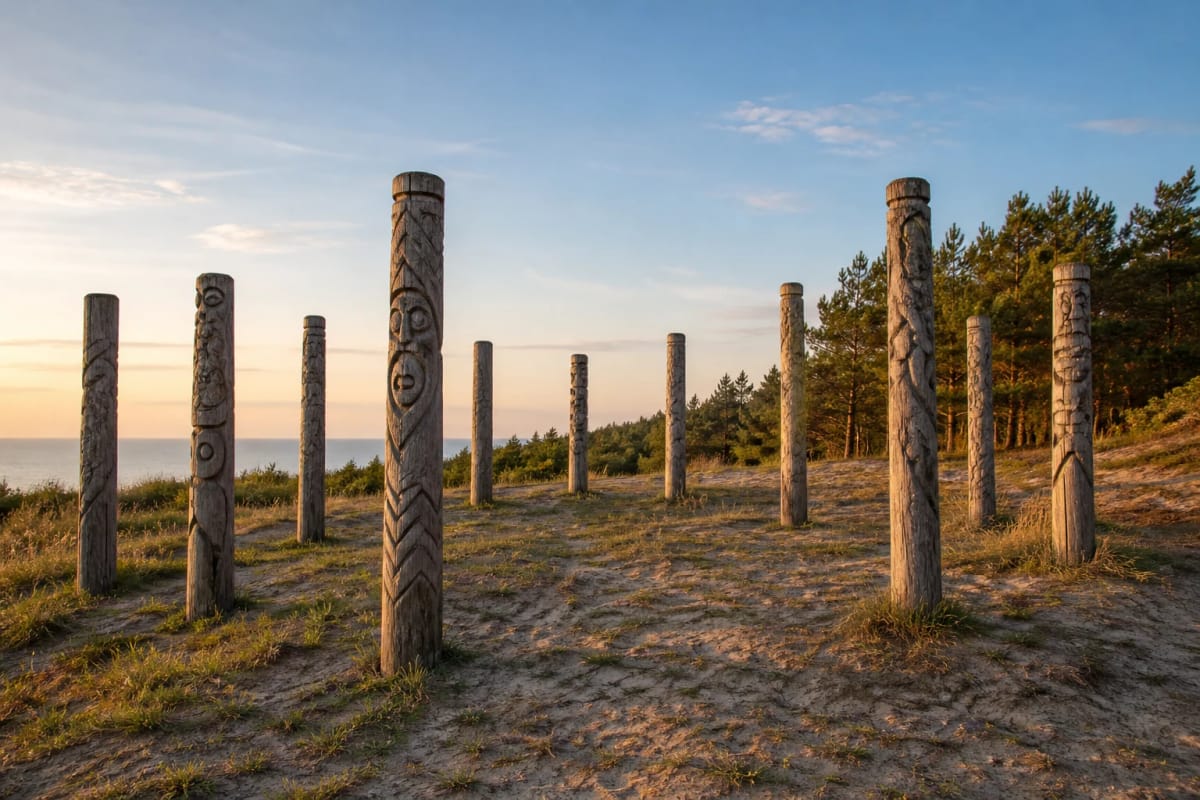
Žemaičių Alkas, also called Žemaičių Alka, stands on a dune in Šventoji, near Jonpaparčio Street and Kuršių takas. For visitors it is a small but expressive coastal place: oak posts, an open sky direction, and the nearness of the sea create a space that feels more like a field of signs than an ordinary sculpture park.
Visuotinė Lietuvių enciklopedija identifies this place as the only reconstructed pagan sacred site with a paleoastronomical observatory in Lithuania. The alka was installed in 1998 on the initiative of Augustas Narmontas, a member of the Palanga Samogitian Society. That is why the Šventoji alkas is worth visiting together with Birutė Hill: in one place you see the archaeological sacred-site tradition, in the other a later, conscious cultural reconstruction of it.
The Birutė Hill observatory echoed by the alkas
The encyclopedic article on Palanga hillfort and sacred site states that the hillfort, Birutė Hill, is dated to the tenth-fourteenth centuries, the sacred site to the fourteenth-nineteenth centuries, and that a temple-observatory stood on its platform in the fourteenth century. Expeditions of the Lithuanian Institute of History, led by V. Žulkus, investigated a 263 m2 area in 1976 and 1983-1984 and found remains of wooden post-structure fortifications in a cultural layer up to 2.5 m thick. The finds are kept in the History Museum of Lithuania Minor.
This observatory system became the basis for the Šventoji alkas. VLE notes that the posts of the alkas were arranged in a particular order, at unequal intervals, echoing the system of a fourteenth- and fifteenth-century sky-observation site that had existed on Birutė Hill in Palanga, based on V. Žulkus's research material. This means the alkas is not free fantasy, but an attempt to materialize a real investigated coastal sacred landscape.
Twelve oak posts, deity names, and Patrimpas's throne
VLE states that twelve oak sculptural posts were installed in the alka. The architect was Saulius Manomaitis, who in 2003 received a J. A. Zaviša Foundation prize for the project, and the sculptor was Virgilijus Vaičiūnas. Eleven posts are dedicated to Baltic gods and goddesses: Perkūnas, Patrimpas, Patulas, Aušrinė, Žemyna, Austėja, Lada (goddess of love and beauty), Ondenis (god of waters), Velnias (god of bogs and the underworld), Mėnulis (god of night light), and Saulė (the Moon's wife).
The twelfth post is called Patrimpas's throne, a pagan pulpit where speeches are made. The sculptures were created after a 5000-year-old, 2 m high wooden post with a goddess mask bearing owl-like features, found during archaeological expeditions of the Šventoji settlements led by R. Rimantienė. Because of that, the imagery of the place has a deep archaeological root.
Sun shadows and calendar festivals
The alkas works as a calendar. VLE states that festival dates can be determined by the shadows cast by the posts as the sun sets, and that the festivals marked at the alkas include Rasos, Kalėdos, Užgavėnės, New Year on March 21-23, Jorė, the festival of goddess Milda, the equinoxes, and Žolinė. This does not mean every visitor will easily perform precise astronomical calculations on site.
The more important point is the principle: by the sea, where the horizon is clear, the position of sunset changes through the year, and the arrangement of the posts turns that change into a visible calendar sign. Because of this, the place is especially understandable in the evening, so the best time to visit is before sunset.
Old sacred site or reconstruction?
It is important to separate two layers here. The old, archaeologically documented layer is Palanga's Birutė Hill and Palanga hillfort with its sacred site. The Žemaičių Alkas in Šventoji is a 1998 site of reconstruction and interpretation, created on the basis of Birutė Hill research and the modern Baltic culture movement.
VLE also explains the technical history of the place: when permission was not given to reconstruct the sacred site on Birutė Hill, a suitable place was found on a nineteenth-century second-row dune ridge on the northern bank of Šventoji. The dune was raised with brought-in soil and given a silhouette recalling Birutė Hill. Over time, the ends of the posts buried in the ground decayed, so in 2017 new posts were installed, raised above the ground on metal rods set in concrete. This confirms that the site is a twentieth- and twenty-first-century reconstruction, not a continuously surviving medieval temple.
How to visit Žemaičių Alkas
The site is an open outdoor space, so it does not require a long visit. Usually 20-45 minutes is enough: walk around the posts, read their names, look at the direction of the sea and dune, and, if possible, stay until sunset.
Because the alkas stands in a coastal dune environment, it is important to stay on paths, avoid stepping through sensitive vegetation, and not treat the posts as play equipment. The best route is slow: Šventoji, the alkas dune, the coastal path, and then the wider Palanga cultural route through Birutė Park.