- Place
- Šilutė, Šilutė District Municipality
- Region
- Pamarys
- Type
- historic town market square and public riverfront space beside the Šyša
- Address
- Old Market Square, 99186 Šilutė
- Coordinates
- 55.34243, 21.45827
- Visit duration
- 30-60 minutes; 1-2 hours with the Šyša riverfront and historic centre of Šilutė
- Best time
- year-round in daylight; May to September for a green riverfront and a longer walk
Senoji Šilutės turgaus aikštė, Šilokarčema Market Square
The bend of the Šyša is an edge of the square, not a backdrop
Šilutė Old Market Square occupies the western part of historic Šilokarčema beside a pronounced bend of the Šyša. The coordinates 55.3424348, 21.458271 mark the representative point of the exact Google Maps place card within the square, not a gate or sole entrance - this is a broad town space reached from several sides.
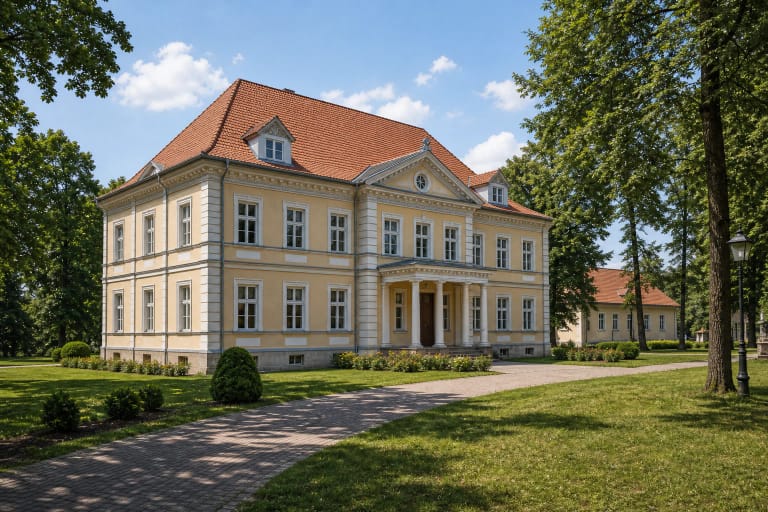
The Register of Cultural Values describes the market square as two irregular rectangular parts linked by a passage. The river bend defines its waterside edge, while the built sides retain different scales. VLE highlights the surviving two- and three-storey early twentieth-century Art Nouveau and modern-style buildings around the square, historically combining shops and flats.
Read the place from river to town: first the bend and stepped riverfront, then the open paved ground, and finally the line of older facades. That sequence explains why water was a trade route here, not merely a picturesque edge.
The inn of 1511 is not a precisely dated first market day
Šilokarčema appears in written records in 1511, when an inn operated beside the Šyša. It created favourable conditions for exchange among travellers, farmers, and fishers, but the date does not prove that the first official market took place that year. Museum historian Darius Barasa has also discussed the more cautious possibility that local exchange predated the inn itself.
VLE dates the emergence of the market to the second half of the sixteenth century. Complaints from the pastor at Verdainė about church attendance during market time show its growing pull, while the first known rules for market-place fees date from 1658. The evidence therefore separates the first mention of the settlement and inn from a later documented, regulated market.
In a 1731 project for establishing a planned town, the existing and proposed market ground occupied roughly 200 x 200 metres, with two inns, a brewery, manor buildings, and artisans' houses marked around it. This is the scale of a historic plan, not a modern survey measurement - the scheme was not executed exactly as drawn.
The fish market was a waterborne trading system
Šilutė market connected the different economies of Pamarys and Samogitia. Fishers from Rusnė, Mingė, the Curonian Spit, and other lagoon shores brought fish by water; Samogitian farmers carried flax, hemp, honey, and other produce; merchants from Klaipėda and Königsberg offered salt, spices, tobacco, sugar, and metal goods.
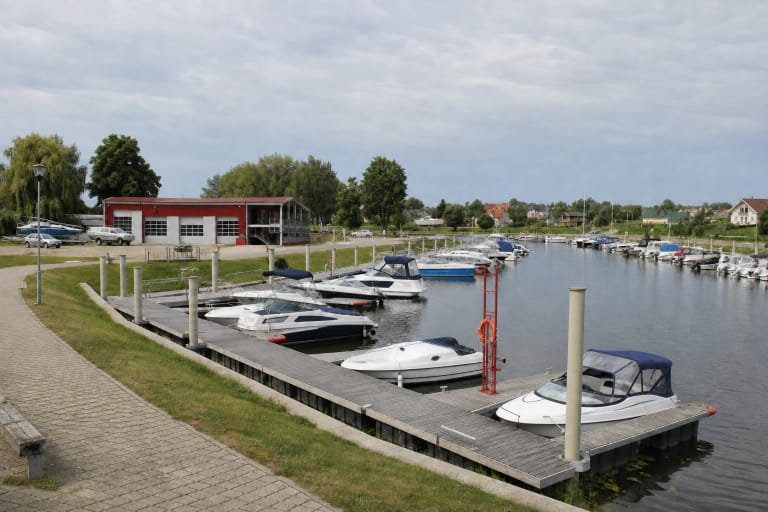
The square gradually developed specialised areas for fish, grain and vegetables, butter, livestock, firewood, and hay. Fish could be sold straight from boats, while hay also came along the Šyša. The historic landing belonged to the Old Market river bend; it must not be confused with the later harbour basin that operates at a different address today.
An official 1912 document cited by the museum historian recorded about 6,000 people, 2,000 carts, and 120 boats arriving at Šilutė market in a week. The figures are approximate numbers from a period document, but they convey a scale that is difficult to imagine from today's quiet public space.
The square contracted and the market moved
Buildings occupied part of the large trading ground in the first half of the nineteenth century. This produced the two Old Market sections still described in the Register. Their changing perimeter is not an accidental flaw - it records the shift from an open trading field to a denser part of town.
Hugo Scheu, who acquired Šilokarčema Manor in 1889, gave about 3.5 hectares of manor land for expanding the market. Sources distinguish Old and New Market squares by 1910; the New Market lay near the end of today's K. Kalinausko Street, so it should not be identified either with this river bend or with the present municipal market.
Trading continued in Old Market Square until 1962, when the market moved to Cintjoniškių Street. The square today is therefore the site of a historic market, not a guaranteed daily marketplace. Town festivals and temporary events may bring back crowds, but their schedules must be checked separately.
The 2022 renewal did not erase the earlier layers
The official Šilutė Tourism Information Centre dates the square's renewal to 2022, while the municipality's annual report records completion of work on the square, paths beside the Šyša, and lighting. Visitors now find an open paved area, stepped access towards the river, benches, planted strips, and pedestrian paths.
The modern surface is not the end of the site's story. Before the renewal, Register documents recorded a fieldstone paving type in the south-western part and older cobbling surviving beneath asphalt, while protected facades around the square also contribute to its value. The new riverfront layer should therefore be read together with the historic plan and built edges.
In 2023 the municipality launched a separate ideas competition for the square's aesthetic design because functional infrastructure work was not regarded as the final visual solution. Competition renderings should not be mistaken for completed features - visitors should rely on what is actually present on site.
Open without gates, but not without practical limits
The square is a public outdoor space without a separate ticket, gate, or museum-style opening hours. Allow 30-60 minutes for the square alone, or 1-2 hours with the Šyša riverfront, Hugo Scheu Manor, and buildings of the historic centre. Events, maintenance, or temporary traffic controls can alter normal access.
Most of the square and principal paths are paved and appear fairly level, but the riverfront terraces include steps and no official accessibility audit for the complete route was found. Park only where local signs permit and keep areas reserved for events or servicing clear; a broad paved surface is not automatically a parking area.
Supervise children beside the Šyša and take care on wet or icy steps. This is not a confirmed bathing area, and the old fish market no longer operates here. For the trading story, begin with the river bend and facades; for museum context, continue to Hugo Scheu Manor.