- Place
- Šilutė, Šilutė District Municipality
- Region
- Pamarys
- Type
- historic railway-station building complex
- Address
- Geležinkelio g. 4, Šilutė
- Coordinates
- 55.34710, 21.48403
Žibai-Šilokarčema station, Szibben-Heydekrug station
Šilutė Railway Station on the land of Žibai village
Šilutė Railway Station belongs to the story of the Klaipėda-Tilsit railway line. It was built on the land of Žibai village, so it was historically called the Žibai-Šilokarčema (Szibben-Heydekrug) station - the town of Šilutė only merged in the early twentieth century from the settlements of Šilokarčema, Žibai, Verdainė, and Cintijoniškiai.
The Register of Cultural Property protects not only the station building but the whole building complex (code 30555), listed as a state-protected object of regional significance that falls within Šilutė's historic town area. That makes it possible to speak about the full railway infrastructure: passengers, luggage, locomotives, water, and the working routines of railway staff.
The 1871-1875 Klaipėda-Tilsit railway
According to the Register, after Germany won the war against France, the state railway from Klaipėda to Tilsit began to be built in 1871 and was completed on July 1, 1875. It was on this line that Šilutė station appeared, connecting the town with the port of Klaipėda, Tilsit, and East Prussia.
The railway network later grew denser: the Universal Lithuanian Encyclopedia notes that in 1912 a narrow-gauge railway was laid from Žibai and dismantled after 1945. In this way the broad-gauge and narrow-gauge railway layers overlap in Šilutė.
The yellow-brick station building complex
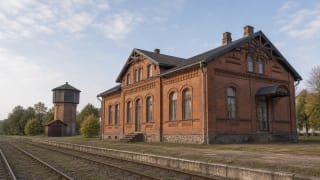
The Register singles out four structures in the complex: the station, the water-supply building, and the southern and northern railway workers' houses; service buildings also survive nearby. The station had all the necessary buildings, including a small depot for running locomotive repairs.
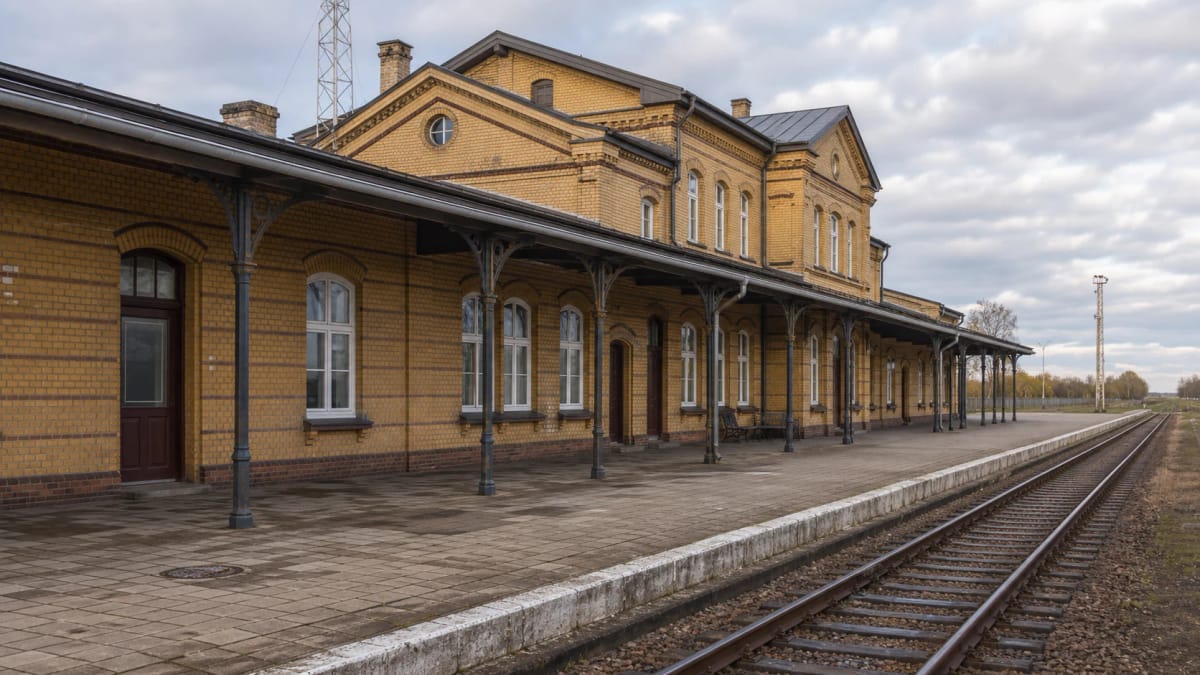
The station building was constructed to standards adopted in Prussia: it had to have a waiting hall, a ticket office beside it, a luggage room, offices, and a restaurant, with staff apartments on the second floor. The yellow-brick architecture is typical of East Prussian railway culture, where function and representation meet in a restrained way.
The memory of deportations from Šilutė station
In 1948-1952 Lithuanian residents were deported en masse from this railway station into the depths of the Soviet Union - a fact recorded in the Register entry itself. According to the encyclopedia, about 1,300 people were deported from Šilutė district during that period. The place therefore carries the weight of historical memory as well as technical heritage.
When visiting, it is important not to reduce the station to a handsome facade. The tracks and platform here remember both everyday journeys and the forced removal of people, so both layers need to remain visible in the story.
How to view Šilutė station
Šilutė Station is active transport infrastructure, so view it from public and safe areas, without stepping onto the tracks or interfering with railway traffic. During research, no separate heritage ticket or tourist opening hours were found.
The station is best combined with Šilutė Evangelical Lutheran Church and Hugo Scheu Manor. One town walk can then connect the railway, sacred heritage, and manor culture.