
- Genre
- Origin legend
- Source status
- chronicle tradition
- Motifs
- Palemonas, Rome, Nemunas, nobility, origin, chronicles
Palemonas, Palemonas myth, Legend of Lithuanian descent from Romans
The legend
The Palemonas legend tells that a noble man named Palemonas came from Rome or Roman lands to Lithuania with companions. Fleeing political unrest or seeking safer land, they travelled by water and reached the Nemunas region. According to sixteenth-century Lithuanian chronicles, Palemonas, with his family and about five hundred companions, settled by the Nemunas, Jūra, and Dubysa rivers.
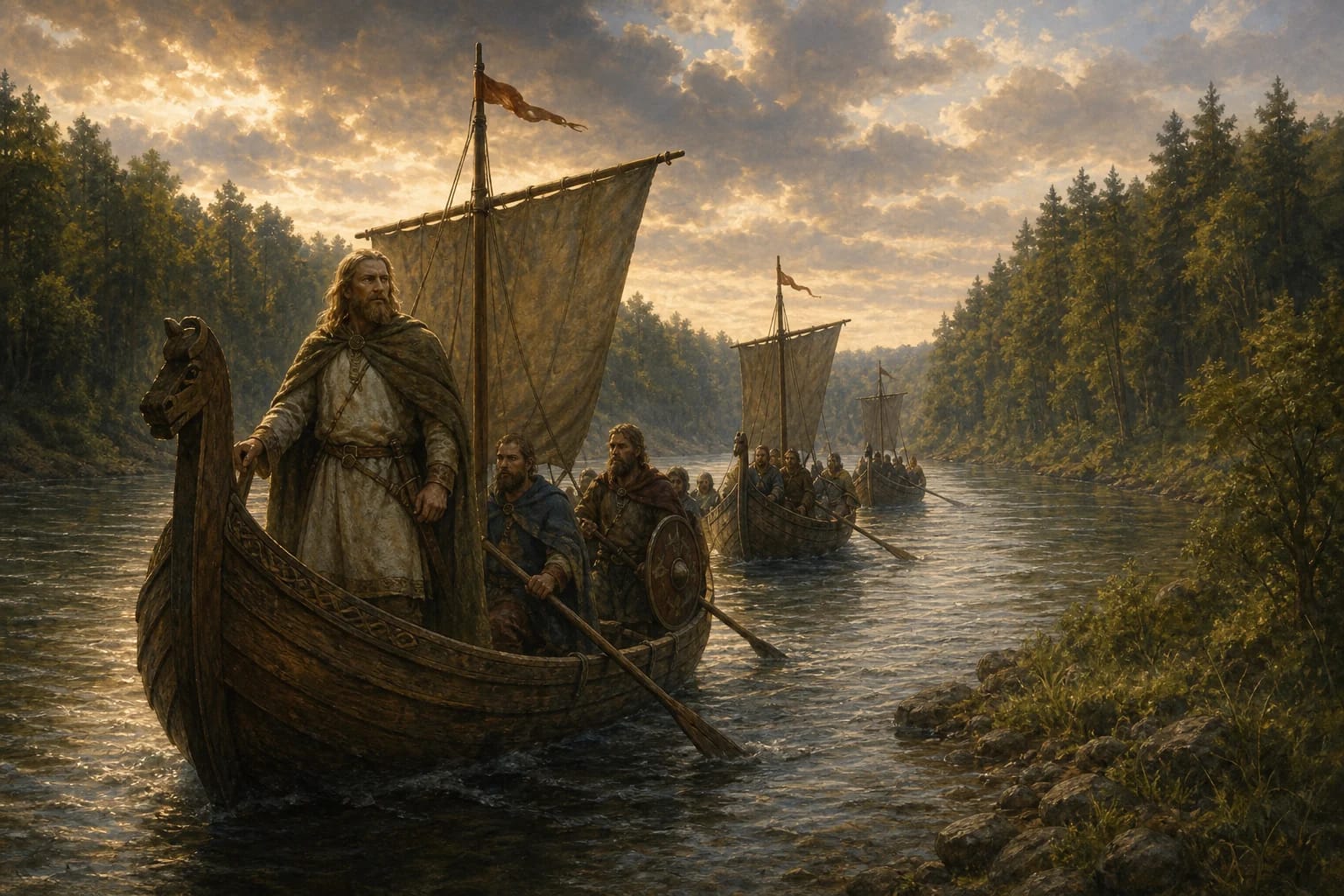
The arrivals found a forested land rich in rivers. They settled, founded places, began lineages, and gave rise to a tradition of rule. In the chronicles, Palemonas' sons Barkas and Kunas are portrayed as founding Jurbarkas and Kaunas, while the grand dukes of Lithuania are traced to his descendants.
The story creates a genealogy: Lithuanian nobles are imagined as having an old, honourable, Roman beginning. It is more about political self-understanding than everyday folk belief.
Interpretation: what does the Palemonas legend mean?
The legend is a story of origin prestige. It let Lithuanian nobles imagine themselves not as peripheral or accidental but as heirs of an ancient European, Roman tradition.
Rome functions as a sign of authority. In medieval and early modern Europe, a Roman connection could give political weight, cultural honour, and genealogical depth.
The Nemunas becomes the route of arrival and rooting. It connects a distant origin with the Lithuanian landscape.
This legend also shows how chronicles create political memory. They not only record events but also offer origin stories that help a community understand its place among other peoples and states.
History, sources, and the origin theory
The Palemonas legend belongs to sixteenth-century Lithuanian chronicle tradition and to the theory of Lithuanian descent from Romans. In the broader and full chronicle compilations, one version makes Palemonas a relative of Emperor Nero fleeing persecution, while another makes him a fifth-century figure withdrawing from Attila the Hun. Those variant settings already show the literary and political character of the story.
VLE describes Palemonas as a legendary ancestor of Lithuanian princes and nobles, not as a documented historical person, and notes that chroniclers probably took his name from Roman historical writing where Palaemons appear as rulers of Pontus in Asia Minor.
Such origin legends were common in Europe, where families, states, and cities often traced themselves to prestigious ancient peoples or heroes. In Lithuania, the Palemonas story gave the nobility a grand beginning scene.
Historically, the legend should not be simplified into a claim that Lithuanians literally descended from one Roman group. Its importance lies in political culture and historical imagination.
Why this legend matters
The Palemonas legend helps explain how the culture of the Grand Duchy of Lithuania built a noble past for ruling families.
Today Palemonas is important as an example of chronicle imagination: a story can become a tool of political identity even when it is not literal history.