- Place
- Palanga City Municipality
- Region
- Palanga
- Type
- sea pier and resort promenade
- Coordinates
- 55.92010, 21.04660
Sea pier, Palanga sea pier
Palanga Pier: what makes it special
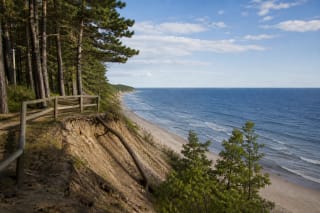
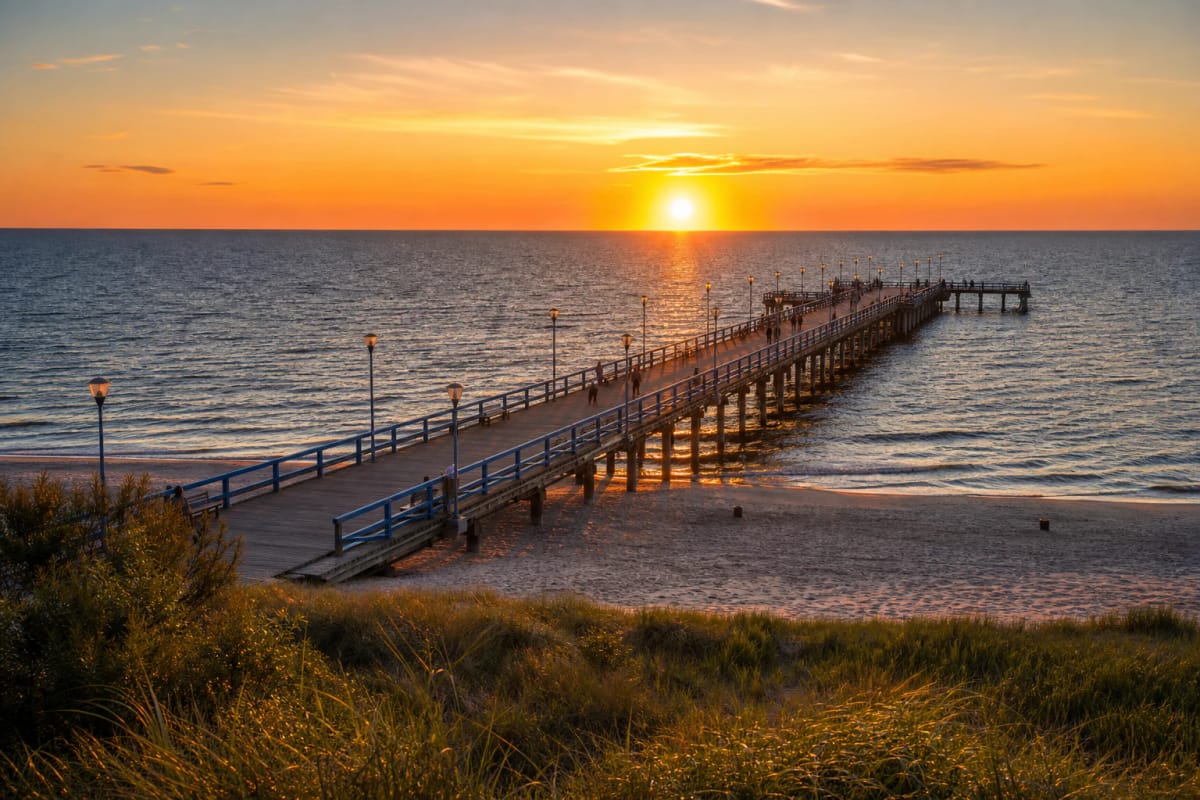
Palanga Pier is the point where the bustle of J. Basanavičiaus Street turns into the sea horizon. People walk here not only for the distance out over the water: from the pier you see dunes, the broad beach, the line of waves, and one of Lithuania's clearest Baltic sunset scenes.
The pier is hard to separate from the resort itself. The current pier is about 470 m long, so a walk takes longer than it appears from shore, especially if you stop to take photos or watch the sea. Lithuanian encyclopedic sources note that the sea pier is one of the old elements of the Palanga townscape restored and adapted for public needs after the restoration of independence.
From landing pier to promenade
The pier's history did not begin as a romantic promenade. The Lithuanian encyclopedic article on Palanga's history states that a pier into the sea was built in 1889 as the summer resort grew more popular. Stories connect the late-nineteenth-century Tiškevičiai counts with a ship landing intended to help transport bricks made in their brickyard.
Accounts mention that the ship Phoenix sailed from the landing to Klaipėda and Liepāja, and when brick export did not prove successful, passengers began to be carried by the same ship. Storms and sand, however, constantly created problems, so it became clear that the place was not suitable for shipping. The pier remained as a resort walking place.
Why the pier became a walking place
Once the shipping idea failed to settle, the sea pier began to form as a favourite promenade. This was a natural turn for a resort: if navigation did not work, the pier became a public space where holidaymakers could experience the sea more closely than from the sand.
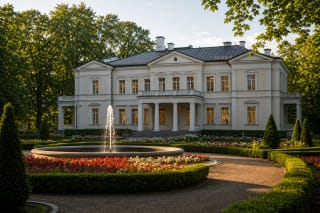
The wider context matters. The Palanga history article notes that in the early nineteenth century Palanga became a summer resort, and in the 1870s-1880s, as its popularity grew, the town expanded faster. It was in this period that the pier was built in 1889, followed by the Tiškevičiai manor palace in 1897-1902. The pier is therefore not an isolated structure but part of Palanga's transformation into a seaside resort.
The present Palanga Pier
Time, waves, and wind repeatedly weakened the older structures, so the pier has been rebuilt several times. The current pier on concrete piles is about 470 m long, and this later reconstruction largely shaped the sea-pier view visited today. Lithuanian encyclopedic sources note that the pier belongs to the restored and reconstructed elements of the old Palanga townscape.
In the square near the pier stands the sculpture Jūratė and Kastytis by sculptor Nijolė Gaigalaitė. It works as an introduction to the pier: before walking out over the sea, visitors pass another Palanga symbol recalling Lithuania's best-known sea legend.
How to plan a visit
For a calm impression, come early in the morning when the beach is still empty. For the classic Palanga experience, choose sunset, but expect more people then, especially on summer weekends. A living Palanga tradition is connected with the pier: on summer evenings people gather at the far end to watch the sun set into the sea and often applaud after it disappears.
In strong wind or stormy weather, a walk on the pier can be uncomfortable. In winter and after storms, watch for slippery areas, and explain to children that they need to behave carefully near the railings and at the end of the pier.