- Place
- Puziniškis village, Panevėžys District Municipality
- Region
- Aukštaitija
- Type
- literary memorial museum in the 1901 manor house of the Puziniškis estate
- Address
- 4 Puziniškis village, Smilgiai eldership, Panevėžys District
- Coordinates
- 55.86875, 24.06491
- Visit duration
- 1-1.5 hours for the exhibition and manor setting; longer with a pre-booked educational programme
- Best time
- Tuesday-Saturday after confirming the visit in advance, avoiding the 13:30-14:00 lunch break
Gabrielė Petkevičaitė-Bitė Birthplace Museum, Puziniškis Manor, Puziniškis Estate, Puziniškis Museum
This is Bitė's birthplace estate, but the red-brick house is not her birth house
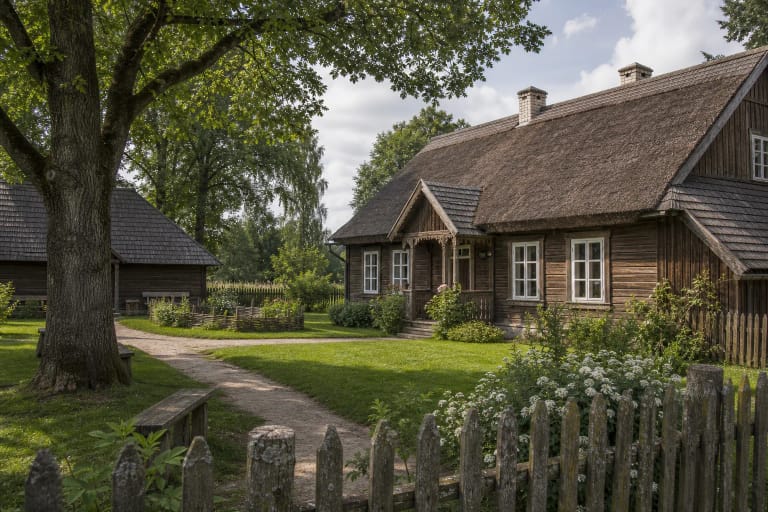
Gabrielė Petkevičaitė-Bitė was born at Puziniškis on 30 March 1861 in the present calendar. In her own recollection, quoted by the Cultural Heritage Register, the family home then was a low, thatched cottage with three rooms, a kitchen, a separate cooking room, and a small upper chamber called a salka. That timber house still stood on the estate in 1926. The masonry manor house open to visitors today is therefore neither Bitė's birth house nor an untouched interior from 1861.
The Petkevičius family's story here began earlier. KVR records that the writer's grandfather Felicijonas Petkevičius bought neglected land and that the family settled at Puziniškis in 1835; the estate is considered to have been established in the mid-nineteenth century. Bitė's father, physician Jonas Leonas Petkevičius, returned after his studies in 1855 and made the household a place of medical help, education, and public service as well as farming.
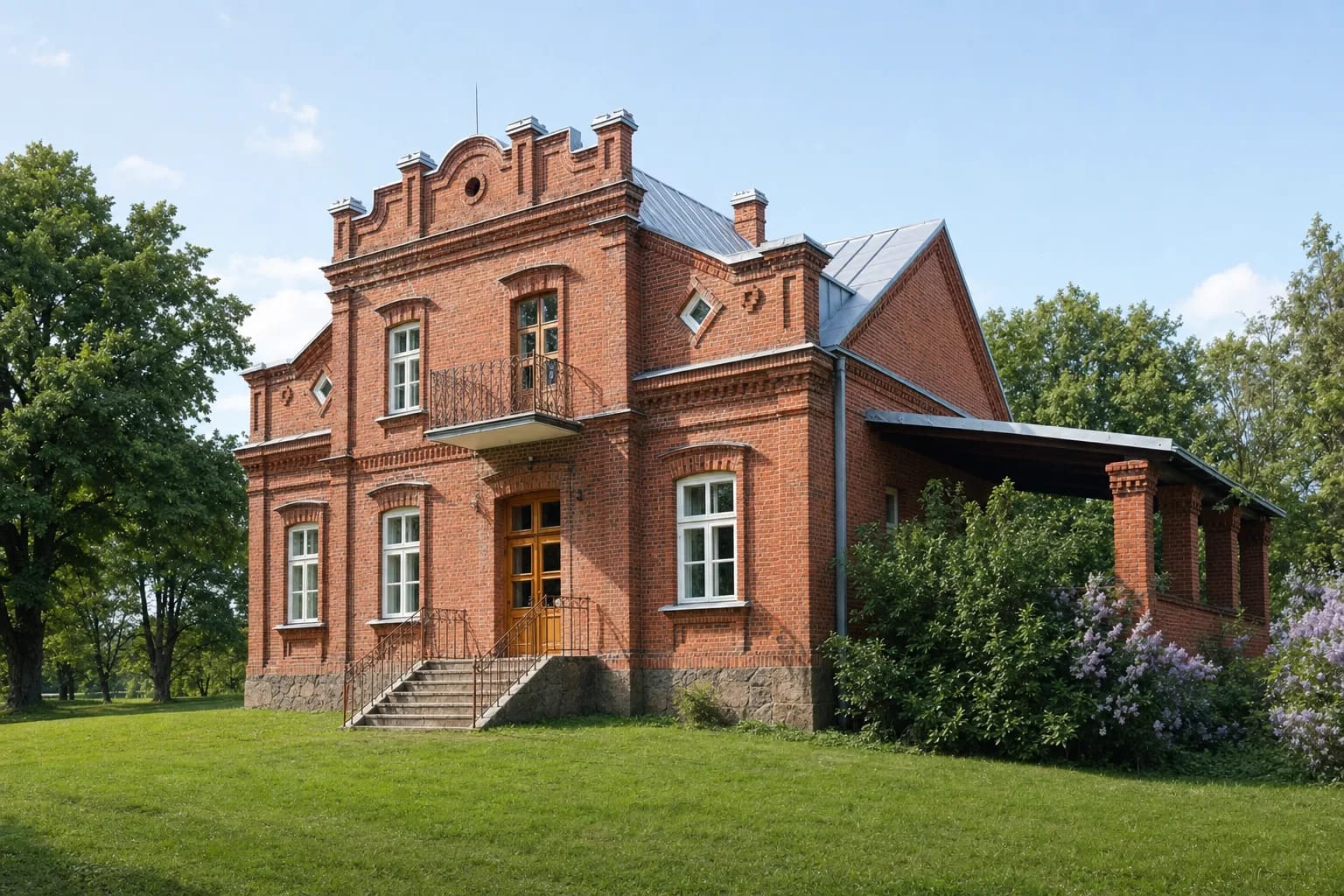
The present manor house was completed in 1901 from a design prepared earlier by Bitė's brother Jonas. He died of tuberculosis in 1893, and their father treated the new house as a memorial to his son; pines he had planted supplied timber for its construction. It is accurate to call the museum Bitė's birthplace because the estate and family setting are authentic. It is inaccurate to search the present building for a surviving room in which she was born.
The 1901 house belongs to a nationally important protected estate
Puziniškis Manor estate is listed in the Cultural Heritage Register as code 404, with monument status and national significance. Its two registered components are the manor house, code 23217, and the park, code 23218. Protection extends beyond the facade to the estate plan, level terrain, park and pond, the north-south approach road, and the paths crossing the central part of the property.
KVR describes the house as one storey with a mansard and a basement beneath its northern section. Mezzanines on the west and east elevations, a projecting section on the south front crowned by a stepped gable, a balcony, and an open veranda to the east articulate the compact rectangular building. Toothed cornices, brick pilaster strips, small windows of several shapes, and a fieldstone base animate the exposed red ceramic brick.
Registered interior features include a two-flight timber staircase with turned balusters, two white tiled stoves, timber flooring, and cylindrical brick vaults in the basement. The internal plan changed during later reconstruction, however. The museum should be understood as authentic Petkevičius-period architecture and a genuine memorial site, not as a completely untouched domestic time capsule from 1901.
Puziniškis was Bitė's home, classroom, and a meeting place for Lithuanian culture
KVR gives four precise periods when Bitė lived at Puziniškis: 1861-1865, 1901-1909, 1914-1919, and 1925-1927. The estate was both an early-childhood setting and a base for mature work, but it was not her only home. Large parts of her life belong to Joniškėlis and Panevėžys, and her residence at Puziniškis was intermittent.
During the ban on Lithuanian printing, the Petkevičius household concealed Lithuanian publications, hosted private gatherings of intellectuals, and taught local people to read and write. Bitė contributed to the underground Lithuanian press from 1890, co-founded the Žiburėlis society with Jadvyga Juškytė in 1894 to support poor pupils, cared for patients, and taught peasant children. The museum consequently treats education, philanthropy, and civic action as seriously as her fiction.
Puziniškis became a cultural centre for northern Lithuania in the early twentieth century. Jonas Biliūnas, Jonas Jablonskis, Povilas Višinskis, and other leading figures visited, while Žemaitė lived here for a time. Žemaitė and Bitė signed their collaborative writing Dvi moteri, meaning Two Women. That partnership is documented history, though it should not be embellished into a claim that both writers lived permanently together at the manor.
Displays and activities connect literature with schooling and domestic knowledge
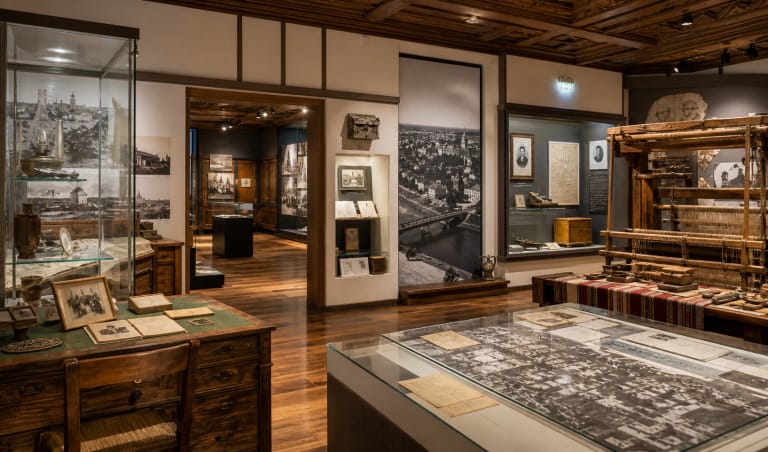
A memorial exhibition opened at Puziniškis in 1987, when Panevėžys District Public Library also assumed care of the museum. KVR records restoration of the house in 2009-2010, while the museum's own account highlights an EU-funded interior reconstruction in 2009. The current exhibition presents Bitė, her colleagues, and the national cultural movement, with a separate narrative devoted to children's writer and teacher Matas Grigonis.
The public description does not provide an object-by-object provenance catalogue. Photographs, documents, the recreated classroom, and other material are therefore best read as a memorial interpretation rather than automatically assumed to be Bitė's personal possessions. Visitors interested in authenticity should ask which exhibits are originals, which are reproductions, and which were made for educational use.
The Old Home School programme draws on a school that operated in the manor during the First World War: participants stitch a small exercise book, write with a goose quill, and solve period-style problems. Folk Medicine in the Petkevičius Home introduces herbs and ends with herbal tea. The local food programme asks visitors to identify grains and finishes with porridge cooked over a fire. Separate Culture Passport activities are designed for Years 1-4 and Years 5-8.
The museum also hosts cultural events and presents the Gabrielė Petkevičaitė-Bitė Literary Prize. On an event day, the normal exhibition visit may operate differently. Check the day's programme as well as the nominal door-opening time before travelling.
Hours and prices are published for 2026, but arranging the visit remains wise
The official page, last edited on 5 June 2026, listed Tuesday-Saturday hours of 09:30-18:00, with a lunch break from 13:30 to 14:00. Monday and Sunday were closed. The same block also says the museum can be visited by prior arrangement. It does not make clear whether every individual visitor must register, so calling +370 614 62 010 before setting out is the safest interpretation.
When checked, the posted admission was EUR 1 for a child or school pupil, EUR 2 for an adult, and EUR 2 for an educational-programme participant. Culture Passport activities were separately shown at EUR 1. Combining several educational programmes adds a museum fee according to group size: EUR 5 for up to 10 people, EUR 10 for up to 20, and EUR 20 for up to 30. Recheck prices and the exact programme before booking because both can change.
The address is 4 Puziniškis village in Smilgiai eldership. The coordinate marks the manor house itself, not a formally documented parking space. The museum publishes no comprehensive accessibility audit, while the historic building contains stairs, a mansard, and a basement. Ask directly about step-free entry, which floor is visited, toilets, companion admission, and where a vehicle may stop.
Plan the visit as part of a literary and Panevėžys District day
Allow about 1-1.5 hours for the principal displays and an unhurried look at the manor setting. A booked class, herbal tea, or porridge activity requires longer and does not run automatically for every arrival. The rural location, lunch break, and prior-arrangement note make a spontaneous drop-in less dependable than at a large urban museum.
Bitė's story continues in Panevėžys, where the public library bears her name and Panevėžys Regional Museum preserves a substantial collection of objects and documents connected with her. Žemaitė Memorial Museum at Bukantė supplies another perspective on the Dvi moteri collaboration, although it belongs to a separate route across Žemaitija.
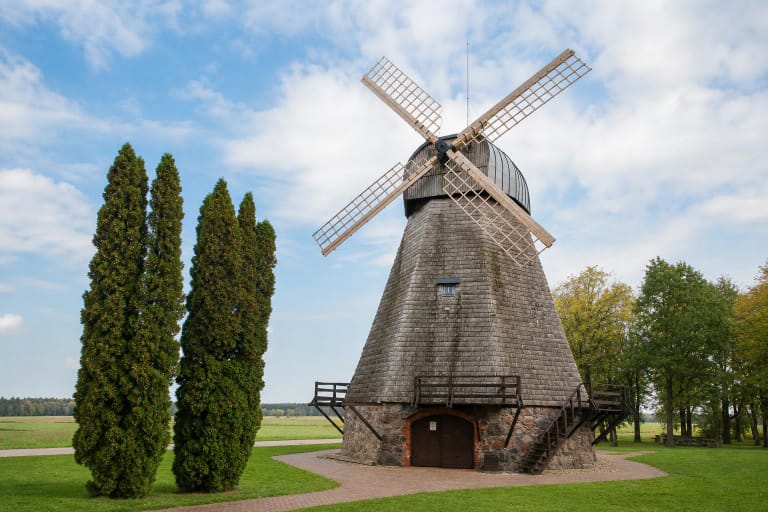
For a closer second stop on the same day, use the Flax Museum inside Stultiškiai Windmill. Both are small, highly specific museums whose schedules deserve checking, but their contrast is valuable: Puziniškis focuses on literature, education, and civic culture, while Stultiškiai explains flax processing and windmill technology.