- Place
- Skuodas District Municipality
- Region
- Skuodas region
- Type
- hillfort with an outer ward, settlement, and burial-ground context
- Address
- Puodkaliai village, Skuodas Eldership, Skuodas District
- Coordinates
- 56.22910, 21.52470
Puodkaliai Hillfort with outer ward and settlement, Puodkaliai Hillfort and burial ground, Hillfort of the Puodkaliai Hillfort with outer ward and settlement
Puodkaliai Hillfort by two rivers
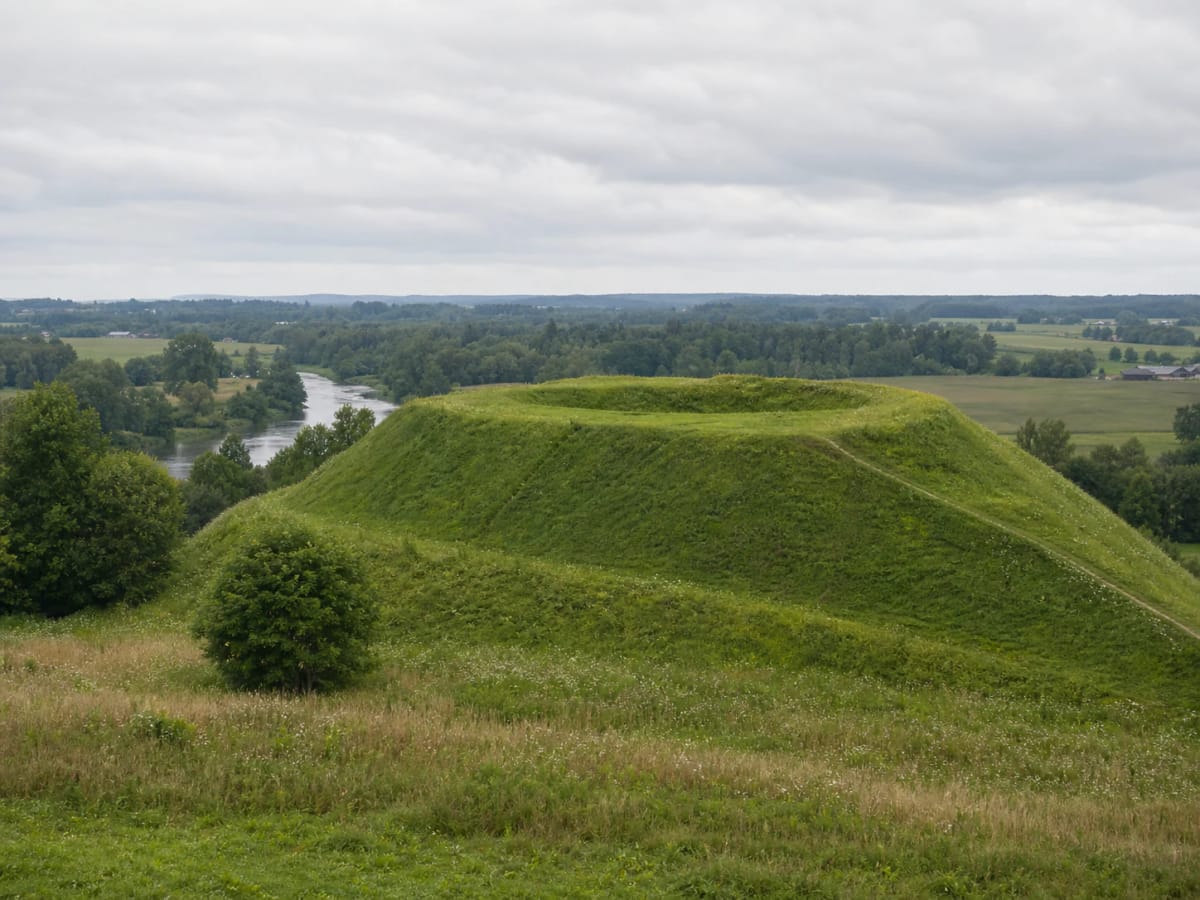
Puodkaliai Hillfort is in Puodkaliai village, Skuodas District, on a hill on the left bank of the Bartuva and the right bank of the Erla, close to their confluence. The rivers are not only scenic background here - they explain why the location was convenient for defence, movement, and settlement.
In the Register of Cultural Property, the object is listed as the hillfort of the Puodkaliai Hillfort with outer ward and settlement (unique code 3254), with national-significance monument status. It belongs to the wider Puodkaliai Hillfort with outer ward and settlement complex.
The platform, a 140 m rampart, and steep slopes
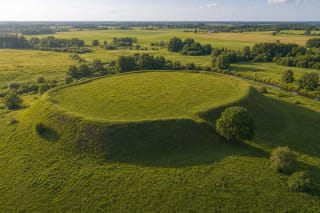
VLE gives the hillfort platform as elongated, about 80 x 90 m. Its clearest feature is a rampart 140 m long on the south-western and western edges, up to 5 m high and 17 m wide. Those dimensions make it clear on site that this is not a small rise, but a complex defensive structure.
The slopes of the hillfort and the outer ward are steep, and there was a road on the north-western side of the hillfort. The hill's position between two rivers strengthened its natural defence and limited the approaches.
Outer ward, settlement, and burial ground
The complex includes a semicircular outer-ward platform (about 20-30 m long and 150 m wide), with a ditch 6 m wide and 2 m deep dug on its western edge. West of the outer ward lies a settlement of about 2 ha at the foot of the hill.
About 0.65 km west of the hillfort is a ninth- to thirteenth-century cremation burial ground - the dead were buried cremated. The burial ground was damaged in the 1970s during the building of a dam, and in 1975 it was excavated by Ignas Jablonskis.
Finds and dating
The burial ground yielded weapons (a spearhead), tools (an axe, a fire-striker, a knife, a razor), ornaments (brooches, bracelets, rings), a drinking-horn mount, and sherds of wheel-thrown pottery. These finds are kept in the National Museum of Lithuania and testify to the rich material culture of the Curonians.
The Register of Cultural Property dates the hillfort to the first millennium to the thirteenth century, while VLE dates the wider hillfort and burial-ground complex even more broadly, from the first millennium BC to the thirteenth century AD. The difference shows a long-used place rather than a single construction date. VLE also links the complex with Skuodas, mentioned in written sources in 1253.
How to visit and what to combine in the Skuodas region
The hillfort is an outdoor archaeological site, so there are no tickets or opening hours. It is still a protected monument: do not dig, drive on slopes, damage the ground, or collect finds. The best time is a dry day from spring to autumn, because slopes and riverbanks are slippery after rain.
Most visitors need 30-60 minutes. Puodkaliai Hillfort is worth combining with Skuodas Museum, Apuolė Hillfort, and Mosėdis Stone Museum, and with more time, Barstyčiai Stone. This kind of route shows that the historical landscapes of north-western Lithuania are not isolated points on a map.