
Summer
Rasos Festival
Evening of June 23 and night into June 24
Rasos is one of Lithuania's most important calendar feasts. It is linked with the summer solstice, nature at full strength, the power of herbs, water and fire symbolism, and communal singing until dawn.
Tradition context
- When
- Evening of June 23 and night into June 24
- Season
- Summer
- Themes
- Summer solstice, kupoliavimas, wreaths, dew, fire, water, songs
Rasos is the old Lithuanian summer solstice festival, centered on herbs, dew, bonfire, water, songs, and greeting the sun at dawn.
What Is Rasos in Lithuania?
Rasos is the old Lithuanian summer solstice celebration. It is held when the day is longest, the night shortest, and nature reaches summer fullness. This is why herbs, water, fire, sun, and dew are so central.
Rasos is often mentioned together with Jonines, but the names emphasize different layers. Rasos stresses the older Baltic worldview and natural cycle, while Jonines is linked with St John's Day and name-day tradition. VLE notes that this summer-solstice feast has been known in Baltic lands since the 14th century (mentioned in 1372 in a document of Bishop Henry II of Warmia); before Christianity it was called Kupoles or Rasos and celebrated throughout the last third of June, later identified with St John the Baptist's day.
When Is Rasos Celebrated?
Rasos usually begins on the evening of June 23 and lasts until the morning of June 24. The important thing is not only the date but the experience of the night: dusk, bonfire, songs, herbs, water, and waiting for the sun.
The shortest night is a boundary time in Lithuanian custom. In traditional imagination, nature is open, plants have gathered force, water and dew are special, and a person can renew themselves together with the year cycle.
From Evening to Sunrise
Rasos often begins with kupoliavimas, wreath weaving, and creating the festive space. Later the altar or bonfire is lit, songs are sung, circles danced, wreaths floated, water approached, and dawn awaited.
In the best Rasos celebrations a person is not only a spectator. They gather herbs, weave a wreath, sing, pass through gates, stand by the fire, listen to stories, and wait for the sun. Participation gives the feast its meaning.
Origins: Kupoles, Jonines, and Solstice Tradition
Rasos were also called Kupoles because herbs, kupoles, and their gathering are among the most important signs. With Christian tradition, the name Jonines entered through St John the Baptist. Written references to midsummer customs exist from the fourteenth century.
Kernave Rasos is one of Lithuania's clearest examples. The intangible heritage register notes that in 1967 Rasos were first held in Kernave according to archaic Baltic customs reconstructed from written materials, folklore, and ethnography. That Romuva-initiated activity helped grow the Lithuanian folklore movement.
Today Kernave Rasos draws thousands. On the hillforts, wheels with torches and wreaths are raised, an altar and bonfire are prepared, ritual gates built, ancestors honored, the sun seen off and greeted, and at midnight wreaths floated on the Neris. The feast is listed in Lithuania's intangible cultural heritage register.
Kupoliavimas and Herbs
Kupoliavimas is gathering and recognizing herbs. At Rasos, plants become more than decoration: they are signs of summer fullness connected with health, protection, beauty, fertility, and household well-being.
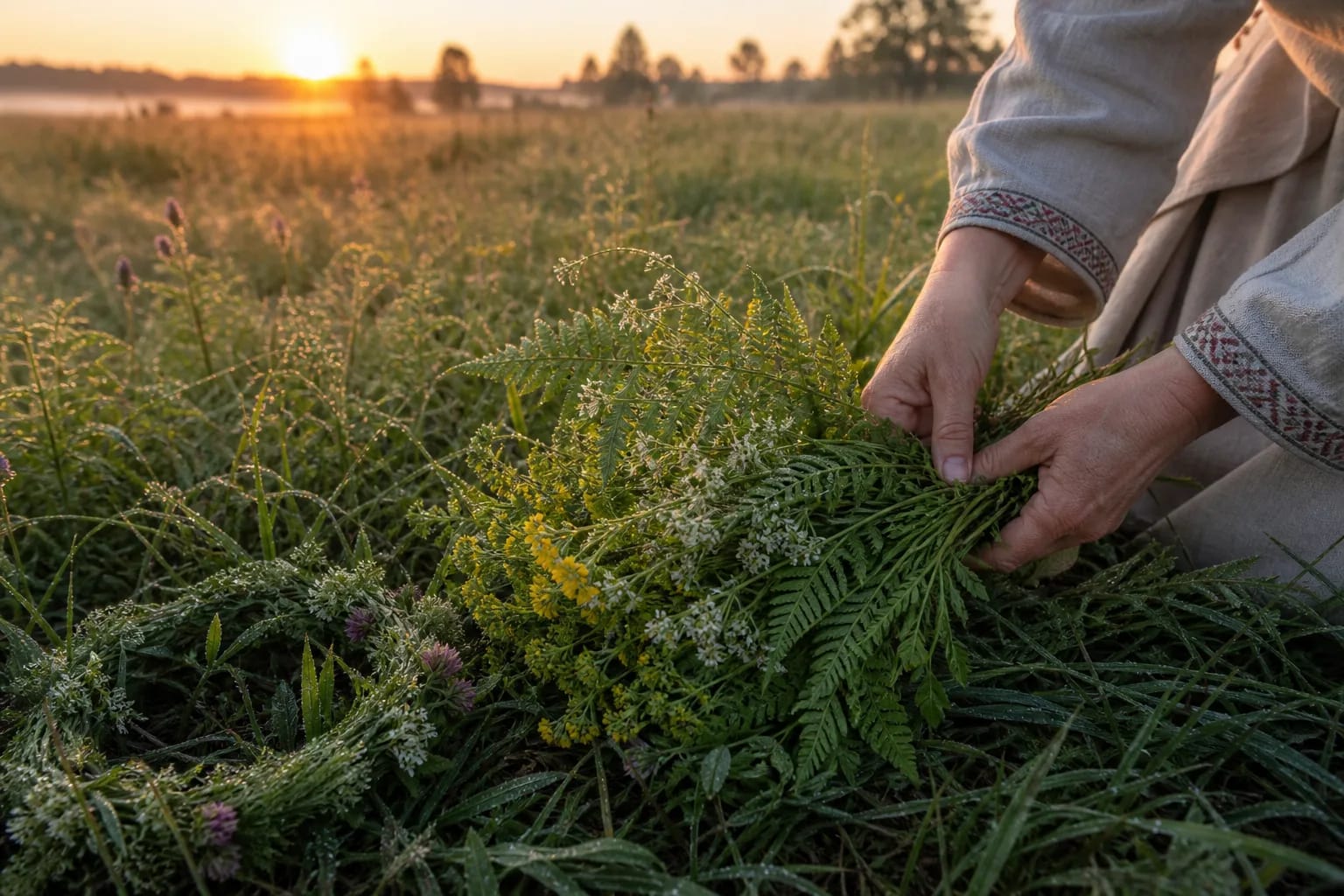
For a contemporary person, kupoliavimas is a simple way to slow down. Gathering plants requires looking, touching, noticing scent, color, and place, turning the feast from abstract history into bodily experience.
Wreaths, Bonfires, and Dew
The wreath joins a person with summer greenery. It is woven from what blooms nearby, so every wreath becomes a sign of place and time. Floating it on water is connected with divination and with sending a night wish into a river or lake.
The bonfire symbolizes sun, light, and the center of community. Dew is different: quiet and morning. Washing in dew shows that the feast ends not with noise but with waiting for dawn, when a person meets light again.
Main Rasos customs and meanings
Rasos customs explain why this night is special. They are tied to nature's fullness, personal renewal, community bonds, and the crossing from the longest day into the half of the year when the sun begins to shorten.
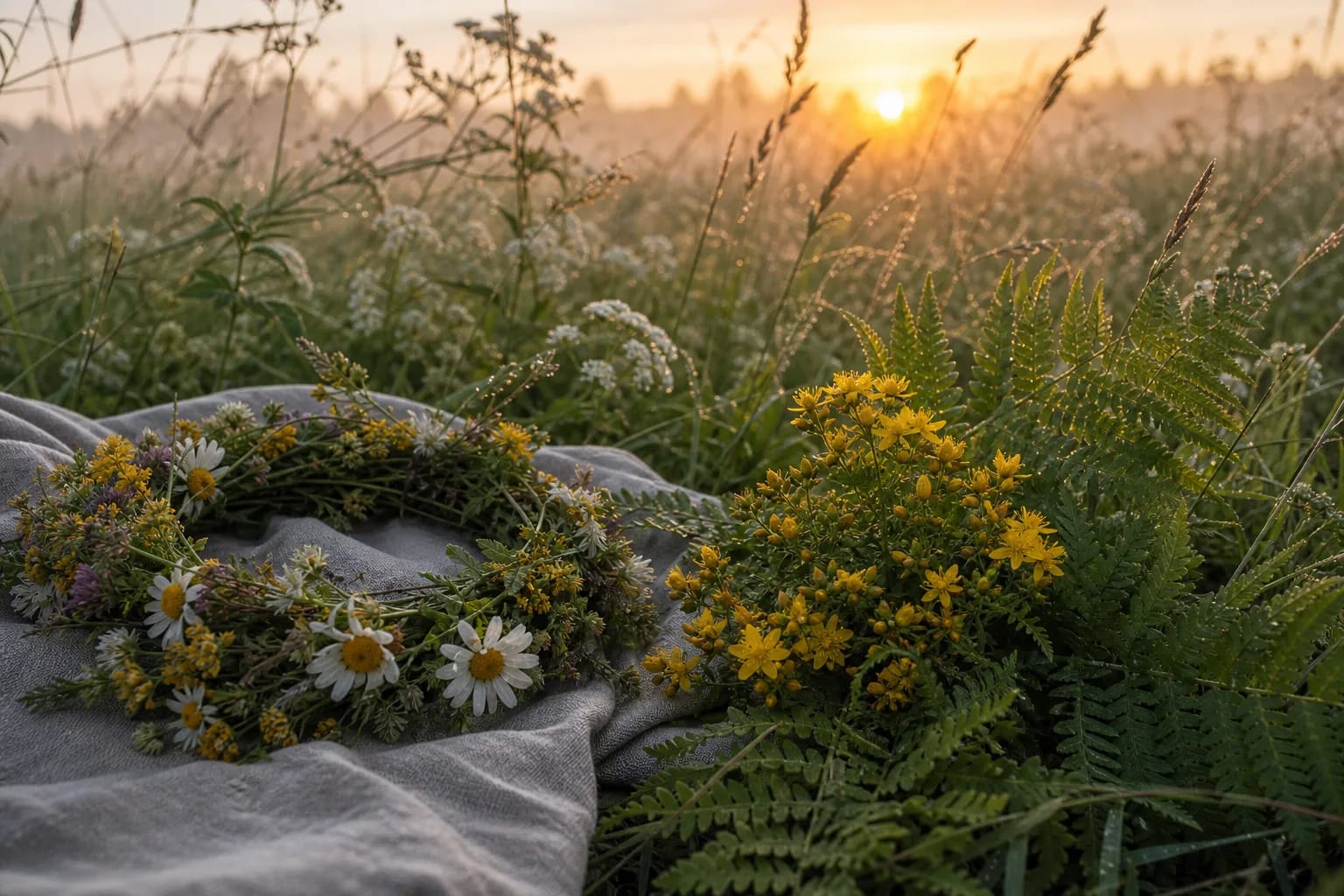
Kupoliavimas: gathering wildflowers, medicinal herbs, and other plants before or during the feast, when solstice plants were believed to hold the greatest life force.
Wreath weaving from gathered herbs. Girls sometimes wove wreaths from nine different plants; the wreath marks the summer circle and festive participation.
Floating wreaths on water. A river or lake becomes a symbolic boundary, and the drifting wreath is tied to divinations about fate, love, or the future.
Ritual gates and entry into the festive space. Gates mark the crossing from everyday life into feast time.
Bonfire and staying by the fire. Fire is linked with the sun, light, cleansing, and the center of community.
Songs, sutartines, circle dances, and night dancing. Repeated rhythm, shared voice, and circular movement matter in Rasos.
Searching for the fern flower. This is a mythic search for happiness, knowledge, and inner light, not a botanical claim.
Washing in morning dew and greeting the sun. Dawn completes the night rites and recalls health, beauty, and renewal.
Where to experience it
Where to experience Rasos in Lithuania?
Rasos is strongest where there is nature, water, hillforts, live folklore, and the possibility to participate rather than only watch a concert.
Kernave
One of the most important Rasos places in Lithuania, with hillforts, Pajauta Valley, the Neris, and a long ritual tradition.
Rumsiskes
The Lithuanian Ethnography Museum suits families and visitors who want clearly presented customs, folklore, crafts, and traditional surroundings.
Urban Ethnoculture Centers
In Vilnius, Kaunas, and other cities, look beyond concerts for wreath-weaving, kupoliavimas, circles, and singing.
Hillforts, Rivers, and Lakes
Smaller community Rasos by water are often more intimate than large events and make participation easier.
Rasos: songs, sutartines, and related pages
Rasos is inseparable from kupolines songs, sutartines, circle dances, and chanting. Songs keep the slow rhythm of the feast from herb gathering to sunrise.
Rasos: frequently asked questions
Are Rasos and Jonines the same?
They are celebrated at the same time and share many customs. Rasos stresses the older solstice, dew, and herb layer; Jonines is tied to St John's Day and name-day tradition.
When is Rasos celebrated in Lithuania?
Most often on the evening of June 23 and the night into June 24. The key time is from sunset to sunrise.
What are the main Rasos customs?
Kupoliavimas, wreath weaving, bonfires, singing, circle dances, floating wreaths, searching for the fern flower, and washing in morning dew.
What is kupoliavimas?
Kupoliavimas is gathering herbs. At Rasos the plants are considered special because nature is at summer fullness.
Why are wreaths floated on water during Rasos?
Floating a wreath is one of the best-known Rasos acts. Traditionally it was linked with love or future divinations, and today it is also a festive wish and bond with water.
What does the fern flower mean?
The fern flower is a mythic symbol. Ferns do not bloom, so the search speaks about happiness, inner light, knowledge, and mystery.
Where is the best place to celebrate Rasos?
Kernave is among the best-known places. Also look for Rumsiskes, ethnoculture centers, town communities, and local folklore groups near rivers, lakes, or hillforts.
What should visitors bring to Rasos?
Warm clothing for the night, comfortable shoes, a blanket, water, mosquito protection, a flashlight, and herbs gathered locally or brought for a wreath.
Why are Kernave Rasos important?
Rasos in Kernave were revived in 1967 according to reconstructed Baltic customs, helped grow the Lithuanian folklore movement, and are listed in the intangible heritage register.