- Place
- Priekulė, Klaipėda District Municipality
- Region
- Lithuania Minor
- Type
- historic railway station building complex
- Address
- Geležinkelio Stoties Street, Priekulė, Klaipėda District
- Coordinates
- 55.56092, 21.30648
Priekulė railway station building complex
Priekulė Railway Station on the Klaipėda-Tilsit line
Priekulė Railway Station is one of the clearest ways to see how Lithuania Minor was connected by infrastructure. The town stands on the Minija, southeast of Klaipėda, and was crossed by the Klaipėda-Tilsit-Königsberg railway, which in the second half of the nineteenth century changed the links, trade, and movement between towns.
The Cultural Heritage Register protects not only the station building but the whole building complex (code 33207), listed as an object of local significance and architecturally typical. That matters because the railway functioned as a system: the station, water tower, warehouse, railway workers' houses, and service buildings formed one everyday working infrastructure.
The 1875 line and the station on manor land
The Klaipėda-Tilsit-Königsberg railway was laid in the second half of the nineteenth century, and in 1875 a station with its full infrastructure was built in Priekulė. According to the Register, it rose on the land of the Priekulė manor owner John George Gleich, so the station's origin is closely tied to the local manor's history.
Priekulė station was not accidental: it was one of the intermediate links between the port of Klaipėda, the border area, and East Prussian towns. In front of the station the landowner Sperber planted a wood of silver spruces, so from the very start the railway node also had a landscaped setting.
The red-brick station building complex
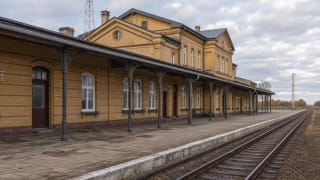
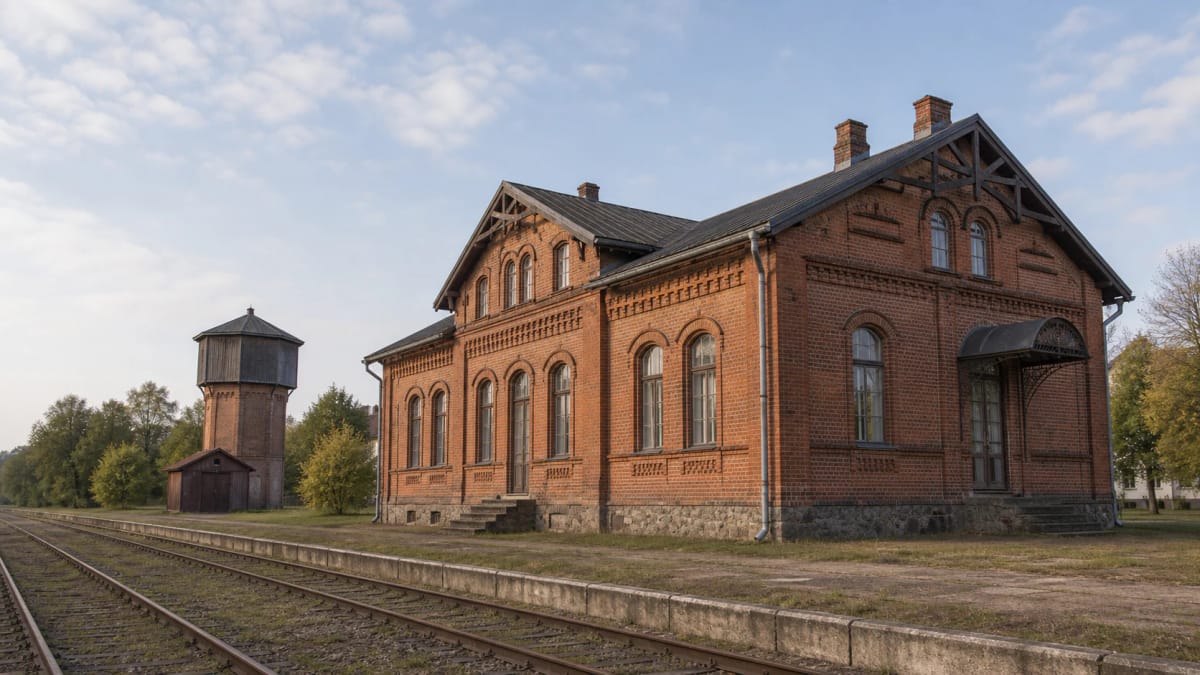
Within the complex the Register singles out seven valuable structures: the station building, the first and second railway workers' houses, the water tower with its annex, the warehouse, and the western and eastern service buildings. A field-stone pavement survives at the entrance and is also protected as part of the complex.
The buildings are red-brick, in the historicist and so-called brick style typical of East Prussian railway architecture. When visiting, look at the rhythm of the facades, the window openings, roof lines, and track perspective, because these details create the character of railway architecture.
What the railway node in Priekulė shows
The complex lets the place be read not only as a handsome old building but as a node of travel, post, goods, and daily work. The ground floor of the station had a passenger waiting hall with a buffet beside it, while the water tower and warehouse show that locomotives and freight were serviced here.
The railway workers' houses are a reminder that the staff who maintained the station lived beside it. Such details restore the human scale: people waited for trains, arranged business, loaded belongings, and kept the town connected with the wider Klaipėda region and East Prussia.
How to view Priekulė station
The station is not a classic museum, so a visit is mostly an exterior and setting walk. Be careful around the tracks and stay in public areas, because the railway infrastructure is still in use - lines run through Priekulė to Klaipėda and Pagėgiai.
Priekulė Railway Station is worth combining with the town's museums and St. Anthony of Padua Church. Together they show Priekulė as a place of transport, religion, literature, and political history - after all, the writer Ieva Simonaitytė was born here.