- Place
- Priekulė, Klaipėda District Municipality
- Region
- Lithuania Minor
- Type
- active Evangelical Lutheran church and heritage property of regional significance
- Address
- 8 Pamarių Street, Priekulė
- Coordinates
- 55.55254, 21.31729
- Visit duration
- 15-30 minutes for the exterior; 30-60 minutes if the interior is open or you attend worship
- Best time
- in daylight for the architecture, or at a service whose time you have checked in advance
Priekulė Lutheran Church, Priekulė Evangelical Church, Priekulė Evangelical Lutheran parish
A church created from the 1903 parish house
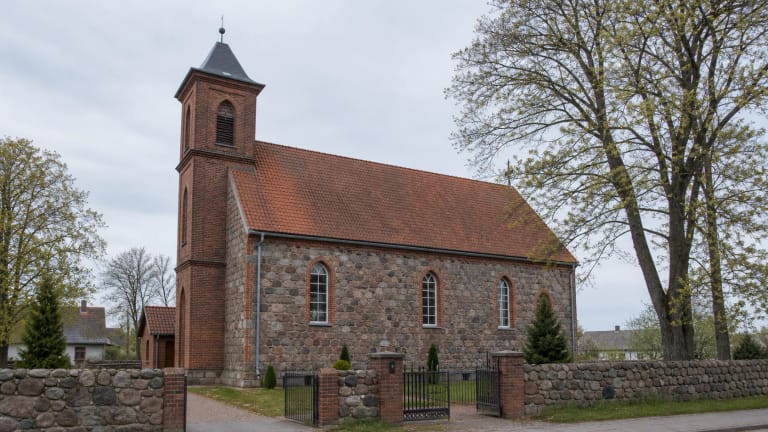
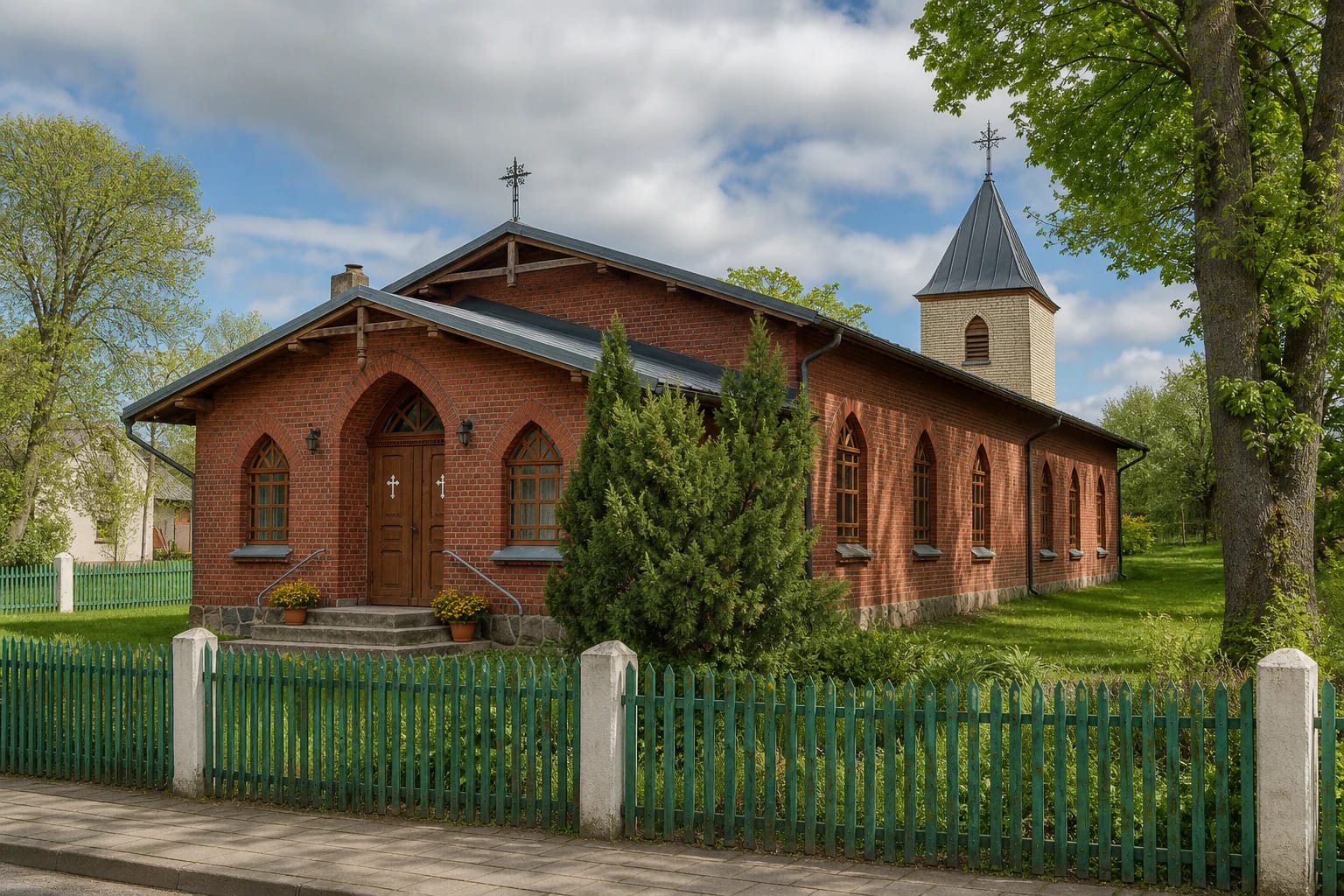
The church seen on Pamarių Street is not a remnant of Priekulė's old church. It is the parish house built and consecrated in 1903, where confirmation candidates were taught and congregational activities took place before the Second World War. Services were also held here during the coldest winter weather. After the war, the building became the parish's permanent church.
Its long, single-storey red-brick body, low gabled roof, and pointed door and window openings reflect the East Prussian masonry tradition of the late nineteenth and early twentieth centuries. The pale-brick bell tower at the west end was added only in 1956-1957. It holds two bells transferred from the closed church at Kairiai, while a metal cross characteristic of Lutheran places of worship in the Klaipėda Region crowns the roof.
The building is entered in the Cultural Heritage Register under unique code 31053 as a property of regional significance. Its importance comes not from monumental scale but from authentic materials, restrained architecture, and the congregation's uninterrupted bond with the site.
The parish and the lost church of 1697
VLE dates the founding of the Priekulė parish to 1587, but the official parish history stresses that the date of independence is not conclusively settled and that sources cite 1587, 1628, and 1635. An even earlier pre-Reformation chapel is presented as a possibility, not as a securely documented starting point for the present parish.
Construction of the old masonry church began in 1688, and it was completed and consecrated in 1697. At first it was a towerless sanctuary about 37 metres long and 17 metres wide, with tall windows. An 18-stop organ was installed in 1821, while a reconstruction completed around 1885 added a clock tower approximately 40 metres high.
The old church burned during fighting in October 1944. Its surviving ruins were demolished after the war, but official sources disagree on the date: the parish history gives 1954, while the Klaipėda District audio guide says March 1957. Since 1992, the nearby site has been marked by a symbolic altar and memorial inscription designed by architects Marija and Martynas Purvinas.
A congregation that defended its right to worship
After the war, the parishioners who remained moved into the former parish house, and the Soviet authorities registered the congregation in 1948. When the local government attempted to take the building in 1953, the parish went to court and won. This episode explains why the modest 1903 structure matters to Priekulė as more than an architectural object.
The church remained an active place of worship at a time when many Lutheran congregations in the Klaipėda Region lost their buildings. Catholic services were also held here before Priekulė had a Catholic church of its own. The bell tower built in 1956-1957 finally gave the former parish house a clearly recognisable church silhouette.
A restrained interior and the 2018-2020 renewal
Inside, white walls, exposed light-painted roof timbers, wooden pews, altar, and pulpit create an unadorned Lutheran space. The building retains a dual purpose: worship takes place in one part, while the other contains a spacious community hall used for fellowship meals and gatherings after services.
The parish began planning the renewal in 2018, and by 2020 the work was largely complete. The roof coverings of the church and tower were replaced, the interior was renewed, and underfloor heating was installed. The official 2020 account still described a ramp beside the entrance steps as planned work, so it does not confirm present step-free access.
Planning a visit in Priekulė
On 14 July 2026, the official parish page listed Sunday worship at 11 am. This is an active congregation rather than a museum with daily opening hours, so check the latest schedule or contact the parish on its published number, +370 656 56374, before travelling. The exterior is visible independently from the street, but an open churchyard gate and access to the interior cannot be guaranteed.
No separate visitor ticket or permanent sightseeing hours are published. The most reliable ways to see the interior are during worship, at a parish event, or by prior arrangement; seek permission before taking photographs during a service. Contact the parish in advance about mobility needs as well, since no current public confirmation of a ramp or accessible toilet was found.
A short walking route can include the site of the old Lutheran church, Priekulė Church of Saint Anthony of Padua, and the Ieva Simonaitytė Memorial Museum. The railway station adds another expressive layer of East Prussian-era architecture.