- Place
- Plikiai, Klaipėda District Municipality
- Region
- Klaipėda District
- Type
- Evangelical Lutheran church and parish building complex
- Address
- Klaipėdos g. 6, Plikiai
- Coordinates
- 55.78797, 21.28274
Plikiai Lutheran Church, Plikiai Evangelical Lutheran church building complex
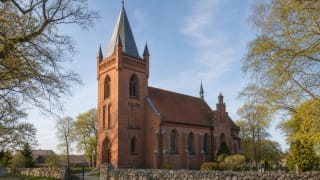
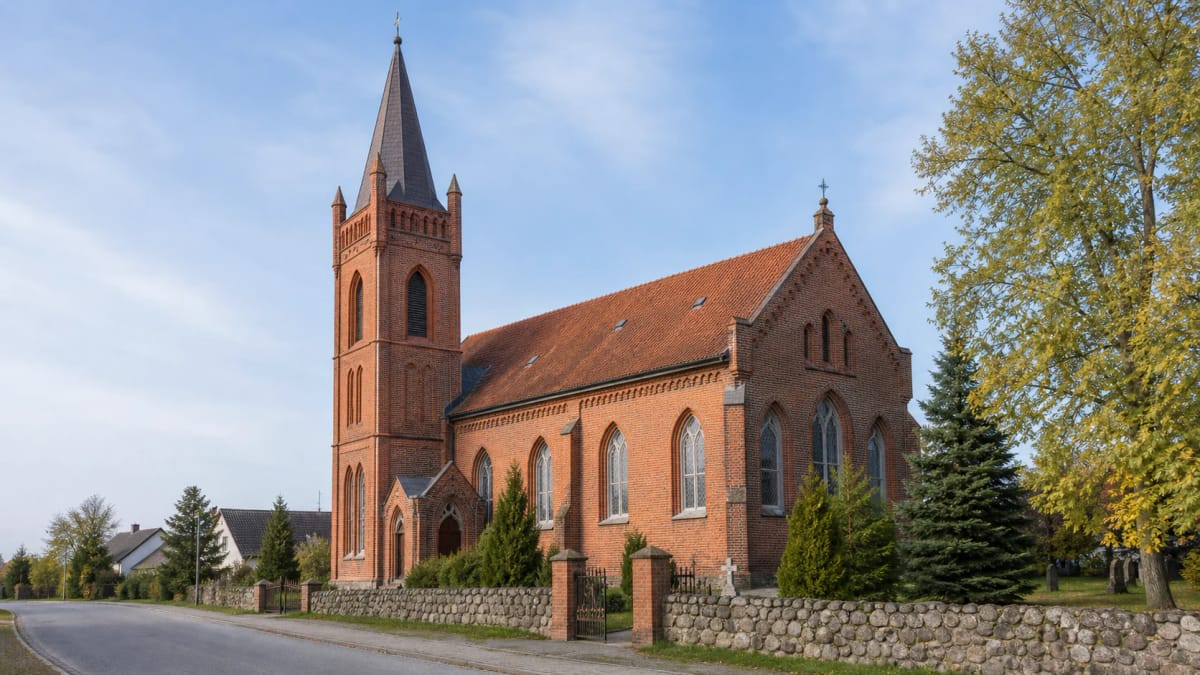
The Plikiai red-brick neo-Gothic church and its building complex
Plikiai Evangelical Lutheran Church stands by the Klaipėda-Jokūbavas road, in the Kretingalė eldership of Klaipėda District. It is easy to miss when driving past, but worth a stop for its red-brick neo-Gothic architecture and the history of Lithuania Minor parishes.
In the Cultural Heritage Register the church (code 16030) is a state-protected object of regional significance and part of the Plikiai Evangelical Lutheran church building complex (code 23587), in which the parish-school building is also important. The Register calls its architectural value "rare" as a factor determining significance - this is a less common example of a masonry Lutheran church in the Klaipėda region.
The 1891 community and the 1896 construction
The settlement by the small Eketė, a tributary of the Danė, has been known since the early eighteenth century. According to the history by Albertas Juška published by the Evangelical Lutheran Church of Lithuania, an independent Lutheran community was founded here in 1891; it comprised as many as 25 villages (Baugštininkai, Eglynai, Grauminė, Radailiai, Vytaučiai, and others) that had previously belonged to the Kretingalė and Klaipėda smallholder parishes.
The first pastor, Feliksas Žemaitaitis (whose name suggests origins in Greater Lithuania), served the community for 37 years - until his death in 1928 - and it was through his efforts that work began on the parsonage and the church. The neo-Gothic, single-tower, red-brick sanctuary rose in 1896 (the Register: built in 1896; VLE notes it was consecrated in 1896).
Tower, two naves, and interior
According to Register data, this is a church of asymmetrical, composite volume: a rectangular-plan main body, a square-plan three-tier bell tower at the north-west corner (set slightly to the left), a lower three-sided apse to the east, and a sacristy by the apse. This tower placement gives the facade not strict symmetry but a livelier small-town composition. The roofs are gabled, the foundation has a hewn field-stone plinth, and the walls are of ceramic brick.
The interior has two naves; the central and side naves are divided by a two-tier plastered-brick arcade supported on two square pillars. In the west part, above the narthex, is an organ-choir balcony with a wooden railing on wooden pillars. On the wall are plaques listing parishioners who died in the First World War, along with a surviving 1896 wooden altar with a mensa (about 3.9 m tall), a separate pulpit on the right, and an organ case; the church had two bells.
The parish school and community history
The Plikiai parish school was built immediately after the church's consecration and even entered the history books: in 1898 it was inspected by the Prussian minister of religious affairs Robert Bosse, who was investigating how the introduction of German was being enforced in schools attended by Lithuanian children. In Plikiai the parishioners dared to ask that at least religion be taught to their children in their mother tongue.
In the early twentieth century the Plikiai parish had about 2,700 people, roughly three quarters of them Lithuanian-speakers. Lithuanian identity was cultivated here: the cultural society "Beržas" was founded in 1912 and "Jaunųjų sandora" in 1923, and the Singers' Society choir took part in the 1927 Lithuania Minor and the 1928 Second Lithuania song festivals.
War, the Soviet era, and visiting
In the winter of 1944 Plikiai was taken by the Lithuanian 16th Division, and the front line paused here before the decisive assault on Klaipėda. New settlers found the church intact - only the parsonage had burned. Sadly, the Soviet destruction-battalion men (stribai) based in the parish school honed their aim by shooting at the church windows, doors, and cross, and once inside they broke the altar and bayoneted the organ. Even so, services never stopped; the postwar parish was officially registered on 28 September 1948, and since 1976 the pastor here has been Liudvikas Fetingis.
In 1991 the centenary of the parish's founding was solemnly marked. Today the Plikiai community is small (about 120 people). There are no public tourist hours, so the exterior can be viewed independently from public space, while the interior is best arranged with the parish. Plikiai church combines well with the Vanagai sanctuary, Karklė, Kretingalė, and Klaipėda Old Town.