- Place
- Vanagai, Klaipėda District Municipality
- Region
- Klaipėda District
- Type
- Evangelical Lutheran church and protected building complex
- Address
- Ievos Simonaitytės g. 44, Vanagai
- Coordinates
- 55.55951, 21.42191
Vanagai Lutheran Church, Vanagai Evangelical Lutheran church building complex
Vanagai church in the landscape of Lithuania Minor
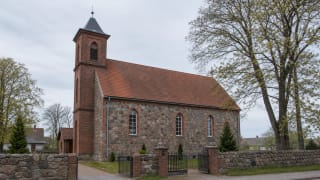
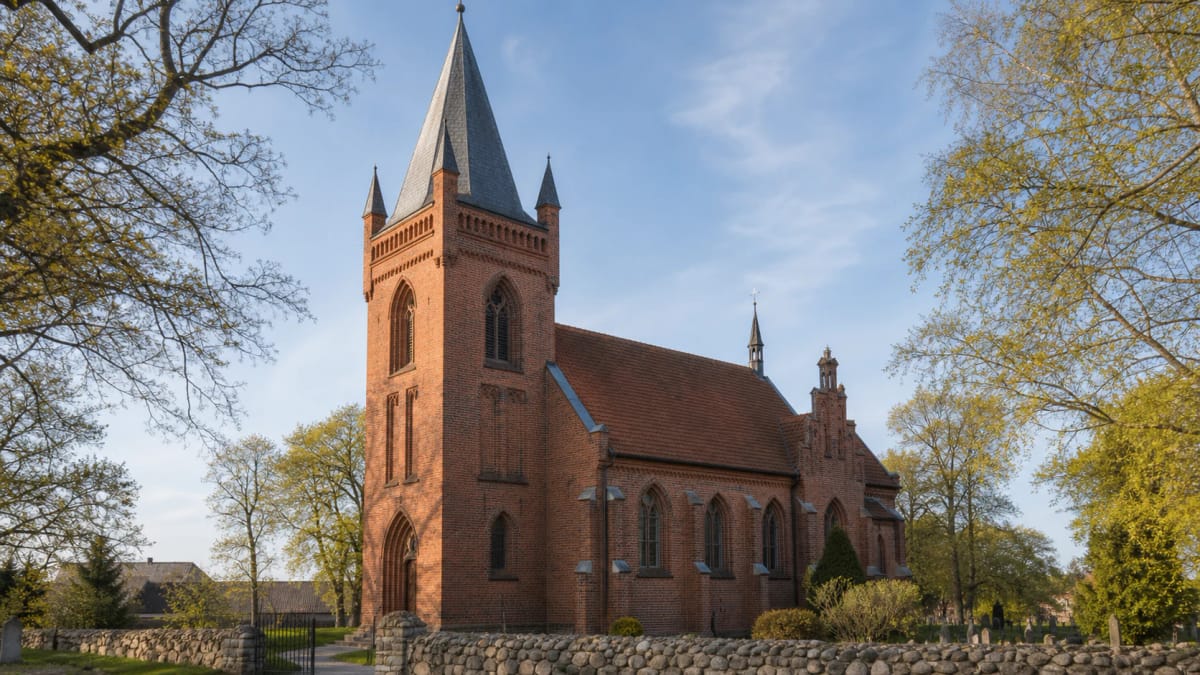
Vanagai Evangelical Lutheran Church stands in Klaipėda District, in Vanagai village of the Agluonėnai eldership, where Lutheran heritage is not a museum backdrop but part of local identity. The red-brick sanctuary, with its tower and massive cross, is visible far across the Pamarys lowland and looks especially fine against a background of green pine forests.
In the Cultural Heritage Register the church (code 15978) is a state-protected object of regional significance and part of the Vanagai Evangelical Lutheran church building complex. What is valuable is not only the worship space itself but also the broader sacral setting, with the ethnographic Vanagai cemetery beside it.
From a Priekulė district to a parish (1890-1905)
According to the history by Albertas Juška published by the Evangelical Lutheran Church of Lithuania, in 1890 fourteen north-eastern villages of the Priekulė parish (Agluonėnai, Aisėnai, Dėgliai, Poškos, Stankaičiai, Vanagai, and others) were joined into a separate Vanagai spiritual district. Martin Mehlhorn was appointed its temporary pastor in 1901 and at first held services in a primary school opened in the house of the landowner Gložaitis.
When a separate two-class folk-school building was put up in 1901-1902, the services moved there. In 1905 the Vanagai community was granted parish rights, and the young, energetic pastor Emil Bleiweiss arrived, building a parsonage with a hall for confirmation classes in 1906.
The 1907-1909 construction: architect Tamošaitis and the Kaiser's support
The church was designed by the Ragainė master Tamošaitis (Tomascheit), who seems also to have directed the construction in person. The cornerstone was laid in the summer of 1907 in the presence of the bishop. The building was supported by the Consistory (2,600 marks), East Prussian parishes (2,725), the parishioners themselves (9,000), the Synod and Church Council (25,000), and - the largest sum, 28,660 marks - by the Kaiser; the local people also pledged to haul 380 m3 of stone. The consecration took place on 21 February 1909, with two services, German and Lithuanian.
According to Register data, this is a hall-type church of rectangular, asymmetrical composition, with a tower, apse, and sacristy; the walls are ceramic-brick masonry with buttresses, a cylindrical brick vault rises over the nave, and the gable roof is clad in clay tiles. The building has pronounced neo-Gothic, Art Nouveau, and even rationalist features, so it is not just a standard village church in a historicist style. It was restored in 1999 (restoration project by architect P. Ramonas).
The interior and Ieva Simonaitytė's church
The church has two naves and vaulted wooden ceilings; the altar and pulpit are separate, the pulpit on the left. Official descriptions mention 1909 painting, the stained-glass windows "St Peter" and "St Paul" (the Register links them to Robert Siebert of Königsberg), and a 1908 Voelkner organ. It was this very church that the writer Ieva Simonaitytė, who grew up here, described vividly in her memoirs - the stained glass with the apostles Peter and Paul remained her strongest childhood impression, and a folk legend held that they had been donated by Empress Augusta herself.
The tie to the writer is no accident: the street by the church is named after Ieva Simonaitytė, and in 1977 she herself found a master and funded the repair of the old organ. In the adjacent parish cemetery lie the community's pastors - the India missionary Kristupas Lokys and Jurgis Sprogys - and in 1970, at Simonaitytė's initiative, the remains of the first pastor, Emil Bleiweiss, were brought here too.
The Soviet era and visiting
The war spared the remote Vanagai parish - returning people found their homes almost untouched, and services in the church resumed as early as 1945. The postwar parish was officially registered on 3 August 1948 and had about 750 members, but deportations and emigration greatly reduced it. In 1959 the church's fiftieth anniversary was solemnly marked. Today it is an active Vanagai parish (about 200 people), with services led by pastor Remigijus Šemeklis.
There are no regular tourist hours, so the exterior can be seen independently, while interior access is best arranged through the parish. The church is easy to combine with Agluonėnai, Dovilai, and Priekulė - a single trip that reveals the whole cultural network of Lithuania Minor in Klaipėda District.