- Place
- Klaipėda District Municipality
- Region
- Seaside Regional Park
- Type
- relict coastal lake in a nature reserve
- Address
- near Karklė, Seaside Regional Park, Klaipėda District
- Coordinates
- 55.83500, 21.06860
Plocis Lake, Plazė, Plocis
Plazė Lake: Lithuania's lake closest to the sea
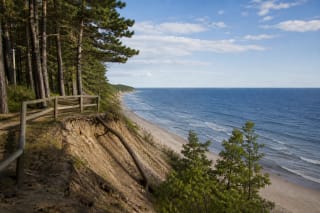
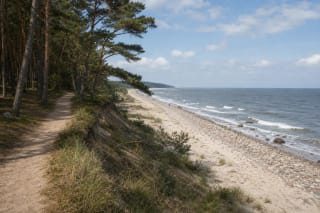
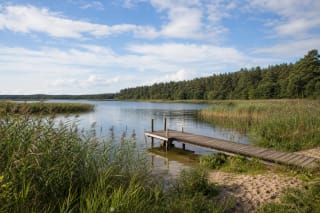
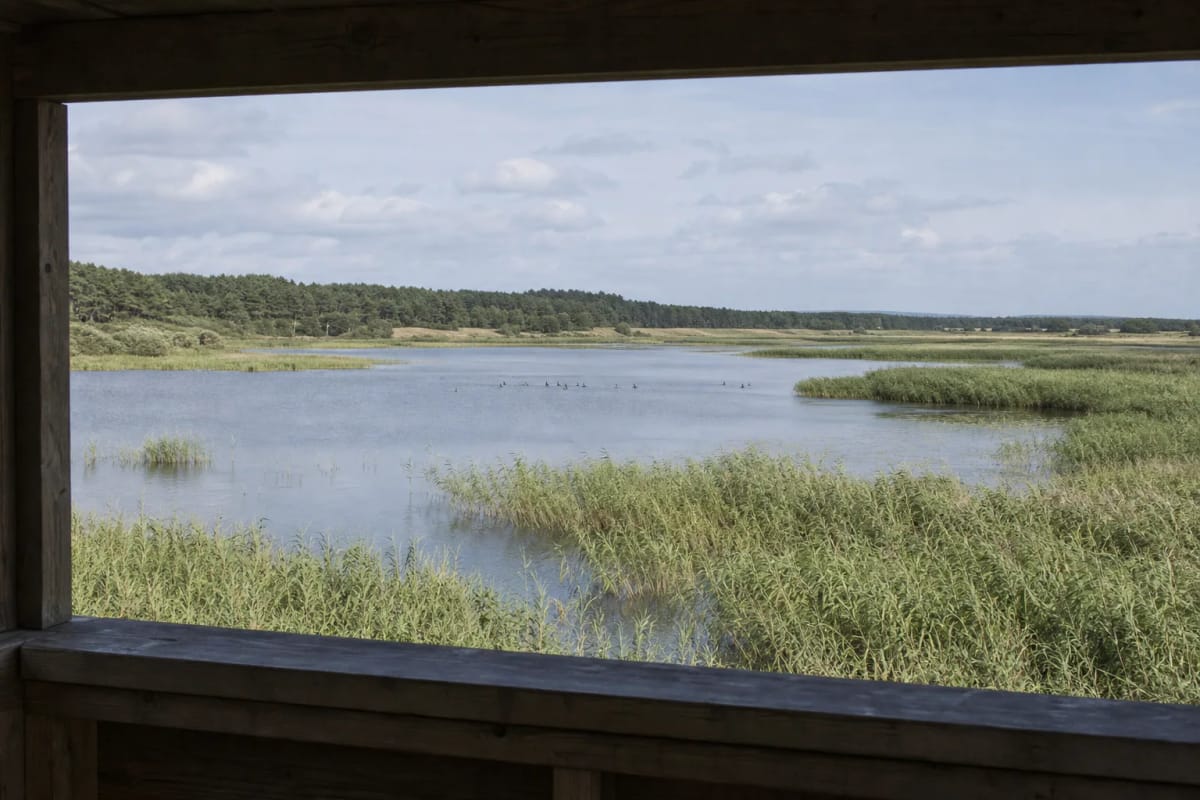
Plazė, officially Plocis, Lake near Karklė is Lithuania's lake closest to the Baltic Sea: only a few hundred metres separate it from the shore. It is a shallow, slowly overgrowing relict lake set between seaside forest and wetlands in Seaside Regional Park.
The place is special not for swimming or fishing, but for nature. The lake and its surroundings are protected as a strict nature reserve, so visitors cannot go to the water itself. Its life, especially abundant birds, can be watched only from a special observation shelter on the shore.
A relict coastal lake
Plazė Lake formed about 10 thousand years ago on the terrace of the former Baltic Ice Lake and is considered Lithuania's closest glacial-origin lake to the present sea. It is a non-outflow, relict water body left behind a coastal ridge and gradually growing over.
The lake is very shallow, with average depth about 70 cm, while its area is given differently in sources, roughly from 3 to 6 ha. The shores are marshy, covered with black alder and wet forest. On a clear day, the sea can be glimpsed on the horizon from the shore.
Plocis Nature Reserve: strict protection
The lake lies at the heart of Plocis (Plazė) Nature Reserve. This strict state nature reserve was established in 1997, covers about 228 ha, and extends along the coast between Karklė and Nemirseta. It is part of the larger Seaside Regional Park.
It protects rare coastal flora and birds. In black alder stands on the shore, a great cormorant colony with more than a thousand nests breeds, and in spring and autumn the lake becomes an important stop for migratory waterbirds. Because of this protection, access to the lake itself is forbidden.
The birdwatching shelter
The only way to see the lake is from the birdwatching shelter on its shore. It has mounted binoculars, and the roof protects observers even in rain. Reach it on foot or by bicycle along the paved Karklė-Nemirseta path, about 3 km from the nearest parking area.
The best time is spring or autumn migration, when bird numbers are highest. Watching is free, but do not leave the path or try to approach the water, as that would violate the reserve protection.
Name and how to visit
The lake has two names: the older, Germanized Plazė and the Curonian name Plocis, restored by the State Commission of the Lithuanian Language in 2013 from the word meaning 'flat'. Both names are used, so Plocis (Plazė) Lake is common.
Do not confuse Plazė Lake with Lake Plateliai in Žemaitija National Park: that is a completely different, large and deep lake. A visit to the observation shelter combines well with Olando Kepurė, Karklė coast, and Kalotė Lake, all within one Seaside Regional Park.