- Place
- Kaunas City Municipality
- Region
- Kaunas
- Type
- interwar sport, education, and state physical-culture centre
- Address
- Sporto g. 6, Kaunas
- Coordinates
- 54.89833, 23.93457
Kuno kulturos rumai, Lithuanian Sports University central building, LSU central building, Kaunas Azuolynas sports complex physical culture palace
A building for the state sport project
The Physical Education Palace at Sporto g. 6 is not ordinary university administration. VLE defines the Kūno kultūros rūmai as the first state sports institution in Lithuania, active in Kaunas in 1932-1940. The building was the material centre of that idea: physical culture was understood here as a question of education, army preparation, hygiene, and state modernization.
Today the palace is the central building of Lithuanian Sports University. LSU contacts list Sporto g. 6, and the VLE article on Lithuanian Sports University directly connects the central building with Vytautas Landsbergis-Žemkalnis's 1934 architecture. This is a rare continuity: the building is still used according to a logic very close to its original purpose.
Why here, by Azuolynas
AUTC explains that the initial idea to build the Physical Education Palace formed as early as 1926/27 in the Sport League central committee, then re-emerged in 1930. Another location was considered, but the area by Azuolynas was chosen because it was close to the centre while being away from dust and city noise.
The place was not an empty field without sporting memory. AUTC states that before the palace, the Lithuanian Physical Education Union stadium and Tennis Club courts already operated here. The palace became the first substantial building of the Azuolynas sports complex, later joined by the sports ground and Kaunas Sports Hall.
Construction in 1932-1934
AUTC dates the palace to 1932-1934. The final project was prepared in 1933, and the first construction stage was finished in 1934. The register also states that the building was built in 1934 and names architect Vytautas Landsbergis-Žemkalnis as the author.
Construction was not a single, completely finished event. AUTC and the register mention an expansion in 1939, when a second floor was added above the side auditorium wings. Later came a swimming pool, additional floors, and an auditorium-laboratory extension. Today it is important to distinguish the interwar core from later university expansion layers.
What the palace was for
AUTC quotes the original function: the palace was to train future school physical-education teachers, army instructors, and those who wanted the right to teach physical education. VLE adds that the Kūno kultūros rūmai prepared physical-culture programmes for schools, organized courses for teachers and instructors, and led the work of sports organizations.
The palace was also planned for the wider public. AUTC mentions popular lectures on physical education and sport, the possibility for organizations to use the premises, a planned anthropometry and treatment department with the Medical Faculty, and even a sunbathing terrace. This is the language of interwar modernity: health, discipline, science, and sport joined into one state programme.
Classicism and modernity in one building
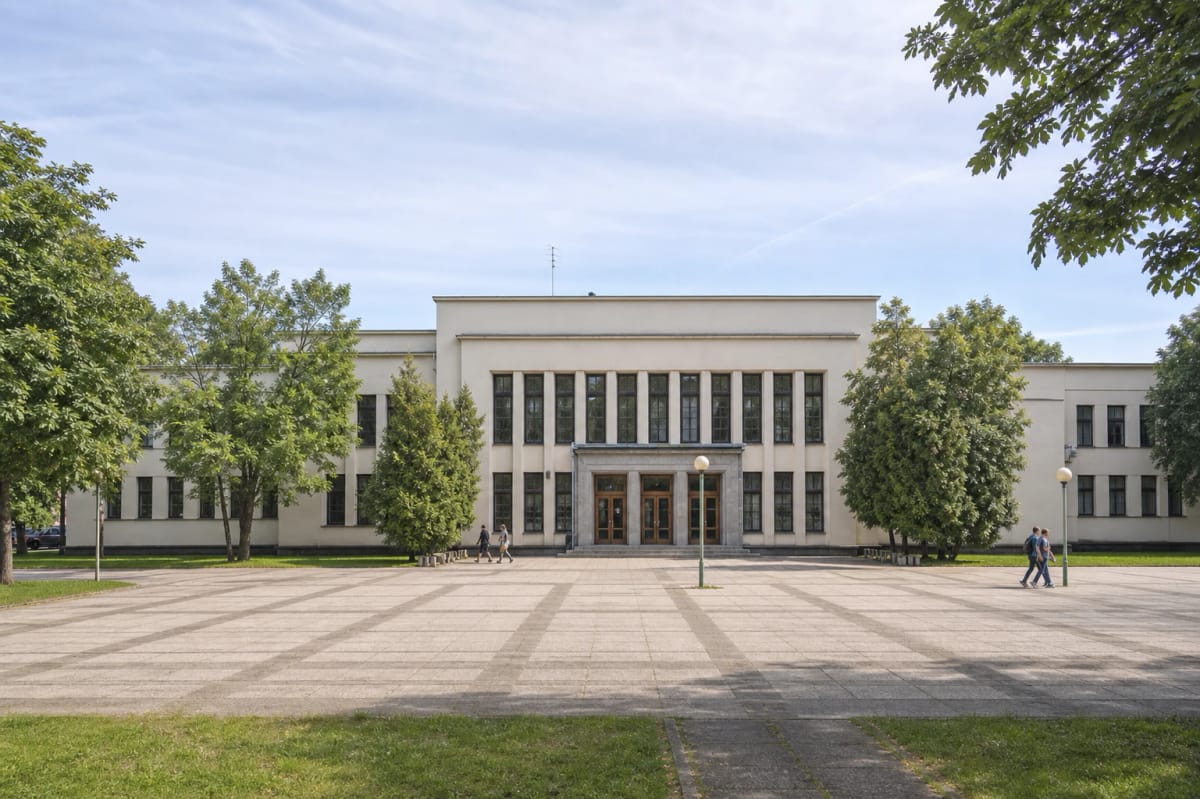
At first glance the facade is restrained: a low horizontal volume, symmetry, smooth plaster, rhythmic rectangular windows, and a central portal with three recessed entrance openings. On the north facade, the register records a shallow projection, rusticated-render portal, parapets, cornices, and smooth plaster type.
AUTC gives an important thought from Landsbergis-Žemkalnis: in designing the palace he wanted to connect the classical origins of physical culture, associated with Greece, with modern times. The building is therefore not a purely rationalist box. It has the discipline of classical rhythm, simplified and placed inside the logic of a modern sports institution.
Sports hall and roof structure
The real value of the building is not only the facade. The register's valuable-features description identifies the sports hall in the central part, two gymnastic halls, and staircases on the eastern and western sides. At second-floor level, the hall is encircled by a reinforced-concrete gallery with plastered parapets.
AUTC highlights one of the most modern solutions: the sports hall's semi-cylindrical reinforced-concrete frame roof slabs with overhead lighting. The register today protects the logic of exposed arched metal beams and skylight. This was a building where sports-space technology was as important as the representative entrance.
Interior details
The register mentions a reinforced-concrete coffered lobby ceiling, profiled mosaic-concrete stair steps, openwork metal railings, wooden handrails, three wooden double glazed north-entrance doors with transoms, and a wooden glazed lobby partition.
The interior also preserves memorial signs: a plaque for the first Lithuanian National Olympics on the north facade, a bronze plaque to Vytautas Augustauskas in the lobby, and marble plaques to sports figures and European basketball champions who trained in the hall. These make the building not only architecture, but also a place of sports memory.
Higher Courses of Physical Culture and LSU continuity
The VLE article on Lithuanian Sports University identifies the Higher Courses of Physical Culture, established in 1934, as the university's origin. In 1945 the Lithuanian State Institute of Physical Culture was founded; it later became the Lithuanian Institute of Physical Culture, the Lithuanian Academy of Physical Education, and from 2012 Lithuanian Sports University.
This sequence matters for visitors because it explains name confusion. Physical Education Palace is the interwar name used in the AUTC entry; Kūno kultūros rūmai is the name seen in VLE and the register tradition; LSU central building is the current practical identifier.
Cultural heritage status
In the Cultural Heritage Register the object is called the physical culture palace of the Kaunas Azuolynas sports buildings complex. Its unique code is 1149, and the parent complex, Kaunas Azuolynas sports buildings complex, has code 31618. The significance level is listed as national, and valuable features include architectural, historical, and memorial character.
The register's status wording is specific: initiated to be declared state protected. The page should therefore use the exact register language rather than simplifying it to say that the building simply is state protected.
UNESCO modernism context
The Physical Education Palace is part of the Kaunas modernism story, closely tied to the development of the Azuolynas sports complex. The UNESCO World Heritage property Modernist Kaunas: Architecture of Optimism, 1919-1939 speaks about the temporary capital's rapid urbanization and local expression of modern architecture.
The most accurate wording is that the palace is part of the Modernist Kaunas context and the Azuolynas sports buildings complex, but the individual building should not be called a separately inscribed UNESCO site. Its value in the story is modern state sports infrastructure, not merely a beautiful facade.
How to view it
The best first view is from Sporto Street, opposite the central portal. From there you can see the symmetry, three recessed entrance openings, rhythmic windows, and long horizontal block. Then walk to the sides to feel how the building fits into the Azuolynas sports zone.
This is an active university building, not a museum with regular visiting hours. The register's visitor-information fields are empty, so travellers should most reliably plan an exterior visit. Interior access depends on LSU activities, events, or separately arranged possibilities.