- Place
- Nida, Neringa Municipality
- Region
- Neringa
- Type
- Roman Catholic church
- Address
- Taikos g. 17, Nida
- Coordinates
- 55.30237, 21.00218
Nida Catholic Church, Nidos katalikų bažnyčia, Nida Church of the Blessed Virgin Mary Help of Christians
Nida's Catholic church - the first on the Curonian Spit
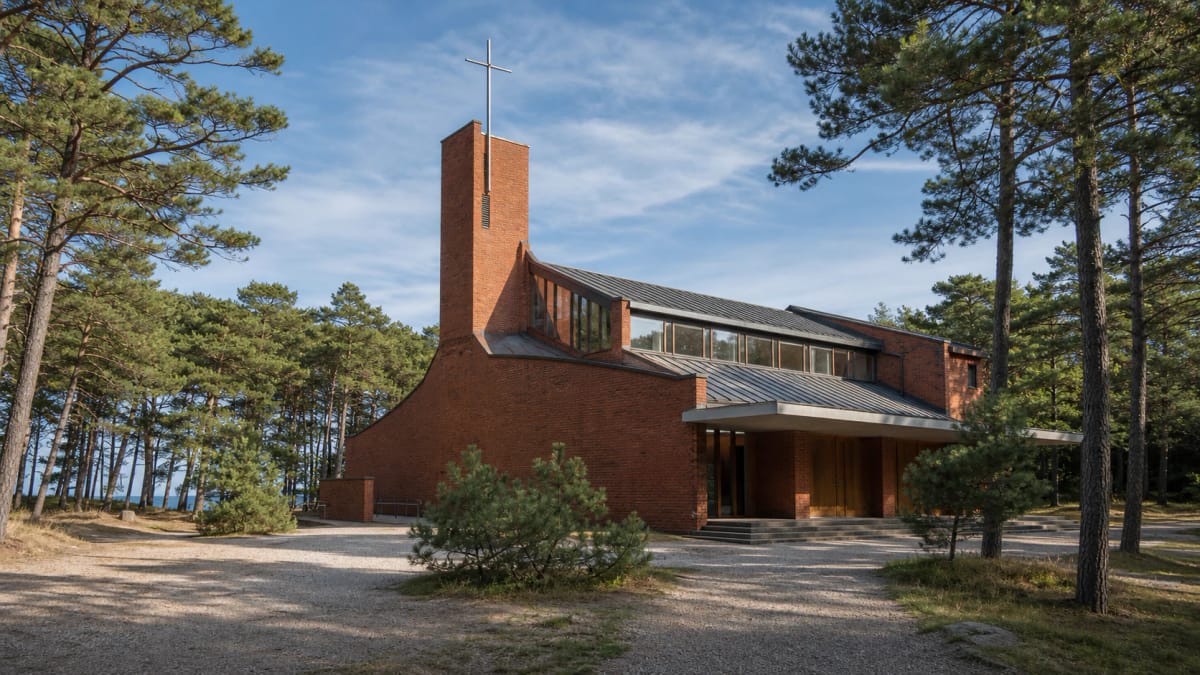
Mary Help of Christians Church in Nida is the first and only Roman Catholic church on the Curonian Spit. It opened on 14 June 2003 and so belongs to the newest layer of sacred architecture on this UNESCO-protected sand spit.
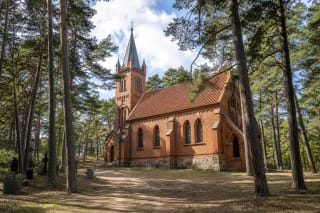
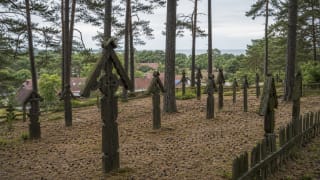
For almost all of its history Nida was an Evangelical Lutheran place, with old cemeteries, wooden krikštai grave markers, and an 1888 masonry Lutheran church. The revived Catholic community prayed from 1988 in the Lutheran church handed over to them, and only in the early 2000s did it gain a church of its own.
The parish and the 2000-2003 construction
The church belongs to the Klaipėda deanery of the Telšiai Diocese. The foundations of the church and community building were blessed on 4 May 2000 by Telšiai Bishop Antanas Vaičius, and the finished building was opened at a ceremony on 14 June 2003.
It was designed by architects Ričardas Krištapavičius and Algimantas Zaviša (VLE gives J. A. Zaviša). The same R. Krištapavičius designed the sundial on Parnidis Dune, so the church fits into a coherent story of contemporary architecture in Nida.
Architecture in dune relief: oak, reeds, and a glass tower
The building is set into a restored dune, so it does not dominate Nida but seems to grow out of the relief. The facade is clad in dark impregnated oak boards, the roof is thatched with reeds, and the glass tower is crowned by a white openwork cross - visible from every side of Nida and rising about 6 m above the roof.
An amphitheatre sunk into the dune slope, a farewell chapel, and a community hall adjoin the church. Timber, reeds, and the dune line let the sanctuary speak the traditional material language of the Curonian Spit, even though its whole form is thoroughly contemporary.
A contemporary sacred-art interior
The interior was conceived as a single contemporary sacred-art space. The font is carved from Italian white marble, weighs about 2 tonnes, and has a boat-shaped upper section by sculptor Mindaugas Kuzma. Suspended nearly 10 m up is an oak Crucifix about 3 m tall and around 800 kg - a work by Stasys Kuzma.
The fourteen Stations of the Cross are rendered in unique, lead-free clear-glass windows by Professor Algirdas Dovydėnas. Bronze candelabra and a processional cross were made by jewellers Vytautas Karčiauskas and Jurga Lago. The church has a computerised Johannus organ from the Netherlands, and a bell of about 1.5 tonnes, cast at the Felczyński foundry in Taciszów, Poland, hangs beneath the roof.
Visiting and a Nida route
No public tourist visiting hours or ticket information were found during research. This is an active place of prayer, so enter respectfully and take service times into account.
The church is easy to combine with the Nida Evangelical Lutheran Church, the old cemetery with its krikštai, the Thomas Mann Memorial Museum, the art colony, and a walk toward Parnidis Dune. That makes a Nida route cultural and sacred as well as natural.