- Place
- Meškėnai, Marijampolė Municipality
- Region
- Suvalkija
- Type
- a state-protected small-leaved lime and botanical natural heritage object
- Address
- 20 Šilo Street, Meškėnai village, Marijampolė Eldership, Marijampolė Municipality
- Coordinates
- 54.54840, 23.46469
- Visit duration
- 15-30 minutes to view the tree's silhouette, trunk, and information board from a safe distance
- Best time
- late June to July for a green or flowering crown, or early spring when the trunk and old branch structure are easiest to see
Meškėnų liepa, Meškėnai village lime tree
The tree's scale comes from its six-metre trunk, not its height
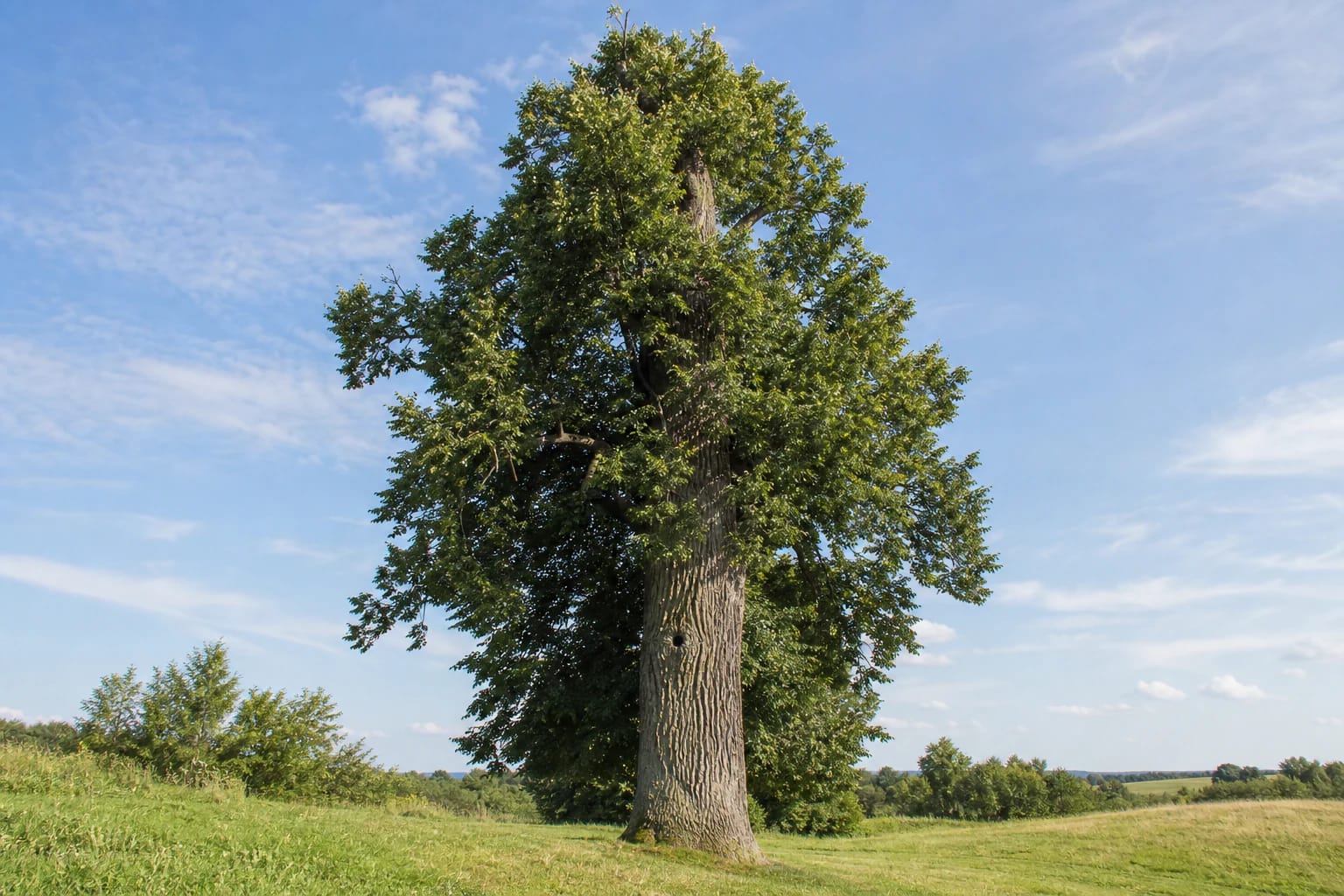
Meškėnai Lime Tree is a small-leaved lime, Tilia cordata, growing in Meškėnai village beside the A16 Marijampolė-Prienai road. It is not a tall forest tree: a short, exceptionally thick trunk rises from a maintained meadow, with a low, spreading crown beginning at about 3 m. That proportion, rather than an age claim alone, gives the lime its distinctive silhouette.
The State Forest Service inspected the tree for its veteran-lime inventory on 10 July 2018. At that time, its trunk measured 6.1 m in circumference at 1.3 m above ground, its height was 12 m, and its crown spanned 16 m. These are measurements from a stated date, so they should not be presented as immutable figures accurate to the centimetre today.
A 2025 Marijampolė Municipality document, citing the State Cadastre of Protected Areas, records Meškėnai Lime Tree as object 0310505050047. Its table rounds the circumference to 6 m and gives the same 12 m height. The official records refer to the same tree and do not conflict: they differ in date and numerical precision.
A broken top changed the silhouette, but the crown remains broad and dense
The 2018 inventory describes the crown as low, broad, and dense. It also records a top that broke long ago, a hollow trunk, and sizeable cavities. These observations can coexist: an old tree may carry vigorous foliage while also being structurally compromised.
The same survey says that the upper part of the tree had been stabilised with cables. A 2024 description by the Lithuanian Arboricultural Centre adds that the crown was reduced around its perimeter in 2010, after which the tree stood about 12 m high. Such work manages mechanical load rather than creating a regular park-tree shape; visitors must not touch the cables or use them as supports for photographs.
Photographs published with the 2024 Tree of the Year nomination show a leafy crown reaching towards the ground, a massive deeply furrowed trunk, and its cavities. Images establish the tree's general appearance but do not replace a professional condition assessment. Branch and cable condition can change after storms, so do not linger beneath the crown in strong wind.
State-protected since 2013, with a precise botanical heritage status
Meškėnai Lime Tree was declared a state-protected natural heritage object by Environment Minister Order D1-792 of 25 October 2013, which took effect on 8 November. Earlier individual orders were later consolidated into a new legal framework, but the lime remains on VSTT's Marijampolė Municipality list of botanical natural heritage objects, updated in 2025.
Popular accounts sometimes call it a natural monument. The current official municipal list uses the more precise designation botanical natural heritage object. This page does not assign the separate higher natural-monument status because it was not found in the current records checked for this guide.
Protection is not limited to the wood of the trunk. Root condition, crown stability, and the surrounding soil all affect the tree, so visitors must not prune it, attach objects, climb into cavities, carve the bark, or compact the ground beneath the crown. Direct work on a protected veteran tree belongs to qualified arborists.
Over 300 years is an arboricultural estimate, not a known planting date
The Lithuanian Arboricultural Centre records the tree's age as unknown and estimates that it may be more than 300 years old. That distinction matters. No published tree-ring study, historical planting entry, or comparable method was found that would justify one exact birth year.
The lime is associated with the former Javaravas Manor area, and some accounts suggest that the estate's owners may have planted it centuries ago. The connection with the manor landscape is repeated in descriptions of the tree, but neither the planter nor a planting date is documented. Circumference alone is not a calendar because soil, growing space, and past damage all affect growth rate.
An arboricultural account preserves a story told by people from the Igliškėliai area: serfs from Javaravas Manor were allegedly tied to the lime's low branches and whipped. It is meaningful as local oral memory of the violence of serfdom, but not as a confirmed episode in this particular tree's biography. No corroborating evidence was found in the public sources checked for this guide.
The exact map pin marks the tree, not a car park
The exact Google Maps listing Meškėnai Lime Tree, place ID ChIJg4uvM8vV4EYRU2Stgh4nQ_c, marks 54.5484004, 23.4646917. That point lies only metres from coordinates published by forestry specialists in 2018 and arborists in 2024, confirming the listing's identity. On 15 July 2026 it showed an average rating of 4.7 out of 5 from 26 reviews.
The 2018 official inventory places the tree immediately beside the A16, about 7 km from Marijampolė. It described the site as maintained and noted an information board, but no direction sign from the road at that time. The arboricultural record gives the address as 20 Šilo Street, Meškėnai. Navigate to the tree listing itself rather than only to the village centre.
The official sources checked do not identify a dedicated visitor car park, a public access easement, or the site's current ownership arrangements. State protection is therefore not permission to drive into a yard. Stop only where it is legal and safe, never on the A16 carriageway or an unsafe shoulder, do not obstruct an entrance, and ask permission before crossing space that is clearly part of a private homestead.
A short stop needs no ticket, but the root zone needs care
On the verification date, Google marked the place open 24 hours, while official VSTT and municipal sources published neither tickets nor set visiting hours. This is not a fenced attraction with staff, so a map status does not guarantee access at every hour. Check the latest map information and observe signs on site before travelling.
Allow 15-30 minutes for one stop. Summer foliage best shows the crown's breadth, while early spring or late autumn reveals the branching structure, lost top, and thick trunk more clearly. Photograph from the meadow or the edge of permitted access rather than standing in a cavity or ducking beneath low branches.
Avoid surrounding the trunk with a group or trampling the entire area beneath the crown. Do not step on exposed roots, put objects into cavities, touch the support cables, or take branches. In windy weather, view the tree from farther away because a visitor cannot reliably judge the stability of old hollow wood and large limbs from the ground.