- Place
- Ginučiai, Ignalina District Municipality
- Region
- Aukštaitija National Park
- Type
- nineteenth-century watermill and technical-heritage exhibition
- Address
- Malūno g. 24, Ginučiai, Ignalina District
- Coordinates
- 55.38542, 25.99484
Ginučiai mill, Ginučiai Watermill exhibition
A mill on the Srovė between Lakes Almajas and Linkmenas
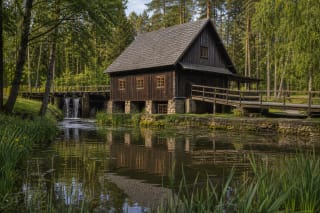
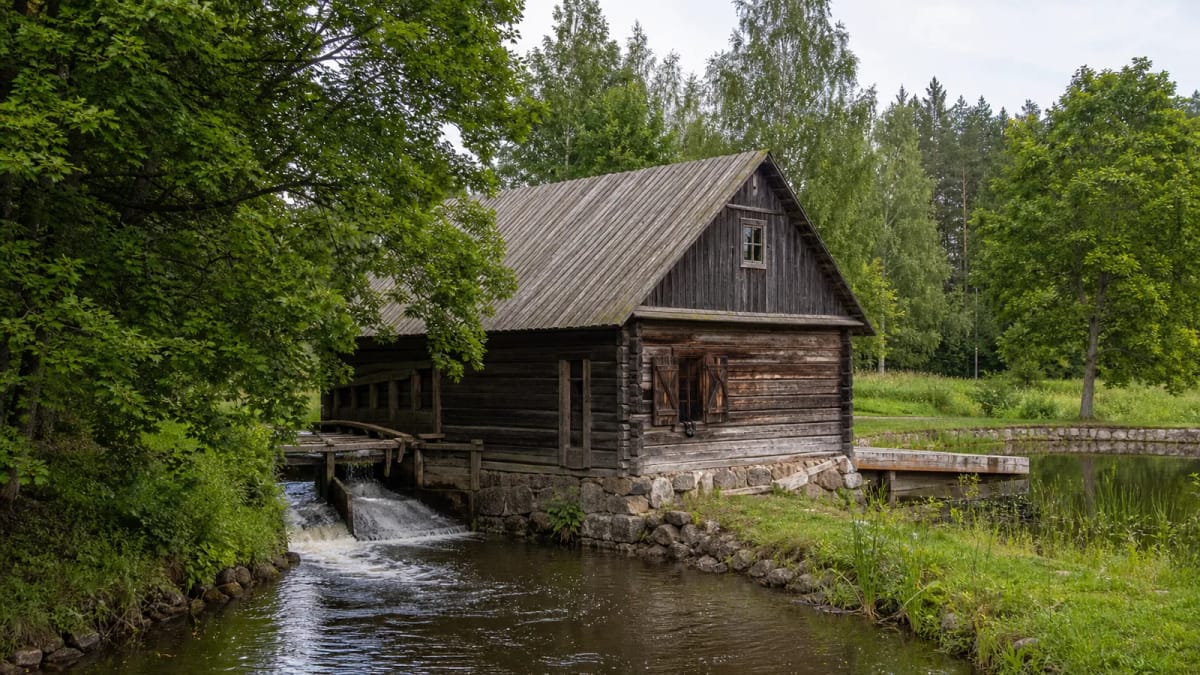
Ginučiai Watermill stands on Malūno Street in Ginučiai village, on the left bank of the Srovė stream, inside Aukštaitija National Park. The Srovė belongs to a waterway system connecting Lakes Almajas, Linkmenas, and nearby lakes, so the mill was built in a wet place with usable fall. This is not just a pretty wooden building beside water: official sources present it as a nineteenth-century technical monument where visitors can understand how water power was turned into milling, sawing, and other village-economy work. The log walls are strengthened with vertical braces and stand on a stone-masonry plinth.
For visitors, the key is not only the facade. The mill's value lies in its equipment and structures: the metal turbine, wooden gears, millstones, sack-lifting devices, and the logic of the transmission system. According to Saugoma.lt, Ginučiai Watermill is the only one of the park's six watermills, Minčia, Ginučiai, Pakretuonė, Pakasas, Gaveikėnai, and Brukninė, to preserve authentic equipment, so the relationship between building and water explains not only the site function but the whole technology.
A nineteenth-century building by landowner J. Gimžauskas
Saugoma.lt and Aukštaitija National Park information state that the mill was built in the second half of the nineteenth century by Linkmenys landowner J. Gimžauskas, with help from several farmers. That origin shows the link between manor economy and village work: the mill did not operate as an isolated craft but as an economic node for surrounding settlements, where peasants from nearby villages brought grain.
The mill ground grain until 1968 and also served wider functions: shingles were cut here, flax and cloth were processed, and electricity was produced. This multifunctionality was typical of eastern Aukštaitija watermills, which VLE says were especially common here alongside Samogitia in the nineteenth and first half of the twentieth century. That explains why Ginučiai Watermill is interesting not only for architecture but also for the history of technology.
A turbine instead of a waterwheel
Ginučiai Watermill belongs to a later generation of watermills. VLE notes that in the late nineteenth and early twentieth centuries, traditional wooden waterwheels in many mills were replaced by low- or high-pressure turbines, which took less space and used the fall more efficiently. The metal turbine was the energy source at Ginučiai, and its rotation was used for both milling and producing electricity for the village.
The exhibition preserves all parts of the milling process: millstones, wooden transmission wheels, a sack hoist, and other devices. These objects are not decorations; they let visitors follow the work sequence from the Srovė's water flow to flour and see how a turbine mill differs from an older wheel mill.
Museum: from sowing to bread
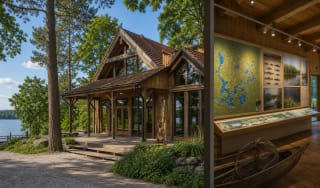
Today Ginučiai Watermill houses a museum telling the path from sowing to bread on the table. That means the exhibition covers not only the mechanics of the mill but the whole grain-farming chain, from field to loaf, making the place useful for children and for visitors interested in craft history.
At the time of research, official park information stated that group visits to the exhibition must be arranged in advance, with bookings taken by phone, and that ticket prices can change. Before travelling, check the Aukštaitija National Park page or contact park staff. For a short stop, the mill can also be viewed from outside.
Ginučiai Watermill in a wider route
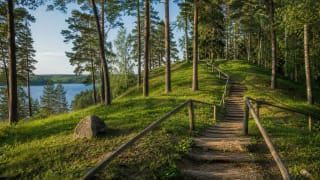
Ginučiai Watermill pairs very well with the Ginučiai and Papiliakalnė hillforts. In one route you see both the defensive ridge with the memory of Linkmenys Castle and the economic system of water power, so the area does not feel like a random collection of sights. A 14 km circular walking route of Aukštaitija National Park also begins by the mill.
The most convenient route joins Ginučiai Watermill, the hillforts, Ladakalnis, and the Šiliniškės Observation Tower, and with more time, Baluošas Ilgasalė. In a few hours this shows the park's main theme: lakes, waterways, villages, and hills that shaped local life over a long time.