- Field
- Baltic amber jewelry, amulets, and applied art
- Type
- traditional craft
- Heritage status
- well attested
- Context
- Baltic amber, succinite, inclusions, Neolithic pendants, beads, strings, rosaries, inlay, mosaic, Palanga Amber Museum, contemporary jewelry
Baltic amber objects, Amber jewelry, Amber jewellery, Amber amulets
Amber Objects forms and objects
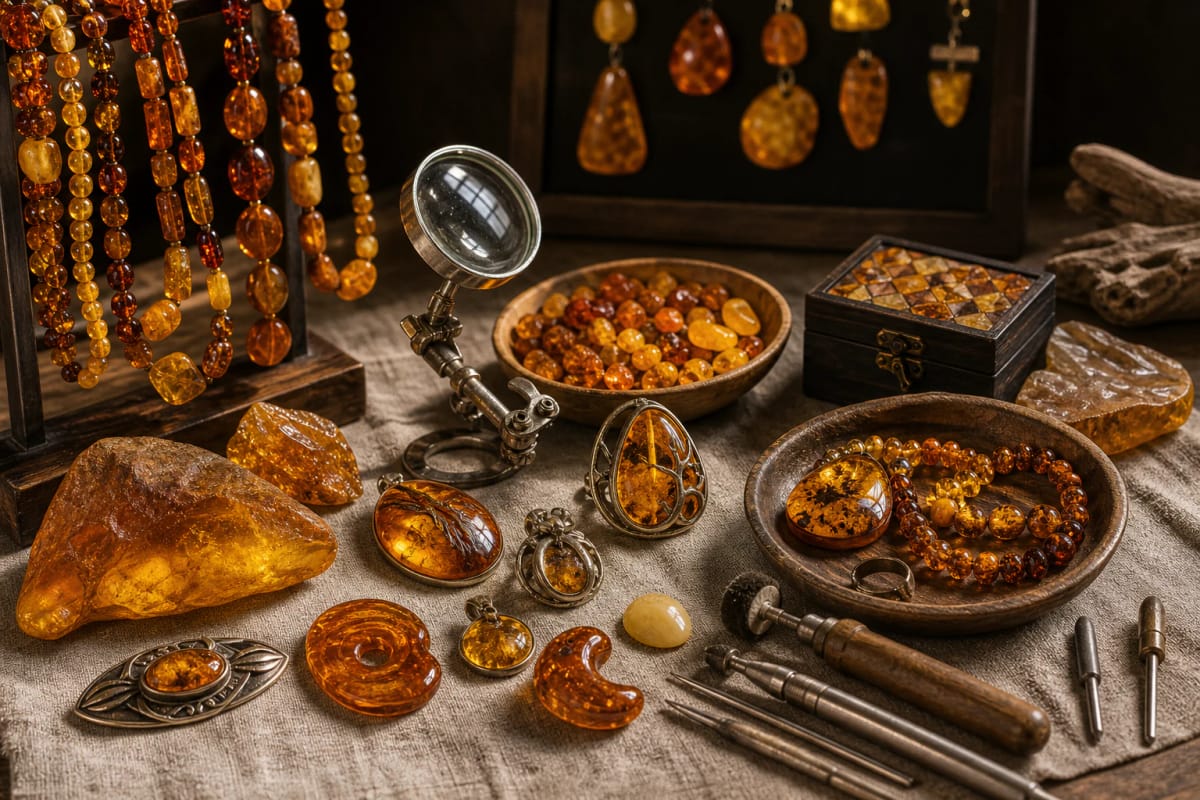
Prehistoric pendants and beads: Neolithic and later trapezoid, oval, round, axe-shaped, or key-shaped pendants, button-beads, disks, and strings.
Baltic jewelry: Amber beads, pendants, strings, plates, and spirals used in dress, burial, and systems of status signs.
Devotional and applied objects: Rosaries, crosses, liturgical objects, boxes, inlaid surfaces, chess sets, mouthpieces, and other applied-art objects.
Contemporary amber jewelry: Earrings, brooches, rings, pendants, modern strings, and author objects combining amber with metal, wood, leather, or other materials.
What are amber objects?
Amber objects are jewelry, amulets, household, liturgical, decorative, and contemporary jewelry pieces made from Baltic amber. VLE defines them as applied and decorative art objects made from amber or amber compounds.
In Lithuania, amber is not only a beautiful coastal souvenir. It has a long archaeological history, significance in trade routes, burial and protective amulet layers, museum memory in Palanga and Juodkrantė, national-romantic images, and a life in contemporary jewelry.
A good account of amber should join material and culture: what Baltic amber is, how it is worked, what objects are known from the Neolithic, where they can be seen, and how natural, pressed, and imitation amber can be distinguished.
Baltic amber: material and light
Baltic amber, often called succinite, is fossilized resin of ancient trees. Its colors range from yellow, honey, cognac, and reddish brown to milky white, greenish, or darker shades. Pieces may be transparent, cloudy, or completely matte.
Amber's beauty depends on light. It not only reflects light but lets it pass through, which makes it seem warm. This is why amber suits beads, pendants, earrings, and objects where translucency matters.
Inclusions, such as insects, plant particles, or other traces trapped in amber, are especially valuable for science and museums. They show not a master's hand but the material's own history, preserved for millions of years.
From the Neolithic to Baltic jewelry
Amber objects are known in the eastern Baltic already in Early and Middle Neolithic contexts. Important places include Šventoji, Daktariškė, Juodkrantė, Palanga, and other coastal or lakeside archaeological sites.
The oldest objects were often pendants, beads, button-beads, disks, plates, rings, and amulets of various geometric forms. They could be trapezoid, triangular, rectangular, oval, axe-shaped, or key-shaped.
In later Baltic culture amber was used in jewelry, strings, burial, and status signs. It was not mere decoration: amber finds in graves point to bodily adornment, wealth, identity, and perhaps protective meaning.
Amber as amulet and burial object
In prehistoric finds, amber is often interpreted as an amuletic material. Its warmth, color, lightness, and sea origin may have given it protective or special meaning, especially when placed in a grave or worn close to the body.
Still, caution is needed: archaeologists cannot always say exactly what a particular person thought about a particular pendant. It is better to write about possible protective, status, decorative, and burial functions than assign one precise meaning to every object.
Amber's value also came from rarity and travel. Even on the coast it was not simply everyday material; farther from the sea it became an object of trade, exchange, and prestige.
Working techniques
Amber is cut, drilled, turned, incised, sanded, polished, inlaid, joined into components, and combined with metal, wood, leather, or textile. The maker must understand that amber is softer than stone but brittle and sensitive to heat.
For beads and strings, drilling and regularity matter. For a pendant, form, weight, hole placement, and the way it hangs on the body are important. In inlay, pieces of different colors must be matched with the base.
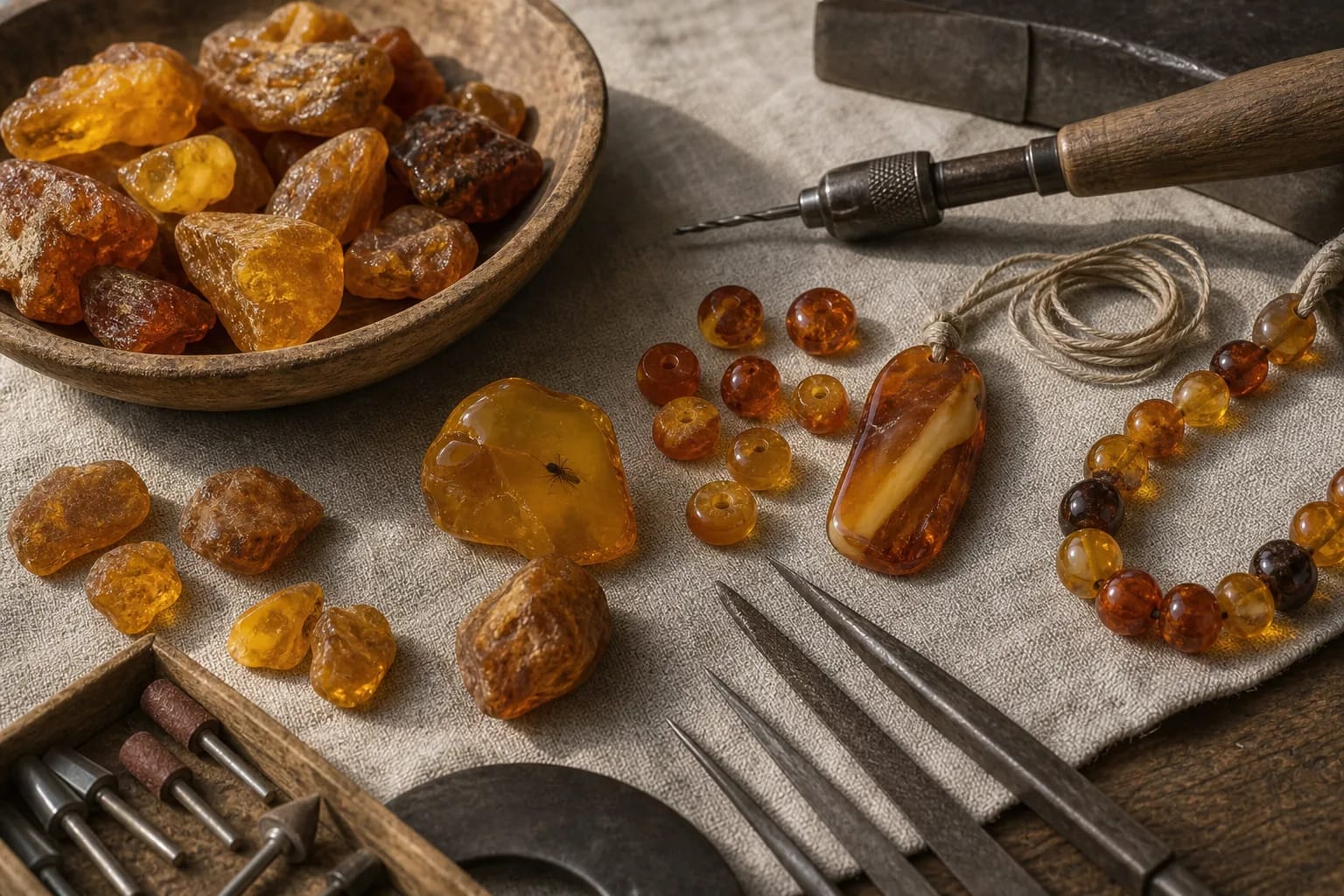
Modern jewelry may use modern tools, but a good amber object preserves respect for the material. Overly aggressive shine or mass-produced form can make amber look like plastic, while its real value lies in natural light and texture.
Natural, pressed, melted, and imitation amber
Natural amber is an object worked from a single or naturally formed piece. Pressed amber is made from smaller amber fragments joined under heat and pressure. Melted or reconstructed amber may have a different structure and value.
Imitations may be made from plastic, resins, glass, or other materials. They may look similar but do not have the same origin, age, or cultural weight. A buyer should ask what exactly the seller's terms mean.
Pressed amber is not bad in itself if it is clearly named. The problem begins when reconstructed or imitation objects are sold as natural amber. For cultural heritage presentation, honesty is as important as beauty.
Palanga, Juodkrantė, and museums
Palanga is the most important center of Lithuania's amber identity. The Palanga Amber Museum, founded in 1963 in the Tiškevičiai palace, presents amber as a natural, archaeological, artistic, and jewelry material. It holds one of Lithuania's largest amber lumps, Saulės akmuo, weighing 3.524 kg; LNDM notes that the exhibition contains about 6000 exhibits.
The museum is especially important for inclusions, archaeological objects, historical jewelry, and contemporary amber art. It shows that amber is not only resort beads but a material with scientific, artistic, and historical layers.
Juodkrantė and Nida are also important to amber history, especially through Stone Age finds and coastal traditions. In 1860-1899 the Prussian company Stantien und Becker mechanically mined amber in the Curonian Lagoon near Juodkrantė, up to 85 tons per year, one of the most important historical Baltic amber deposits. Klaipėda and Palanga became important workshop and trade centers in the twentieth century.
Myth, romance, and national symbol
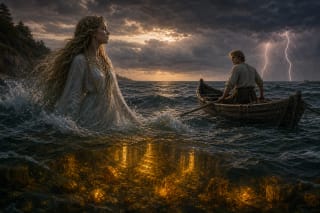
The legend of Jūratė and Kastytis, the image of Jūratė's tears, and stories of Birutė and Palanga helped amber become a romantic symbol of the Lithuanian coast. Amber came to be seen not only as material but as a sign of sea, love, loss, and national memory.
In modern times amber is often called a symbol of Lithuania. That is true as a cultural metaphor, but this status formed historically: through archaeology, museums, resort Palanga, national romanticism, Soviet souvenir culture, and contemporary design.
The best text about amber does not oppose myth and science. Legend explains why people love amber, while archaeology and mineralogy explain what it is and how long it has lived in culture.
How to care for amber jewelry
Amber is sensitive to heat, strong chemicals, perfumes, hair spray, alcohol, and long direct sun. It is best cleaned with a soft damp cloth and stored separately from harder stones or metal so it is not scratched.
Amber beads should be protected from pulling, because old thread can break. Old jewelry is best restrung by a specialist, preserving the original sequence and details if they have heritage value.
Objects with inclusions or museum value require even more care. They are not only ornaments but witnesses to the material's history.