- Place
- Minčia village, Tauragnai eldership, Utena District Municipality
- Region
- Aukštaitija
- Type
- watermill and cultural heritage object
- Address
- Minčia village, Tauragnai eldership, Utena District
- Coordinates
- 55.47644, 25.98024
Minčia Mill
Minčia Watermill: wooden heritage by the stream
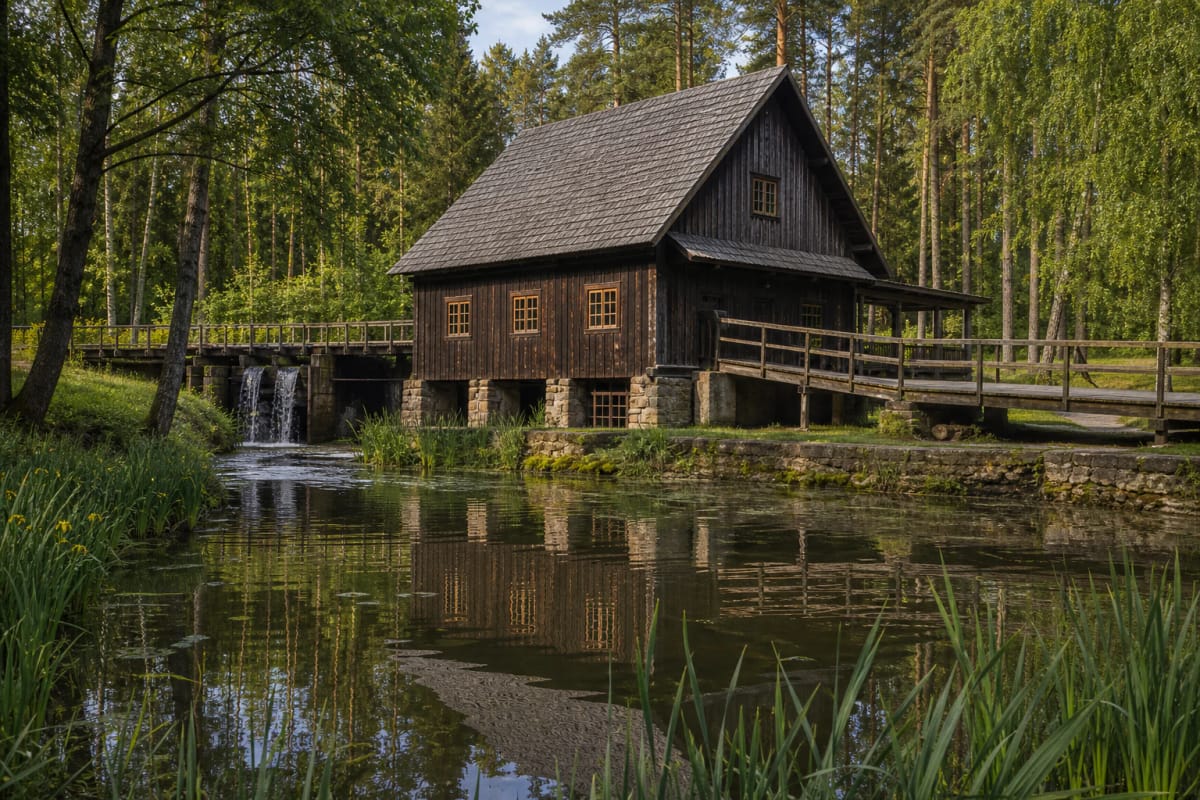
Minčia Watermill is in Minčia village, Tauragnai eldership, Utena District, within Aukštaitija National Park. The Register of Cultural Property lists it as a registered cultural heritage object, unique code 1742, with a protected area of about 5,648 sq m.
The site matters because it preserves the character of a wooden watermill: log construction, stone plinth, gable roof, traditional boarded facade, and fragments of former technological equipment. The register also mentions the former water channel on the western side and remains of turbines, pipes, and transmission.
1792 and a water-powered work system
According to the Register of Cultural Property, in 1792 Minčia Mill is mentioned as an already rebuilt mill of the Bishop of Vilnius. The local history emphasizes that more than 200 years ago people harnessed the Minčia stream and built a dam for the watermill.
Water here was not decoration but power. The register states that in the early nineteenth century landowner Vladislovas Puslovskis set up a copper-cauldron workshop by the mill; in the early twentieth century, under Rogov, the mill was rebuilt and adapted for a sawmill, fulling mill, and dyehouse, with a water turbine installed.
Memory of the 1863 uprising
Minčia Watermill is also linked with the 1863 uprising. The Register of Cultural Property states that insurgents made ammunition here and stored food and clothing supplies. This gives the site a broader historical layer than rural industrial architecture alone.
The official local history tells of insurgent preparation in Minčia Forest and local legends. It is worth separating documented register facts from legendary motifs: the latter help convey local memory, but should not be treated as precisely proven detail.
Twentieth-century changes and restoration
The register states that the mill did not operate during the First World War and resumed work in 1920; from 1945 it belonged to the Ąžuolas collective farm. The mill stopped operating in 1969, the dam was dismantled in 1970, the pond drained, and a road laid across its bed.
In 1983-1986 the building was reconstructed and adapted as a rest house, and in 1986 the pond was restored. This development explains the present appearance: Minčia Watermill is no longer a working grain-milling enterprise, but neither is it only an abandoned monument. It has been adapted for accommodation, events, kayaking, sauna, and other services.
Visiting and services
The official Minčia Watermill website presents it as a rural tourism, recreation, kayaking, and entertainment space. During research, the page listed arrival from 16:00, departure by 12:00, and the need to register in advance, so do not plan spontaneous museum-style interior visiting without agreement.
Because the mill is in Aukštaitija National Park, it is best seen both as a stop at a cultural heritage object and as a possible booked recreation site. Nearby are Minčia Forest, Lake Tauragnas, Lithuania's deepest lake, and the Tauragnai area. Check the official page before travelling for interior access, service prices, and seasonality.