- Place
- Klaipėda City Municipality
- Region
- Klaipėda
- Type
- Klaipėda port-gate piers and seaside walking place
- Coordinates
- 55.71770, 21.11190
Klaipėda port piers, Klaipėda port gates
Melnragė Piers: the Klaipėda port gates up close
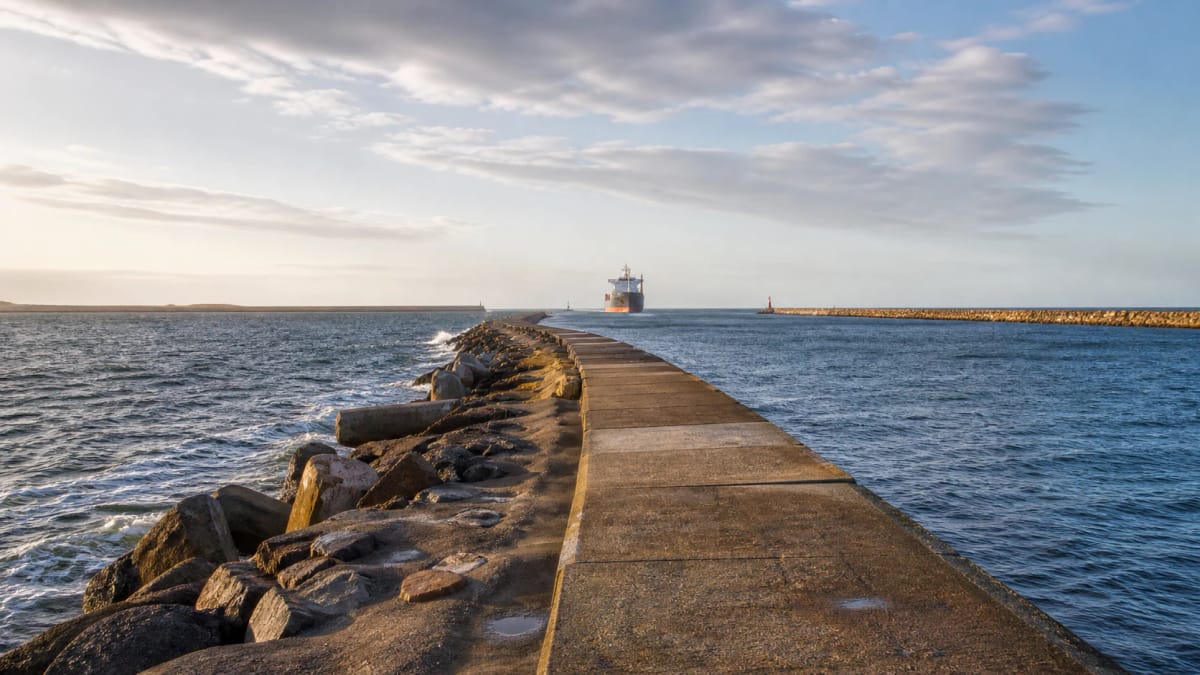
The name Melnragė piers usually refers to the northern pier of the Klaipėda port gates in Melnragė, but the whole view is formed by two piers: the north pier on the Melnragė side and the south pier in Smiltynė. They shape the port entrance, so you see not only the sea here but also the rhythm of Klaipėda port.
This is one of the best places to watch ships entering and leaving the port. Unlike the beach, the pier lets you stand closer to the breakwater structure and the sea boundary itself, but that is exactly why more caution is needed.
North and south piers
Klaipėda Port Authority information gives the current pier lengths: the south breakwater is 1,374 m long, and the north breakwater is 733.66 m. These numbers help explain why the port gates look from the piers like a large engineering landscape, not just a path by the water.
The north pier is easiest for visitors from the Melnragė side, while the south pier is reached from Smiltynė. Both banks open the same port entrance but give different experiences: in Melnragė, the city beach feels close; in Smiltynė, the route belongs more to the Curonian Spit and Lithuanian Sea Museum.
From eighteenth-century port works to modern reconstruction
The Klaipėda Port Authority's historical account links the beginning of the south pier with 1791, when construction work started; by 1806 it had extended about 50 m into the sea. On the northern bank, a 940 m stone quay and a 460 m north pier were built in 1834-1841.
By 1858 the combined hydrotechnical structure reached 2,150 m. On December 16, 1884, completion of the north-pier works was symbolically marked when a gas lamp was lit in a 10 m metal lighthouse: the famous White Lighthouse at the end of the north pier. This recalls that today's walking site began as complex port-safety and navigation infrastructure.
Melnragė piers and Klaipėda port-gate history
According to VLE, Klaipėda seaport infrastructure began developing in the seventeenth and eighteenth centuries: the entrance channel was marked with signs, light markers and quays were built, and the first lighthouse was lit in 1796. In the late eighteenth and early nineteenth centuries the south pier was built, and in 1834-1878 it was lengthened and the north pier was built. The port was then moved from the Danė River mouth into the deeper Klaipėda Strait.
These works explain why the Melnragė piers matter as more than a walking place. They mark the point from which Klaipėda became a deep-water, ice-free port. Today it is a universal state seaport visited each year by about 7,000 ships from around 70 countries, so the ship traffic visible from the piers is a living continuation of port history.
Renewal in 2020-2024
The Klaipėda Port Authority states that the 2020-2024 pier reconstruction renewed the walking surfaces of both piers. Two viewing platforms were installed on the south pier, and access, stairs, and lighting were improved on the north pier.
These works matter not only for the port but also for the city. The Melnragė pier became a more convenient public place for watching the sea, though its primary function remains engineering: protecting the port gates and managing wave impact.
Safety near the piers
The piers are not an ordinary park. In strong wind, heavy seas, ice, or storms, visiting can be dangerous, and access may be restricted. Choose a dry, calmer day, do not walk on wet or slippery structures, and do not stand where waves can flood the path.
No official information on tickets or permanent opening hours for the piers was found in the checked sources. They are a public seaside and port-gate viewing place, but access may depend on safety, works, or weather. If you are travelling specifically for the pier, especially after storms or construction, check Klaipėda Port Authority and city notices.