
- Genre
- Sacred-hill legend
- Source status
- sacred-site tradition of Lithuania Minor
- Motifs
- laumės, Perkūnas, sacred fire, Nemunas, sanctuary
Rambynas, Rambynas sacred hill, Perkūnas's stone
The Legend of Rambynas Hill
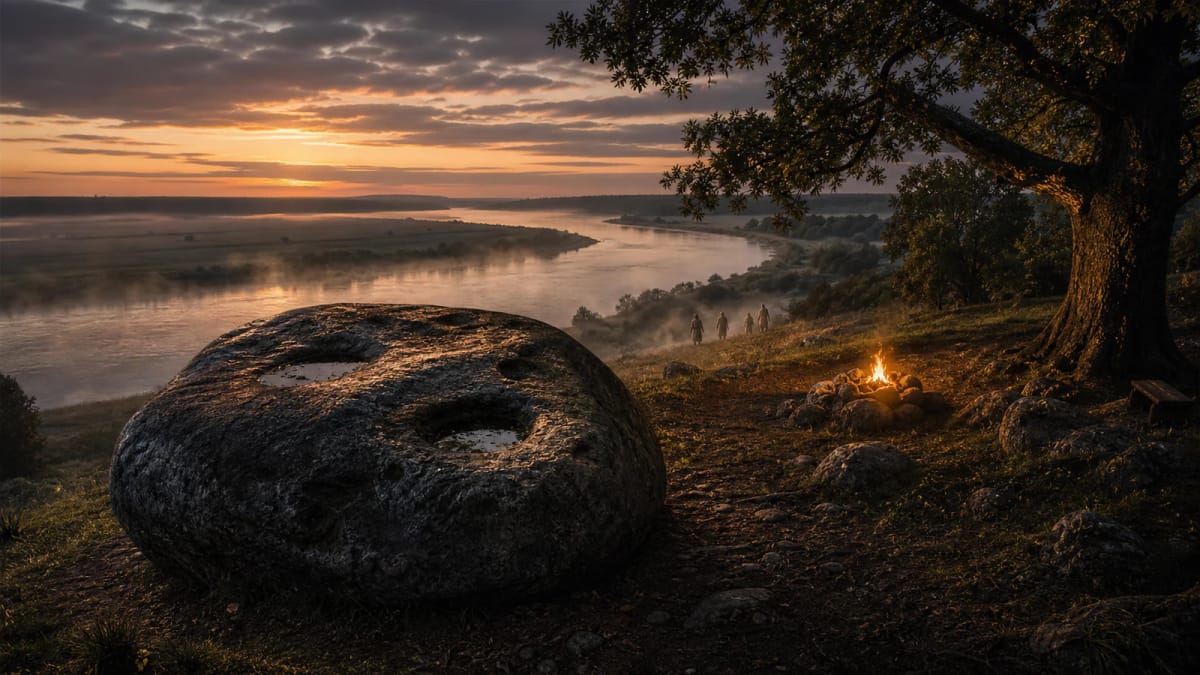
At Rambynas people tell of the great stone of Perkūnas and of laumės who lived beneath it or within the sacred hill. They guarded the place, helped the lost, cared for the poor, and did not allow the sanctuary to be mocked.

When people insulted the stone and the holy place, the laumės left Rambynas. In one story a ferryman carried them across the Nemunas, and as they departed they foretold hard times for the land. The sacred fire went out.
Since then Rambynas has remained a sacred hill where beauty and loss are intertwined. The slope above the Nemunas reminds readers that a sacred place can be lost not only when a building falls, but when respect is lost.
Interpretation of the Rambynas Hill Legend
In Rambynas legends the laumės are not merely frightening beings. They act as guardians of the place, protecting moral order and helping the weaker members of the community.
Perkūnas's stone marks the center of the old sacred site. When the stone is insulted or broken, not only an object collapses, but the relationship with deity and land is damaged.
The departure of the laumės across the Nemunas is a rupture in memory. It explains why sacredness withdrew and why Rambynas became a nostalgic but very powerful cultural place.
History of the Rambynas Hill Legend
Saugoma.lt presents Rambynas as a mythological place and sanctuary of national importance on the right slope of the Nemunas. Sources mention that part of the hill was washed away by the river, while the old stone became the center of legends.
Local-memory and Alkas.lt texts give legends about the laumės, Perkūnas's stone, the ferryman, and the prophecy of hardship. This is one of the strongest mythological place narratives in Lithuania Minor.
The Rambynas page should therefore be read as a text of sanctuary memory, not only as a tourism object by the Nemunas.
Rambynas is a central sacred place of Lithuania Minor, still famous for Rasos or St. John's Day celebrations and associated with the thinker Vydūnas. The famous altar stone was broken in 1811 by a miller who used it for millstones, a detail often repeated in legends about the loss of sacredness. In genre terms this is a mythological sacred-hill legend; Lithuanian place legends are collected in Žemės atmintis: Lietuvių liaudies padavimai (1999) and classified in Bronislava Kerbelytė's catalogue, vol. 3 (2002).