- Place
- Marijampolė, Marijampolė Municipality
- Region
- Suvalkija
- Type
- active historicist Orthodox parish church on a state-protected cemetery site
- Address
- 38A P. Armino Street, LT-68295 Marijampolė
- Coordinates
- 54.54834, 23.34615
- Visit duration
- 20-35 minutes for the exterior, architectural details, and cemetery setting; longer if interior access is arranged or a service is taking place
- Best time
- in daylight for a quiet exterior visit; check official parish notices and make contact in advance if you hope to enter
Marijampolės Švč. Trejybės cerkvė, Marijampolė Old Cemetery Orthodox Church, Holy Trinity Orthodox Church in Marijampolė, Свято-Троицкий храм в Мариямполе
This is the old-cemetery church, not the former Orthodox sanctuary in the city centre
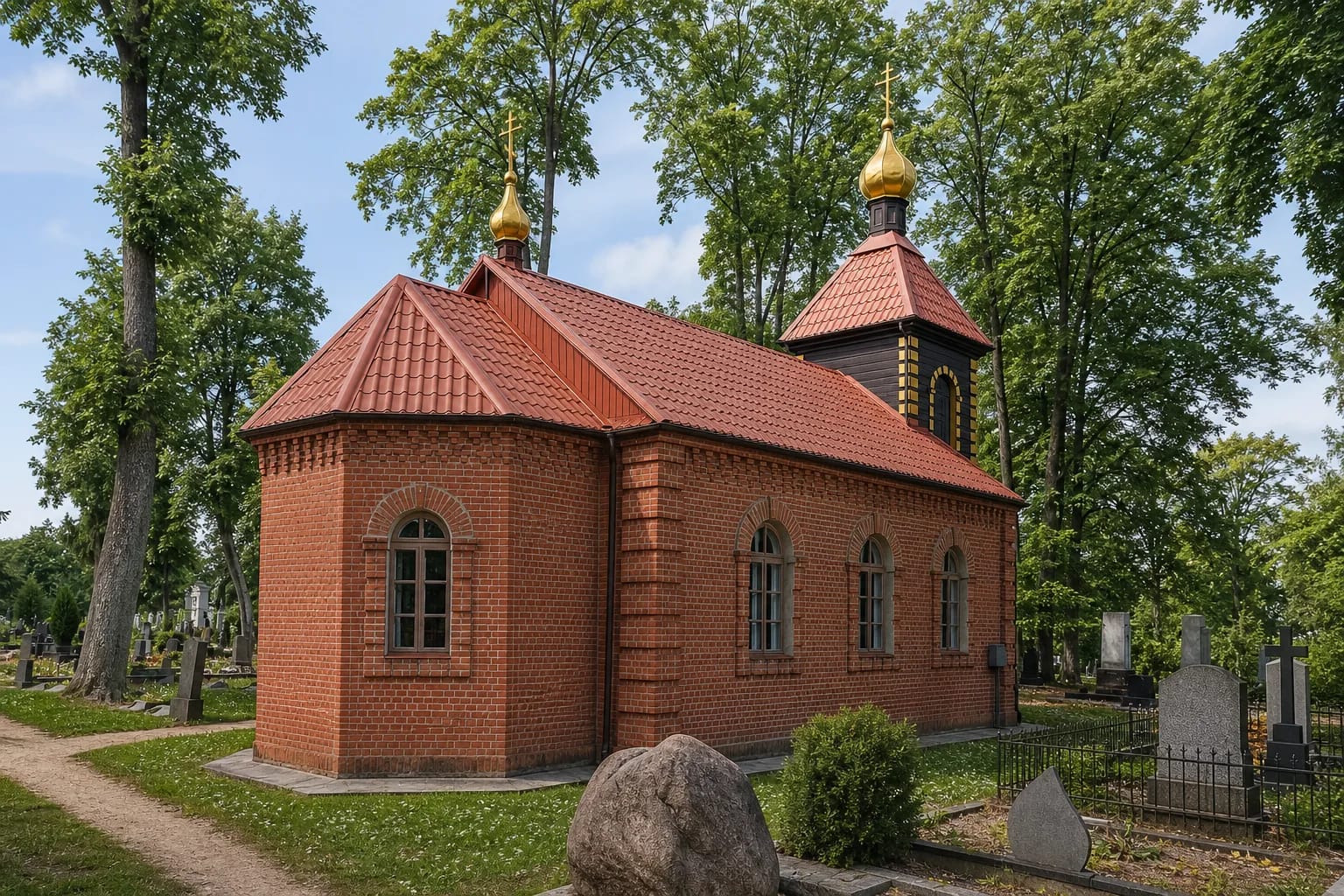
The Church of the Holy Trinity stands at 38A P. Armino Street, within the old cemetery south of central Marijampolė. It is a small parish sanctuary among trees and gravestones, so its timber belfry and gold-coloured cupola are easier to notice from the street than the full length of its red-brick body. The coordinates 54.54834, 23.34615 mark the building itself, not the cemetery gate, a parking space, or an individual grave.
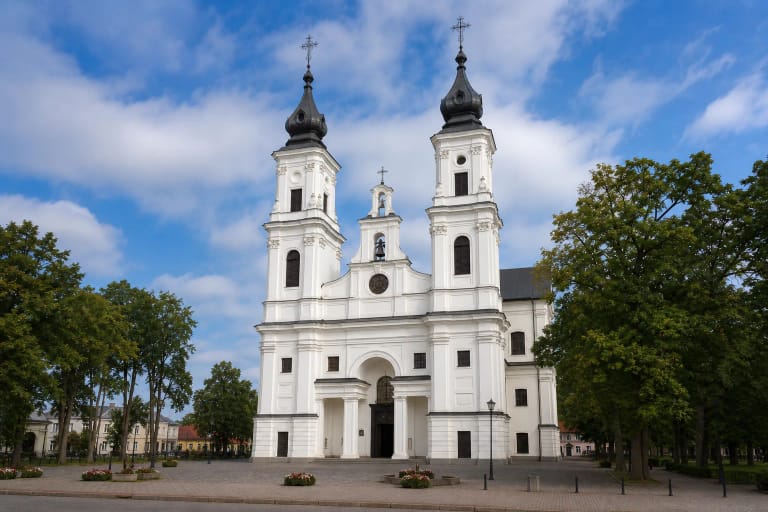
It should not be confused with today's Catholic Church of St Vincent de Paul in the city centre. That building began as Marijampolė's larger Orthodox church and passed to Catholic use during the interwar period. The old-cemetery Holy Trinity church then became the compensatory place of worship for the local Orthodox community. Both belong to one history of the city's faith communities, but their addresses, scale, and present denominations differ.
KVR registers the church under code 20552 as a state-protected architectural and sacred property of regional significance. It is neither an architectural museum nor a disused decorative chapel: an official Lithuanian Orthodox Church notice confirms that worship still took place here in 2026.
The evidence most strongly supports 1907, although the sources preserve other dates
KVR dates the property broadly to the late nineteenth or early twentieth century and preserves three construction years found in the literature: 1894, 1901, and 1907. The same record cites Marijampolė church historian Benjaminas Mašalaitis as favouring 1907. VLE's survey of Marijampolė architecture also gives 1907 directly.
KVR and VLE name district engineer Valerijus Rybarskis as architect. This page therefore uses 1907 while retaining the disagreement openly: 1894 and 1901 are part of the documented source conflict, not dates for separate Orthodox churches once standing alongside this one.
The Lithuanian State Historical Archives preserve 28 units of parish registers from the Marijampolė Orthodox Parish of the Holy Trinity, covering 1913-1961. They document a long recorded parish life, but those dates alone cannot determine the precise day on which construction finished.
A five-sided apse and timber belfry complete the red-brick nave
The plan is unusually easy to read from outside. The central portion is a single-storey rectangular aisleless volume; a five-sided apse closes it to the west, while an entrance porch and single-stage belfry rise at the east. A gable roof covers the main body, a five-plane roof covers the apse, and a four-plane pyramidal roof caps the belfry.
Segmental-arched windows and doors, cornices, rusticated pilaster strips, and moulded surrounds give rhythm to the red-brick masonry. Horizontal timber boarding encloses the upper belfry, making the dark wood stand out from the brick. Yellow accents now pick out the tower corners and openings.
Two small onion cupolas rise at different levels: one above the western roof and another above the belfry. Sheet metal covers them and Orthodox crosses complete their silhouette. KVR also singles out the timber double doors with religious motifs, but whether visitors can see them closely depends on the cemetery gate and church being open.
The Soviet closure followed an interwar revival, while a local artist protected the bell
During the interwar period, the old-cemetery church passed to the Orthodox community as compensation for losing the larger city-centre church, today's Church of St Vincent de Paul. KVR notes that parish life was initially subdued and revived more clearly around 1931. This was a change in institution and community use, not a new construction phase.
The Soviet authorities closed the church completely in 1961. KVR says its liturgical objects went to Riga and to the Orthodox church in Vievis. Artist Vaclovas Vekeriotas kept its bell at his home for roughly twenty years; in 2002 it was formally handed to Marijampolė's Russian community, the Brotherhood of St Elizabeth.
After Lithuanian independence was restored, the building returned to Orthodox use and underwent conservation work. Public accounts date stages of restoration and reopening differently, so this page does not invent one definitive completion day. What matters for a present visit is that its religious function was restored and recent official church notices record worship here.
A service in 2026 confirms a living parish but does not create permanent opening hours
The Lithuanian Orthodox Church reported a prayer service for peace here on 21 February 2026, led by the church's rector, Archpriest Igor Rinkevič. That is reliable evidence for one particular event; it is not a promise that worship occurs at the same hour every week or that the building opens to visitors every day.
In March 2026, Marijampolė Municipality allocated support to a church-repair project. The funding decision shows that conservation remains active, but it does not prove that every job is complete or that the church must be closed. Before travelling specifically to see the interior, check the latest parish or official Lithuanian Orthodox Church notices.
No permanent tourist opening hours, admission price, or regular tour calendar was found in official sources on 19 July 2026. Viewing the exterior carries no ticket charge, but passage through the cemetery gate and access inside depend on actual local arrangements, services, repairs, and any visit agreed in advance.
How to see the church without disturbing worship or the cemetery
Allow 20-35 minutes for the exterior. From permitted paths, look for the five-sided apse, segmental arches, timber belfry, and the two cupolas at different heights. Do not cross graves or touch memorials; this is first a sacred and commemorative place.
If the church is open, ask permission before photographing the interior or people, remain quiet, and do not enter the sanctuary beyond the iconostasis. Sightseeing should wait during worship, funerals, or parish gatherings. No permanent exhibition or self-guided interior route is advertised.
The map point identifies the building, not a vehicle entrance or parking place. Research found neither a confirmed dedicated visitor car park nor a recent step-free access audit; the cemetery gate, path surfaces, and church threshold may limit movement. Wheelchair users and larger groups should contact the parish in advance and follow signs on arrival.