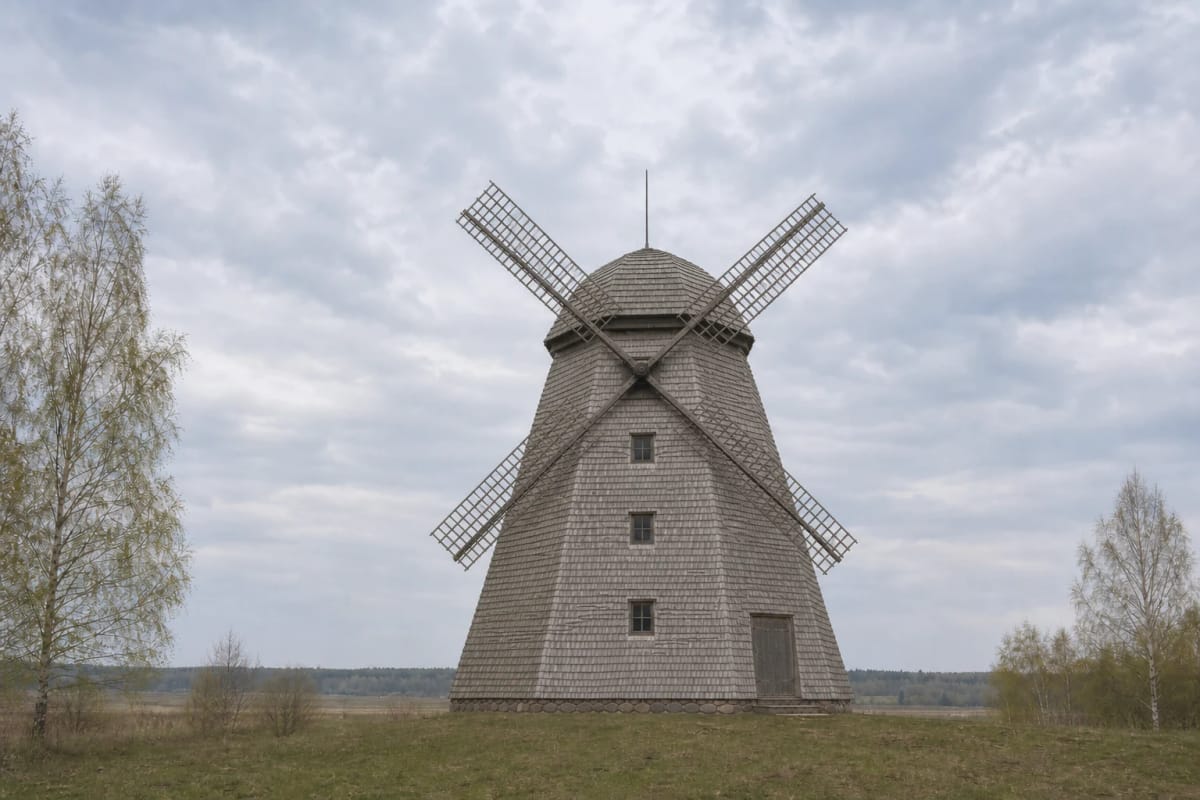
- Place
- Kretinga District Municipality
- Region
- Samogitia
- Type
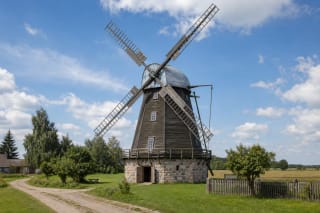
- state-protected four-storey octagonal timber smock mill with surviving technological equipment
- Address
- 44 Gintaro Street (tourism card: No. 4), Lazdininkai, Kretinga district
- Coordinates
- 56.00648, 21.21675
Lazdininkų malūnas, Lazdininkų vėjo malūnas, Padvariai Windmill
Coordinates are more reliable than two different Gintaro Street numbers
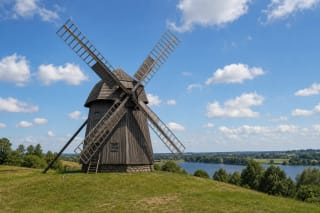
Lazdininkai Windmill stands at 56.0064825, 21.2167516 on a low rise beside the Darbėnai-Šventoji road. Heritage documentation from 2022 gives 44 Gintaro Street, while the current official Kretinga tourism card says No. 4. Navigate by the attraction name or coordinates, as the two numbers refer to the same village but can produce different routes.
This is privately cared-for heritage, not a municipal museum staffed every day. The exterior is visible from the approach and the tourism card describes it as always and freely viewable, but that is not permission to open doors, roam through the private holding, or enter at any hour. A first visit is best made in daylight.
For the interior, both the official tourism information and Google Maps displayed +370 604 80977 in July 2026. Call ahead to agree a precise time, party size, and whether the interior visit remains free that day. Park only where the owner directs and keep the entrance clear.
A 1900 building dismantled and moved in 1907
A specialist Lithuanian mills catalogue dates the timber windmill to 1900 in Padvariai, approximately ten kilometres from its present position. In 1907, a pharmacist named Švatelis bought it, dismantled the structure, transported it, and reassembled it in Lazdininkai. Timber framing made such a move more feasible than it would have been for a masonry tower, although every component of the complex frame still had to be marked and preserved.
The Kretinga regional encyclopaedia also records a wider story in which the mill stood near Vilnius before Padvariai. Current heritage and mill descriptions do not substantiate that earlier stage in detail. The safest documented beginning is therefore Padvariai in 1900, while the Vilnius episode should be understood as a family or local-memory version.
The Lazdininkai site was chosen for the steady winds of the coastal plain. A low rise stands at the edge of the Lazdupis valley, while the old miller's homestead was set farther away so buildings and trees did not obstruct air arriving from the sea. The surroundings have changed, but the tall isolated silhouette still explains the need for open ground.
Jurgis Končius bought the mill with money earned in America
The mill changed hands several times before 1925, when farmer Jurgis Končius acquired it after returning from work in American coal mines with savings for land and a business. Family memory compared the purchase price to the value of about 400 cows. That is an evocative measure of scale rather than a surviving invoice.
Končius worked as the miller himself, grinding and bolting flour for his own farm and surrounding villages. Soviet nationalisation transferred the property to a collective farm, but its former owner continued his craft there until his death in 1956. His biography makes the mill legible as family capital, employment, and a link in the regional food chain rather than picturesque decoration.
Sources disagree about the final years of wind power. The Kretinga regional encyclopaedia gives 1961, while the specialist catalogue says wind drove the stones until 1947, followed by a tractor and electricity. The central chronology is shared: an external power source replaced the wind during the second half of the century, and the mill ceased operation altogether in 1979.
How the octagonal smock mill worked
Lazdininkai is a timber smock mill, often called a Dutch-type windmill. Its octagonal body remains fixed while gearing turns only the upper cap and sail shaft towards the wind. That distinguishes it from a post mill, whose entire body pivots around a central supporting post.
The encyclopaedic description gives a body approximately 11.5 metres wide and 14.5 metres high, rising to about 21 metres at the lightning conductor. Four floors provide more than 500 square metres of internal area. The restored sail cross spans almost 12 metres, but the present sails are more decorative than their predecessors and no longer drive the stones.
Part of the technological chain survives inside: the main shaft, transmission, cap-turning gears, and several millstones. A metal shaft component carries an 1846 casting inscription, making at least this part older than the Padvariai structure of 1900. Mills were repeatedly repaired and assembled with valuable components from earlier machinery, so the two dates do not conflict.
A failed museum, lost machinery, and restoration in 2009-2010
A plan to establish a windmill museum in 1985 never produced an exhibition. Work on the building removed some millstones and mechanisms, so it cannot now be described as fully authentic or operational. The collective farm sold it in 1993; after a long restitution process, Jurgis Končius's daughter Ona Stasė Končiūtė-Nausėdienė recovered the family mill around 1998-2001.
The Cultural Heritage Department confirms a first restoration phase in 2009 and compensation of 45,449 litas. By 2010 the shingled cap had been renewed, four sails reconstructed, rotten beams and the sill strengthened, stairs and doors rebuilt, and the sail shaft repaired. The work saved the silhouette and some machinery but did not restore commercial grinding.
Older publications use register code 1436 or complex codes 23169 and 23170 for the machinery. Heritage accounting was reorganised in 2022: Lazdininkai Windmill remained a state-protected individual object of regional significance under current KVR code 16632, with its technological equipment incorporated into the protected attributes.
Interior access is not automatic, and the Google rating is 4.7
Allow 20-30 minutes for the exterior. Stay within the part of the grounds permitted by the owner and study the octagonal weatherboarding, shingled cap, sail cross, and exposed wind field. For an arranged interior visit, allow 45-60 minutes: across four floors, the point is not merely to see millstones but to follow how movement once travelled from the sails into the milling equipment.
An older plan proposed a viewing platform in the cap, but the current official tourism card does not confirm it as an operating service. Do not treat the mill as a public observation tower or climb without the owner. Steep narrow stairs, low passages, and four timber levels also mean that the complete interior is not accessible to a wheelchair or to visitors with substantial mobility limitations.
On 13 July 2026, Google Maps rated Lazdininkai Windmill 4.7 out of 5 from 41 reviews. That clears the catalogue's 4.5 threshold, though the score and count change. Darbėnai and Kašučiai Lake combine naturally with the same trip, but arrange the windmill interior by telephone first.