- Place
- Klaipėda District Municipality
- Region
- Samogitia
- Type
- Curonian hillfort with a foothill settlement
- Address
- near Kalniškės, northeast of Gargždai, Klaipėda District
- Coordinates
- 55.71120, 21.41620
Gargždai Hillfort, Anielinas Hillfort, Gargždės Pilalė
Kalniškės Hillfort: Curonian Castle by the Minija
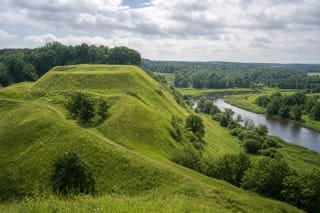
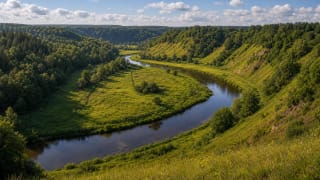
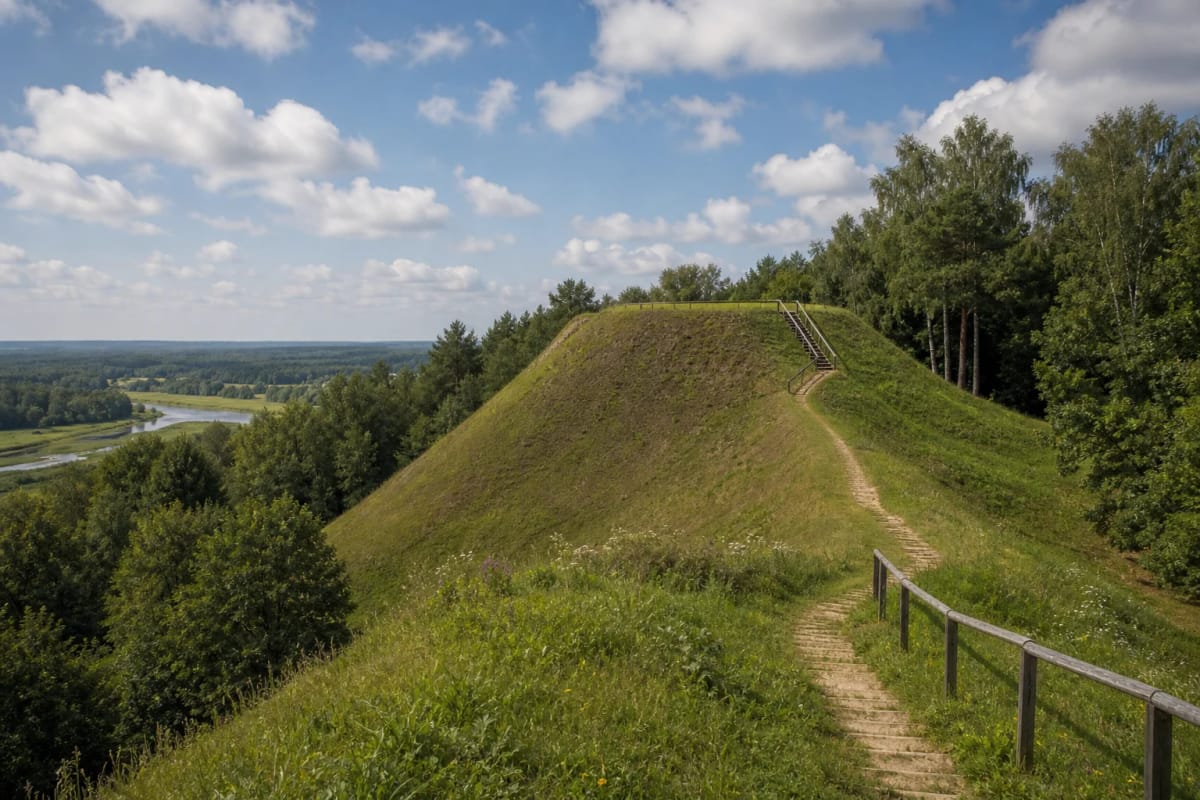
Kalniškės, or Gargždai, Hillfort rises about 20 m above the Minija on the northeastern edge of Gargždai. It is one of the better arranged Curonian hillforts in the Klaipėda region: stairs lead up to it, paths and viewpoints have been installed, and visitors can climb onto the Iron Age fortress site.
Do not confuse this place with the Kalniškės battle and Kalniškės Forest in Lazdijai District, Dzūkija. That is a completely different site more than 300 km away. This hillfort is beside Gargždai in Samogitia.
Shape and Fortifications
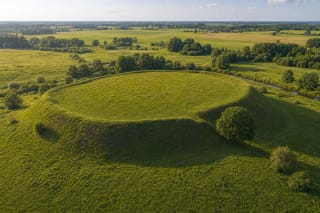
The hillfort was built on a high promontory of the left Minija bank, enclosed on two sides by the river valley and an unnamed stream valley. The slopes are steep, about 20 m high, and the easier eastern approach was the most strongly fortified.
The elongated trapezoid platform covers about 2,500 sq. m. It was once divided by a rampart into a lower eastern part and a larger western part. At the eastern end several ramparts and ditches were built; sources differ slightly, but roughly three ditches and three to four ramparts are indicated. A foothill settlement of about 1 ha lay at the southwestern foot of the hillfort.
Dating, Research, and Finds
The hillfort was inhabited from the end of the 1st millennium BC to the 13th century. The earliest finds reach back to the Bronze Age, and Roman coins have also been discovered. Liudvikas Krzywickis described the site in the early 20th century; later it was studied by the Lithuanian Institute of History. In 1998 the foothill settlement was excavated, and in 1999-2000 slope-stabilization work added visitor stairs.
The fortress was built and occupied by the Curonians. It is believed that this may be the Curonian castle mentioned in the 1253 Courland division act; some sources call it Garisda and identify it with Gargždai. This identification should be treated as a scholarly hypothesis. Finds are held by the National Museum of Lithuania.
Raganinė and Legends
The field around the hillfort is called Raganinė, roughly 'witch place'; tradition says an old-faith sacred site may have stood here. Various legends are also attached to the hillfort: iron doors hidden underground, a sunken manor, underground shelters beneath the Minija, and buried treasure.
These are folklore rather than archaeologically confirmed facts; no tunnels have been found in research. Still, the stories show how important the place remained in local memory.
How to Visit
The hillfort is an open, free site that can be visited year-round. It has stairs, paths, viewpoints, a fire pit, information boards, and a parking area. In summer it is a walking place; in winter it is a popular sledding hill.
Allow 30-60 minutes. On a clear day the top gives views of Gargždai and the Minija valley, and the visit pairs naturally with Gargždai Area Museum and the Minija old valley.