- Place
- Druskininkai, Druskininkai Municipality
- Region
- Dzūkija
- Type
- a lakeside pine and officially marked M. K. Čiurlionis memorial place
- Address
- 11 V. Kudirkos Street, Druskininkai, LT-66165
- Coordinates
- 54.01353, 23.97476
- Visit duration
- 15-30 minutes for the pine, roots, and information sign; 45-60 minutes with a walk along Lake Druskonis
- Best time
- a calm evening in daylight for the lake view, or early spring when the root structure is clearest; avoid strong winds and an icy slope
Druskininkų storoji pušis, Historic M. K. Čiurlionis Pine, Historic Pine of Mikalojus Konstantinas Čiurlionis, Chair Pine, Pine by Lake Druskonis
Two names identify one pine beside Lake Druskonis
The exact Google Maps listing Druskininkai Thick Pine Tree marks a tree at 11 V. Kudirkos Street, coordinates 54.0135329, 23.9747617. The current official Druskininkai events directory lists the Historic M. K. Čiurlionis Pine at the same address, while municipal and official destination pages show the same lakeside setting and unusually rooted tree. These are not two neighbouring attractions but two names attached to one pine.
On 15 July 2026, the exact listing, place ID ChIJ9yFi-PWb4EYRfExPnesuIXc, showed an average score of 4.7 out of 5 from 28 reviews. The number of reviews, average score, and opening-hours label are mutable, so the verification date matters as much as the figures.
The word Thick remains useful because it matches the established map label, but no authoritative object-specific source checked for this guide provides a dated trunk circumference or diameter. It cannot therefore be treated as a verified record or compared with Lithuania's thickest pines on the strength of the name alone. The current official name emphasises the tree's association with M. K. Čiurlionis instead.
The chair shape comes from exposed supporting roots, not the trunk
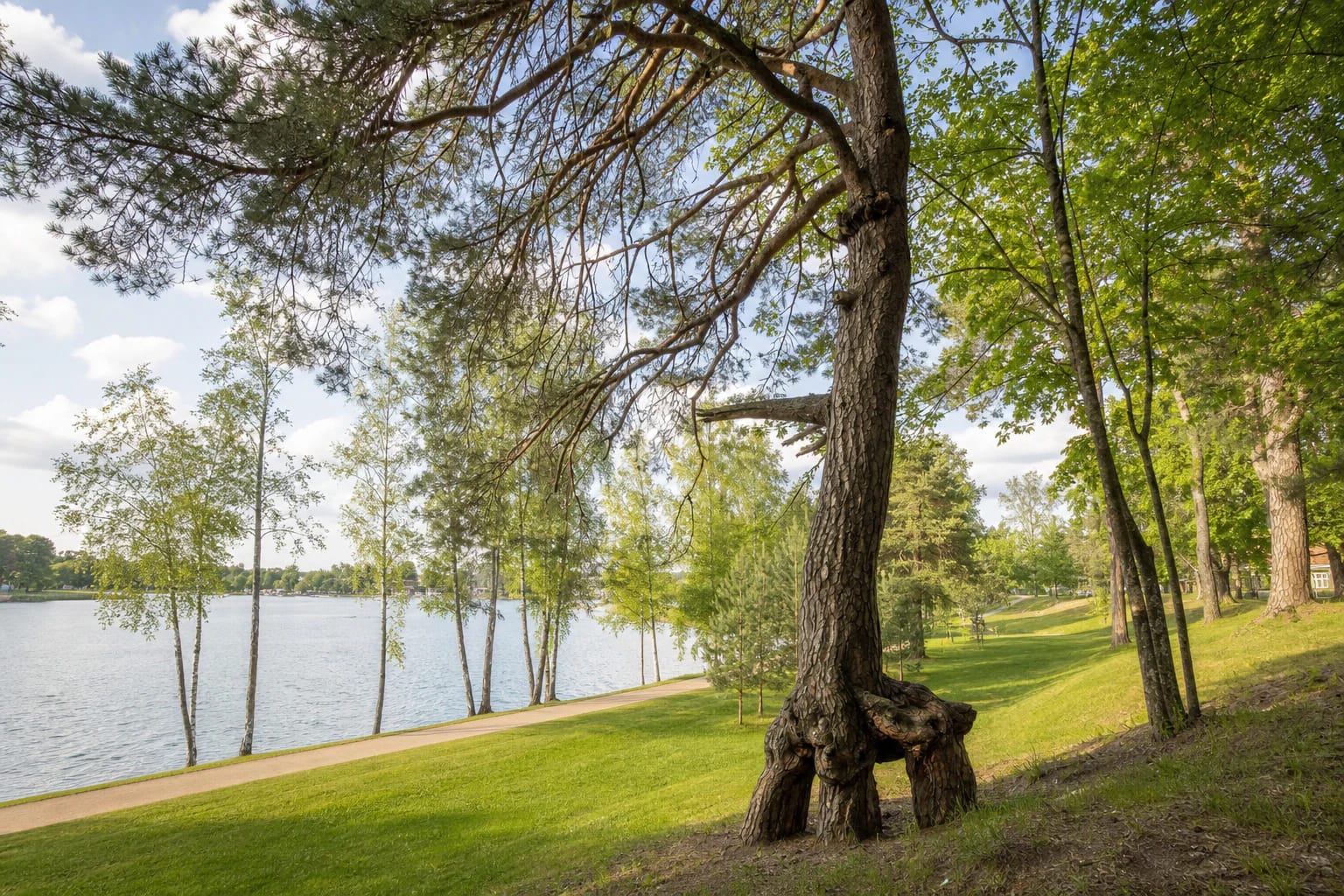
The pine grows not on a level forest floor but on a green slope above Lake Druskonis. Its trunk rises from massive roots that twist downhill above the soil. Open spaces remain between the wooden supports, giving the base the appearance of a low chair from one angle. Higher up, the trunk leans towards the water and divides into old, irregular branches.
Čiurlionis' sisters compared the root formation to a seat, while another official description likens the roots erupting from the soil to candelabra. Those vivid comparisons tell visitors exactly where to look: the defining feature is the exposed base on the slope, not just the canopy overhead.
The official pages checked do not publish a formal species identification, measured height or girth, age, or study explaining why the roots became exposed. Photographs look consistent with a Scots pine, but visual inference is not a botanical record. It would likewise be speculative to attribute the entire form to erosion without a site assessment.
The Čiurlionis connection comes from family recollections, not a late legend
The M. K. Čiurlionis Museum chronology records that the family moved to Druskininkai in 1878, when the future artist was two. The official account of the pine explains that they rented a modest house by Lake Druskonis for almost two decades. That building has not survived; the family later acquired the houses now preserved as the memorial museum.
Jadvyga and Valerija Čiurlionytė recalled a strange pine near the rented home whose thick roots twisted across the surface to form something like a seat. According to their account, their brother Mikalojus Konstantinas liked to sit there in the evening and watch the sun set on the far side of Lake Druskonis. This is recorded family memory, although the public sources do not provide a tree-ring study independently dating the pine.
The family's everyday setting adds useful context. Čiurlionis' father Konstantinas served as organist at the old Druskininkai church from 1878 to 1906, while Mikalojus Konstantinas attended school here and received his first music lessons from his father. The pine is not presented as the proven source of a particular painting. It is a marker of a documented youthful environment and of quiet attention to the landscape.
A 2025 sign turned a family memory into a legible stop on the town map
On 16 May 2025, Druskininkai formally commemorated the pine as a place associated with M. K. Čiurlionis. At the initiative of art historian Aušra Česnulevičienė, the municipality installed a small information sign with a QR code linking visitors to the story of the Čiurlionis family by the lake.
The official Druskininkai page places a present-day photograph beside an image from the M. K. Čiurlionis House-Museum exhibition Old Druskininkai titled Pine by Lake Druskonis. Bringing together the archival view, family recollections, and the living tree is the point of this stop. Visitors are reading both a natural feature and the cultural landscape of the resort.
A commemorative sign is not the same thing as natural-heritage or Cultural Heritage Register designation. It identifies a story and makes the tree easier to find, but does not by itself confer a separate legal category. The 2025 ceremony should therefore not be recast as the date on which the pine became a natural monument.
The current VSTT list does not confirm individual natural-monument status
VSTT's public list for Druskininkai Municipality names Latežeris Oak as the municipality's botanical natural heritage object, and Snaigupėlė Exposure and the Devil's Stone as geological objects. It does not include either Druskininkai Thick Pine Tree or the M. K. Čiurlionis Pine. This page therefore does not call the tree a state-protected botanical natural heritage object or natural monument.
General municipal rules may still protect urban greenery, but that is not equivalent to an individual entry in the national natural-heritage register. No separate public municipal decision granting this particular pine local natural-monument status was found in the authoritative sources checked for this guide.
The absence of that legal label is no reason to damage the tree. Do not climb or sit on the exposed roots even though the family recollection calls them a chair. Modern visitor traffic can compact soil, abrade bark, and accelerate wear on the slope, so the root structure is best photographed from a short distance.
The outdoor stop has no advertised fee, but the exact pin is not a car park
Official Druskininkai pages classify the pine as an outdoor space and publish no admission fee, ticket desk, or set visiting hours. On 15 July 2026, Google marked the place open 24 hours, but that mutable label should be checked again before travelling. Daylight is more practical for the slope, roots, and QR sign, and visitors should not linger beneath old branches in strong wind.
The coordinates mark the tree in a green space beside Lake Druskonis, not a reserved parking place. The closest approach crosses an uneven grassy slope, while a walking path is visible lower down beside the water. No official specification for a step-free route to the roots, surface width, or gradient was found, so a wheelchair user should plan to view the tree from the more level lakeside area and travel with a companion.
This short stop combines naturally with the M. K. Čiurlionis Memorial Museum, Druskininkai City Museum, and Vijūnėlė Park. At the pine, look from three positions: uphill at the supporting roots, side-on at the leaning trunk, and from the shore at the relationship between tree and lake. Those views reveal more than pressing as close to the trunk as possible.