- Place
- Liškiava, Varėna District Municipality
- Region
- Dzūkija National Park
- Type
- hillfort and unfinished brick castle site by the Nemunas
- Coordinates
- 54.08100, 24.04300
Liškiava Castle Hill, Castle Hill, Raganos mūras, Perkūnas Sanctuary
Hillfort above the Nemunas: relief and landscape
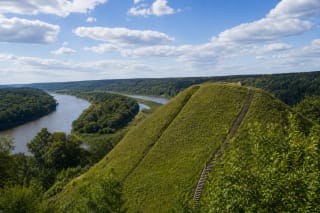
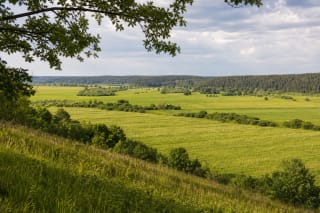
Liškiava Hillfort stands on the left bank of the Nemunas, on the southwestern edge of Liškiava village in Merkinė eldership, Varėna District, in one of the most impressive parts of Dzūkija National Park. VLE describes it as a steep-sided hill: from the south and southeast it is bordered by the Nemunas, while ravines lie to the north and west. On the western side, a ravine about 17 m deep separates the hillfort from Liškiava's sacred hill, so the whole hill reads as a clearly defined defensive site.
The slopes from the Nemunas side are about 30 m high and steep; from the west and southwest they are gentler, 6-7 m high and disturbed, probably where an earthwork once stood. The hillfort platform is elongated, about 100 x 50 m, and remains of castle towers are still visible in its southwestern and northwestern corners. This combination lets visitors read both natural and human-made defensive logic in one place.
Occupied from the third century BC: archaeological data
VLE states that Liškiava Hillfort was used from the third century BC to the ninth century AD, and that an ancient settlement lay at its northeastern and eastern foot, studied in 1975. That means the place has a much longer history than the later brick castle project: people lived here and built up cultural layers for more than a millennium before the medieval castle.
In 1962, 1975, and 1977, archaeological expeditions of the Monument Conservation Institute studied about 250 m2 of the hillfort under V. Daugudis, K. Mekas, and Juozas Markelevičius. The cultural layer is 1.0-1.5 m thick. Finds include hand-built pottery with brushed and rough surfaces, remains of stone paving, animal bones, bone and metal tools and ornaments, and, on the western slope, pits 0.6-1.25 m wide with charcoal. The finds are kept in the National Museum of Lithuania.
The unfinished brick castle after the Battle of Žalgiris
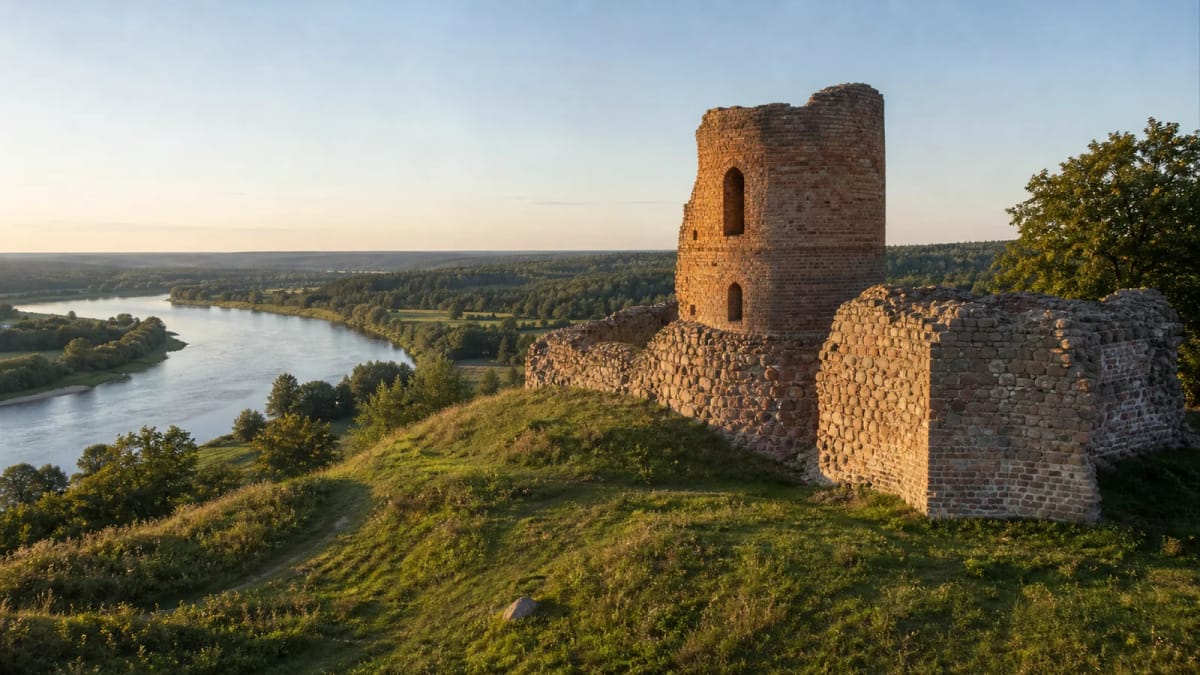
What sets Liškiava Hillfort apart from many other Dzūkija hillforts is the surviving brick castle masonry. VLE states that in the late fourteenth or early fifteenth century a brick castle began to be built on the hillfort, but after the Battle of Žalgiris in 1410 it lost defensive importance and remained unfinished. This is a rare case where the landscape shows not a legend, but a specific building project stopped in progress.
The southwestern tower was almost built: in the nineteenth century it still reached 8-10 m high, while today a 2.5-3 m wall survives, conserved in 1962. The northwestern tower had also begun, and a ditch for defensive-wall foundations had been dug between the towers. These remains are the real trace of an unfinished defensive project, so do not touch or climb on the masonry.
Liškiava ensemble: Holy Trinity Church and Čiurlionis
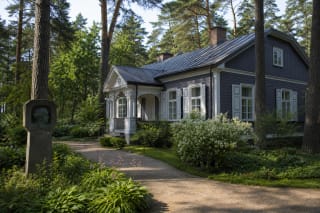
After seeing the hillfort, descend into Liškiava village, where one of Lithuania's most beautiful late Baroque ensembles stands: Holy Trinity Church and the former Dominican monastery. VLE states that the central, domed, Greek-cross-plan church was built in 1704-1741; it contains seven Rococo altars, a pulpit, confessionals, and kneelers, all from the eighteenth century, and a brass bell cast in 1761. One painting, St Bartholomew from 1914, was painted by Antanas Žmuidzinavičius.
Liškiava also has musical memory: VLE notes that Mikalojus Konstantinas Čiurlionis played the organ in this church. The nearby sacred hill and one of the hillfort names, Perkūnas Sanctuary, recall that before the Christian ensemble the place was connected with older Baltic worldviews.
Raganos mūras and legends
Liškiava Hillfort has several alternative names: Castle Hill, Raganos mūras, and Perkūnas Sanctuary. Such names show that the place lived not only in historical documents but also in folk imagination, where the unfinished masonry looked mysterious and even supernatural.
Legends about Raganos mūras should be told as stories, not as archaeological facts. Documented history rests on the hillfort dating, the attempted brick castle construction, and the defensive logic of the landscape; folklore explains why the place became fixed in local memory.
How to visit Liškiava
Allow at least 45 minutes for Liškiava Hillfort, and half a day if you also visit the church, monastery, and Nemunas valley. Walk without rushing, because the masonry remains, panorama, and relief open from different points, and the Nemunas bend from the platform is especially beautiful in evening light.
After rain the steep slopes can be slippery, and the masonry remains must be protected: do not climb on the walls, do not collect stones, and stay on existing paths. This is one of those places where good visiting directly affects heritage survival. Liškiava combines well with Merkinė Hillfort, Merkinė Observation Tower, and Raigardas Valley in one Dzūkija day.