- Place
- Marcinkonys, Varėna District Municipality
- Region
- Dzūkija
- Type
- inland continental sand dune
- Address
- Gaidžiai corner, Marcinkonys, Dzūkija National Park, Varėna District
- Coordinates
- 54.06980, 24.39760
Klonių Hill, Klonių Dune
Gaidžiai Dune: a sand hill in the forest
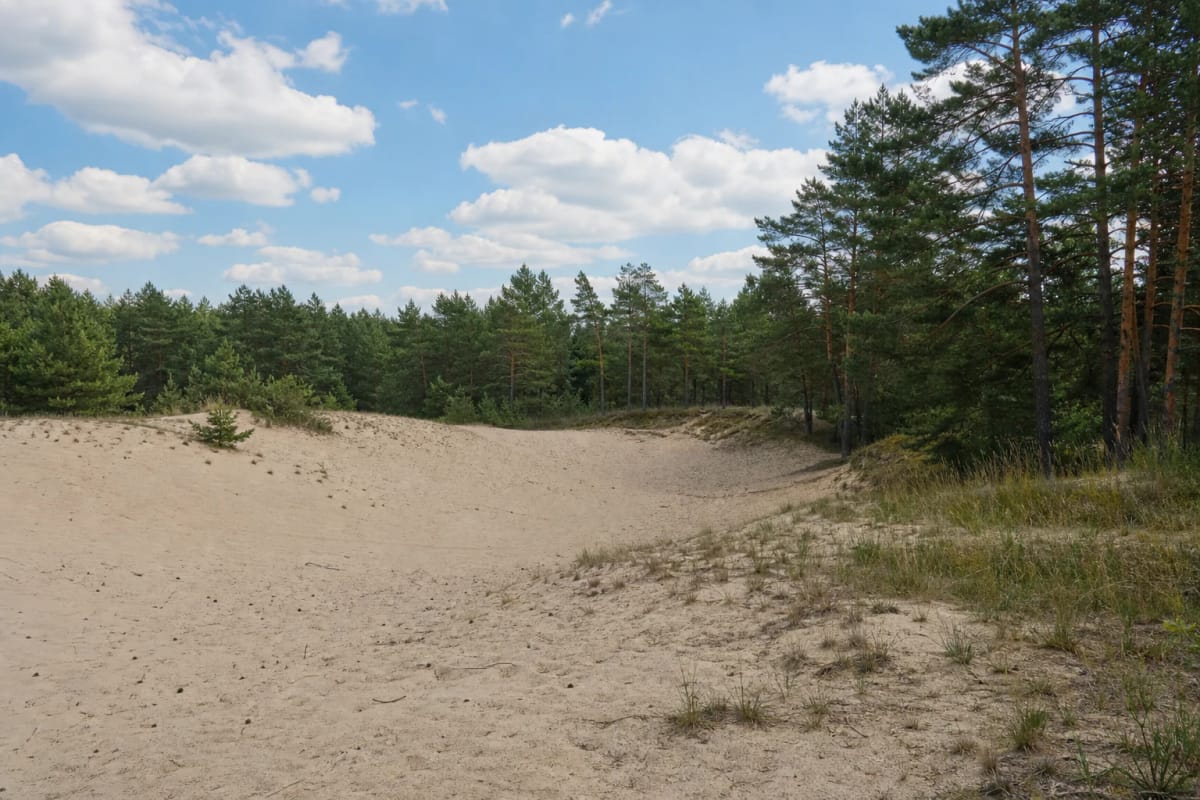
Gaidžiai Dune, officially also called Klonių Hill, is in Dzūkija National Park on the edge of Marcinkonys village, in the area known as the Gaidžiai corner. It is an open pale sand hill surrounded by pine forest, a kind of beach without the sea in the middle of the woods.
The site is impressive because of the contrast: Dainava Forest is green all around, while here bare wind-blown sand opens up. It lets visitors see what a living, still-moving inland dune looks like.
Inland dune and moving sand
Gaidžiai Dune is an inland, or continental, dune formed after the Ice Age from wind-blown sand. Such dunes extend for tens of kilometres in the Dzūkija pinewoods, but almost all are now inactive because trees and grasses have fixed the sand.
Gaidžiai Dune stands out because wind still moves it: it remains open and alive. Popular accounts call it the only still-moving inland dune in Lithuania; it is better to treat that as a widely repeated claim, because official sources phrase the point more cautiously, as a rare dune that has not yet been fully stabilized.
Dzūkija's sandy country
Gaidžiai Dune is part of the Marcinkonys inland dune massif, one of the largest such sand concentrations in Dzūkija. The wider region is covered by pinewoods: Dzūkija National Park is Lithuania's most forested national park, dominated by dry lichen and moss pine stands.
This landscape of sand and pine is typical of Dainava Forest. It is important to remember that this is an inland dune, not a coastal dune, and should not be confused with the Curonian Spit dunes by the sea.
Nature trail
The dune is easiest to reach on foot from the Marcinkonys visitor centre via the nature trail called Per šventas aglas. It is an easy loop of about 11 km that takes roughly three hours and leads through characteristic Dzūkija pinewoods and sandy areas.
At the dune itself, stop longer, look across the open sand, and feel the contrast with the forest. In summer the sand and sun can be hot, so bring water and a hat.
How to visit Gaidžiai Dune
The dune is an open, freely accessible nature site in Dzūkija National Park, with no separate ticket. At the dune itself 30-60 minutes is usually enough; the full trail with stops takes about three hours.
It is convenient to combine the visit with Marcinkonys and other park sites. Before going, check the official national park page for the latest information about the trail and the Marcinkonys visitor centre.