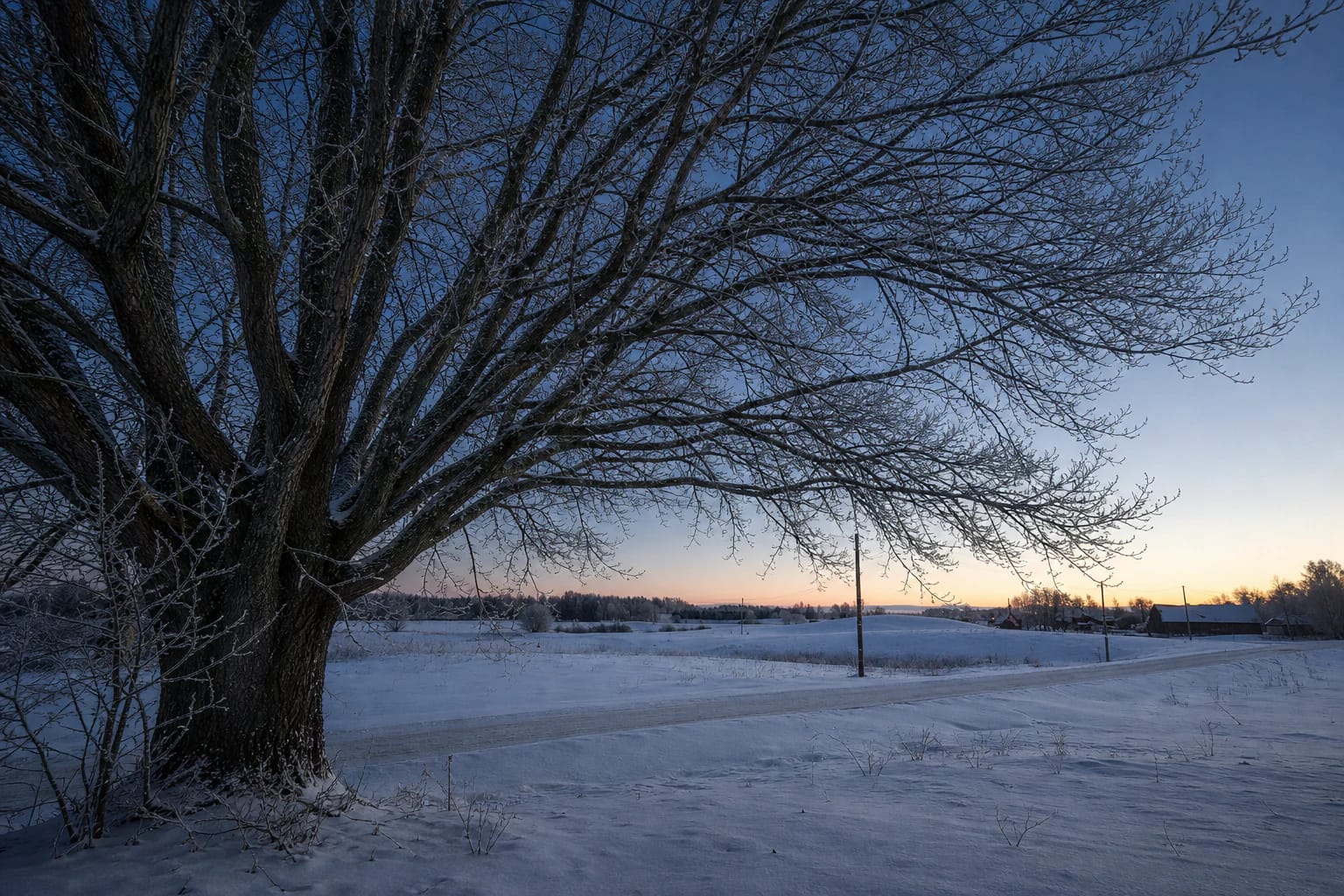
- Place
- Domantonys, Alovė Eldership, Alytus District Municipality
- Region
- Dzūkija
- Type
- a locally named mature oak beside a village homestead and local road, with no confirmed natural-heritage designation
- Address
- 17 Domantonių Street, Domantonys village, Alovė Eldership, Alytus District Municipality
- Coordinates
- 54.38620, 24.18198
- Visit duration
- 10-20 minutes to view the silhouette from permitted roadside or homestead access without moving deeper into private space
- Best time
- calm daylight in spring or autumn, when the crown structure is clear; summer suits a leafy view, while strong wind is a reason not to stand beneath large limbs
Domantonių ąžuolo širdis, Domantonių Ąžuolo Širdis
The name marks a living oak, not a heart-shaped sculpture
The exact Google Maps listing Domantonys Heart Oak marks a tree at 54.386198, 24.181975 beside 17 Domantonių Street. It is a living, widely branching oak at the edge of a village homestead. Google categorises it as a tourist attraction, but presents no museum, park, sculpture, or established nature trail.
On 15 July 2026, the gallery contained one winter photograph bearing a February 2026 date. Heavy primary limbs remain conspicuous in the leafless crown; the tree rises beside a snow-covered local road with open fields beyond. No heart cut-out, separate heart sculpture, protection sign, or visitor panel is visible, so the name should not be turned into a promise that a physical heart-shaped exhibit awaits on site.
The strongest reason to stop is the living silhouette, broad crown, and relationship between one mature tree and an open Dzūkija village landscape. The map name is a useful navigation label, not a botanical description, protection order, or historical record.
The origin of the word Heart is not publicly documented, so this guide does not invent a legend
No explanation was found in the municipal, protected-area, address-register, or publicly indexed local sources checked for this page for who named the tree, when the name arose, or what Heart specifically means. The account attached to the Google gallery photograph uses the place name but does not identify a creator, owner, or origin story.
It would be possible to speculate about an emotional bond with the village, a feature of the crown, or the tree as the centre of a homestead. None of those interpretations is documented. This page therefore treats Heart as part of the place name rather than as a confirmed legend. Any explanation displayed by residents at the tree in the future would carry more weight than an online guess.
The same caution applies to the oak's biography. No public record was found for who planted it, whether it regenerated naturally, which local events it witnessed, or whether oral stories are associated with it. A memorable name is not evidence for a fabricated romance, oath, or miracle tale.
This is not the oak replanted in Alytus city's Domantonys Hills Park in 2017
A very similar name elsewhere in the Alytus area creates a genuine risk of confusion. Alytus city planning documents identify Domantonys, or Cedar, Hills Park as a separate 7.47 ha urban park. Local reporting records that an oak planted there to commemorate restored independence was cut down by vandals and replaced in 2017.
The Domantonys Heart Oak listing points elsewhere: to Domantonys village in Alovė Eldership and 17 Domantonių Street. The Centre of Registers likewise places Domantonys village in Alovė Eldership, while Alytus District Municipality includes it among the settlements of Venciūnai sub-eldership.
Merging the two places would create a false biography. Dates associated with the park oak, including 1991 and 2017, cannot be transferred to the tree at 17 Domantonių Street. Navigate with place ID ChIJ_Q8EQACt4EYRZm2Wbmeb7CA rather than the words Domantonys oak alone.
Current records confirm neither natural-monument status nor an age or set of measurements
The State Service for Protected Areas lists Norūnai Forest Spruce, the Punia Forest trees, and several other named botanical natural heritage objects in Alytus District, but not Domantonys Heart Oak. No separate municipal decision or cadastre entry conferring protected natural-heritage status on this tree was found during the check.
Absence from the current list neither proves that the tree lacks value nor prevents future protection, but it does mean that the oak should not be called a natural monument. VSTT explains that a proposal for protection requires a precise location, quantitative evidence such as height, age, or diameter, and an assessment of qualitative properties. No published evaluation of that kind was found for this tree.
There is likewise no published trunk circumference, height, crown span, planting date, tree-ring study, or arborist's report. The photograph shows a mature tree with heavy branching, yet an image without scale cannot establish metres or years. Even the species should remain at the public name oak rather than being assigned a precise Latin taxon from one leafless view.
The precise pin marks a tree at a homestead, not a car park or public-park gate
The point 54.386198, 24.181975 marks the tree itself beside 17 Domantonių Street. Maps show a narrow local road and scattered homesteads, while the public listing identifies no separate car park, entrance path, toilet, or accessibility provision. The coordinates are therefore a site pin, not a guaranteed place to leave a vehicle.
Alytus District notices confirm the local Domantonys-Židonys road route but do not identify a special entrance for the oak. Slow only when safe, do not stop in the traffic lane, block a gate or field access, or leave a vehicle on crops or grass without permission.
The tree may be visible from the public road, but permitted proximity to the trunk can change with fences, gates, farm work, or residents' wishes. A Google tourist category and a high rating do not create a public right of way. If reaching the trunk would require crossing a yard, fence, or clearly private meadow, ask first.
08:00-19:00 is mutable map data, and a considerate visit is brief
On 15 July 2026, the exact Google Maps listing showed an average of 5.0 out of 5 from eight reviews and daily hours of 08:00-19:00. Such a small review sample can change after one new rating. The hours are editable map information, not a timetable published by a municipality or ticket office.
The listing gave no telephone number, website, ticket price, or booking procedure. The supportable conclusion is only that no public admission charge was found, not that visitors automatically have free entry into homestead grounds. Recheck the listing before a special journey and follow signs and residents' directions on arrival.
Allow 10-20 minutes for the tree itself. In daylight, compare the crown and trunk with the road and fields from permitted access, but do not step on roots, break twigs, or hang ribbons. Do not stand beneath a mature crown during a storm or strong wind, and avoid disturbing a homestead early in the morning or late in the evening even when the map still says open.