- Place
- Daukšaičiai, Vilkaviškis District Municipality
- Region
- Suvalkija
- Type
- a state-protected pedunculate oak and botanical natural heritage object
- Address
- Daukšaičiai village, Bartninkai Eldership, Vilkaviškis District Municipality
- Coordinates
- 54.53337, 23.05210
- Visit duration
- 20-40 minutes for the trunk, broad crown, and field landscape, excluding a possible walk along the final field track
- Best time
- May to October on a dry, calm day for the green crown, or the leafless season to see the old branch structure
Daukšaičių ąžuolas, Daukšaičiai village oak
The open-field oak is defined by a crown wider than its height
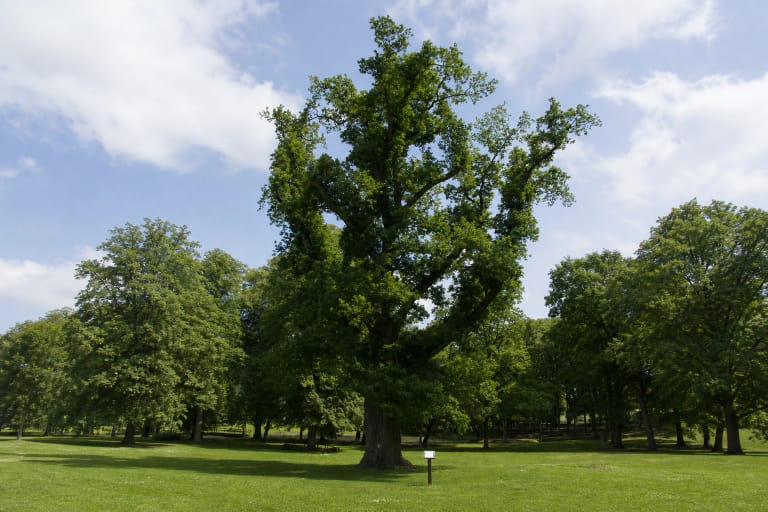
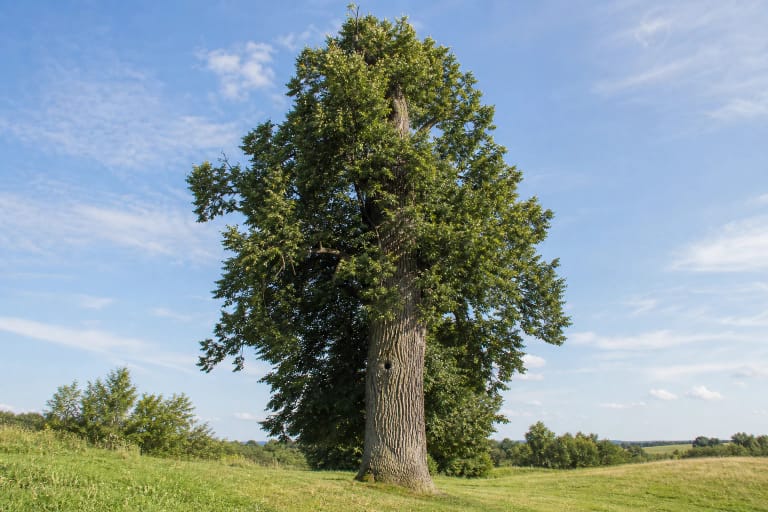
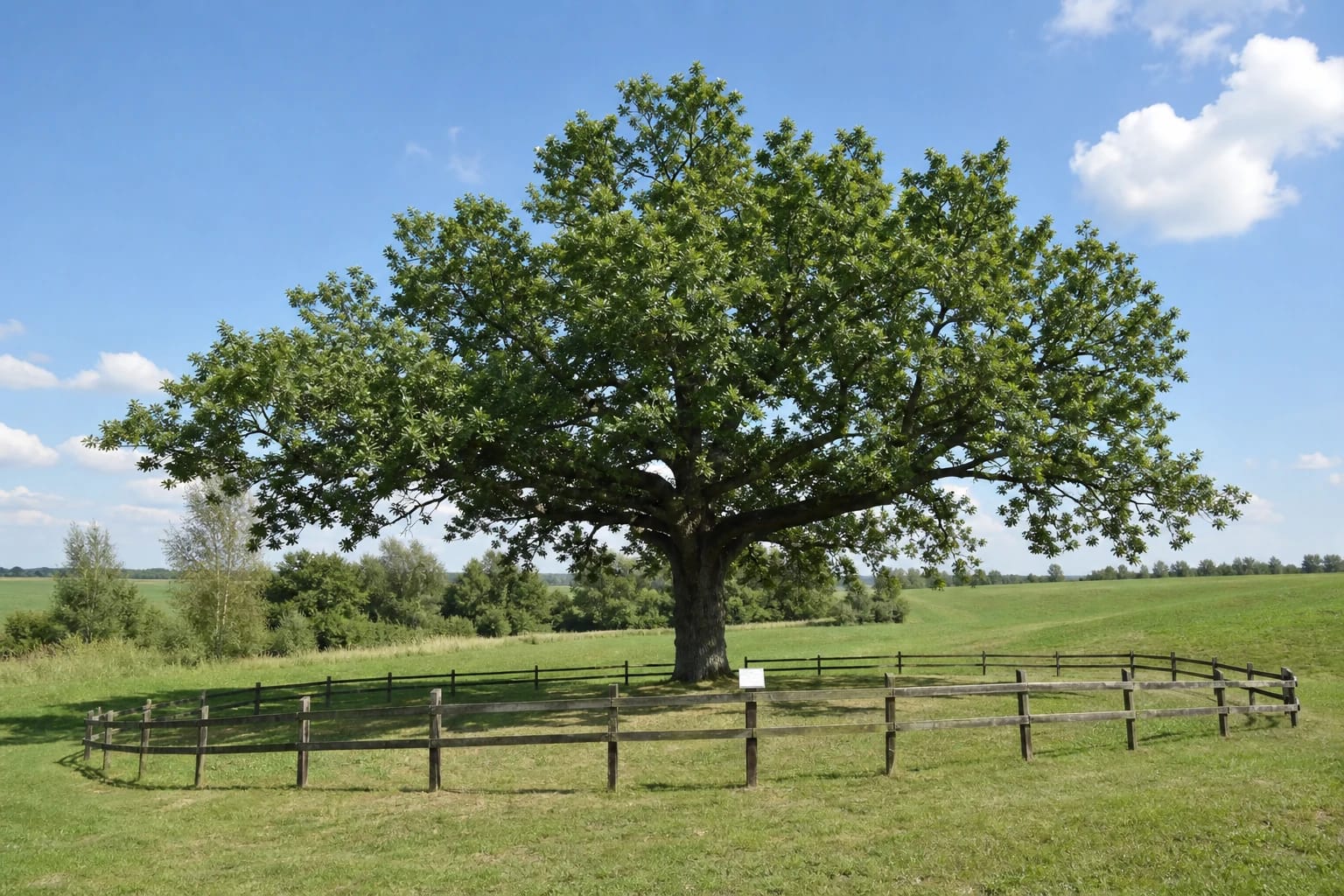
Daukšaičiai Oak does not grow in dense woodland or a formal manor park. It stands in open farmland near the edge of Budavonė Forest. From a distance, the first feature to register is its low, laterally spreading crown. Closer inspection reveals a short, deeply furrowed grey-brown trunk and long principal limbs running almost horizontally.
The State Forest Service measured a height of 22 m and a crown width of 27 m in 2017. The crown was therefore about 5 m wider than the tree was tall. This proportion is characteristic of an oak that has had abundant light and room to grow outward, producing a broad, slightly irregular umbrella-like silhouette.
Documentary photographs from 2023 and 2024 show a dark wooden multi-rail fence around the tree and a small information plaque at the front. Rolling cultivated fields, low scrub, and the woodland edge form the backdrop. Those images establish the site's character, but they do not prove that the fence, plaque, or surroundings remained unchanged in 2026.
The 2017 measurements are a dated baseline, not a permanent condition report
The State Forest Service inspected Daukšaičiai Oak for its veteran-oak inventory on 14 September 2017. At 1.3 m above ground, the trunk measured 108 cm in diameter and 4.5 m in circumference. The tree was 22 m high, its crown spanned 27 m, and the clear trunk rose 4.5 m before the main branches began.
A 2024 Lithuanian Tree of the Year nomination records a circumference of 452 cm, a height of about 22 m, and the same 27 m crown width. The two-centimetre difference in girth should not be turned into a contradiction or blended into a new figure. Measurement date, trunk irregularity, and tape position can all affect the result. This guide uses the clearly dated official 2017 survey as its main baseline.
In 2017, surveyors described both trunk and crown as healthy, and they noted that the tree was bearing acorns. That is a valuable historical observation, not a current arboricultural assessment. Wind, drought, lightning, and branch failure can alter a veteran tree, so old prose and leafy photographs cannot guarantee the present stability of its limbs.
It has been a state-protected botanical natural heritage object since 2016
Section 1.3 of Lithuanian Environment Minister Order D1-88, dated 8 February 2016, names Daukšaičiai Oak among the newly declared state-protected botanical objects. Section 2.20 of the same order approved its boundary plan. The oak remains present in the consolidated list of state-protected natural heritage objects.
Its precise designation is a state-protected botanical natural heritage object. Older or popular descriptions sometimes use natural monument as a general label for a notable old tree, but the legal records checked for this guide do not assign Daukšaičiai Oak the separate higher natural-monument status. Its place among ten nominees in the 2024 Lithuanian Tree election was public recognition, not a legal reclassification.
Protection concerns more than visible trunk wood. Root health, the soil beneath the crown, and the stability of the principal limbs are all part of the living tree. If the protective fence is still present, remain outside it, do not climb the rails, and do not step closer merely for a photograph. Never carve bark, break branches, attach signs, or compact the root zone with a vehicle.
About 200 years is an estimate, not a documented planting date
The tree is a pedunculate oak, Quercus robur, also known in English as the English oak. Its 2024 election profile says it is thought to be about 200 years old. The qualification matters: no planting record or published tree-ring study was found that would establish a precise germination year.
Trunk girth is not a calendar. An oak growing in fertile open ground may thicken at a different rate from a forest tree competing for light, while lost limbs and environmental change can also affect growth. A cautious estimate of roughly two centuries is therefore more honest than an exact age unsupported by evidence.
The tree's value does not depend on whether future research raises or lowers that estimate. Its open-grown architecture, decades of exposure to the agricultural landscape, and protected status make it a living landmark of rural Suvalkija. Visitors gain more by reading the direction of the limbs, the furrowed bark, and the oak's relationship with the surrounding fields than by reducing it to one age label.
The exact map pin marks the tree, not an approach road or car park
The exact Google Maps listing Daukšaičių ąžuolas, place ID ChIJ2X0KIwAx4UYRTGhv0J74_6o, marks 54.533369, 23.0521001. Coordinates published by the State Forest Service convert to approximately 54.53339, 23.05208, and a 2022 Environment Ministry oak study gives virtually the same point. The difference is only a few metres, confirming that the listing identifies the tree itself.
On 15 July 2026, the listing showed 5.0 out of 5, but that average came from only one review. Such a tiny and volatile sample is not evidence of broad visitor consensus, and a single new review can change it sharply. Recheck both the score and review count before travelling.
These coordinates are a site pin at the trunk. They do not identify a driveway, car park, trailhead, or verified right to drive along the route chosen by navigation software. A map app may try to reach the point over an unsuitable or impassable track, so plan the final approach using current signs, weather, and lawful access on the ground.
Dry weather and care on the final field track matter more than speed
In 2017, the State Forest Service suggested taking road 5107 from Vilkaviškis, turning towards Pašeimeniai on road 5132 near Mockabūdžiai, and then driving or walking along a field track. At that time, a direction arrow stood near the end-of-village sign, while an information board and a new fence stood at the oak. A local 2019 report then warned that the final unpaved section could become extremely difficult after rain. Neither the old sign nor the track's current condition has been officially verified for 2026.
The official sources checked identify no dedicated visitor car park, maintained footpath, toilets, lighting, step-free access, tickets, or set opening hours. That does not create an automatic right to visit at any hour or cross surrounding private land without permission. Arrive in daylight and dry weather, never drive across crops, do not obstruct a farm or forest track, and turn back or ask locally if lawful access is unclear.
Allow 20-40 minutes at the oak itself, plus extra time if you need to walk from a lawful stopping place. Photograph from outside the fence, stay away from heavy low limbs in strong wind, and expect soft or muddy ground after rain. Check current map information before departure rather than relying on an old route description alone.