- Place
- Kretinga District Municipality
- Region
- Samogitia
- Type
- Japanese landscape-tradition garden in Kretinga District
- Address
- Sodų g., Mažučiai village, Darbėnai Eldership, Kretinga District
- Coordinates
- 56.03000, 21.20896
Japanese Garden in Mažučiai village, Japoniškas sodas
Japanese Garden in Mažučiai: the largest in Europe
The Japanese Garden in Kretinga District is not a town park with a few decorative features. It is a large, consistently shaped landscape garden. The official presentation calls it the largest in Europe and gives an area of about 16 ha, so visitors enter a space that rewards slow walking and careful observation. More than 100,000 people have already visited it.
The garden is in Mažučiai village, Darbėnai Eldership. That matters because the Japanese landscape tradition here is not inserted into a big-city decorative setting. It meets Samogitian fields, forest, ponds, and Lithuania's climate, making the garden both a cultural dialogue and a landscape experiment.
Creators: Hajime Watanabe, Rokas Vaičius, and Šarūnas Kasmauskas
Official garden sources link its creation with Japanese master Hajime Watanabe and Dr. Šarūnas Kasmauskas. The original initiator was Rokas Vaičius, who invited Watanabe and studied bonsai art in Japan. This partnership is the garden's main source of authority: it is not only imitating 'Japanese' signs but working through the logic of landscape composition, stone, water, and plants.
The garden's beginning is given as 10 October 2007. That means the site is still relatively young, but old enough to have begun forming its own character. In landscape gardens age matters: trees grow, compositions mature, and the relationship between paths and plants changes with seasons.
What to see in the garden
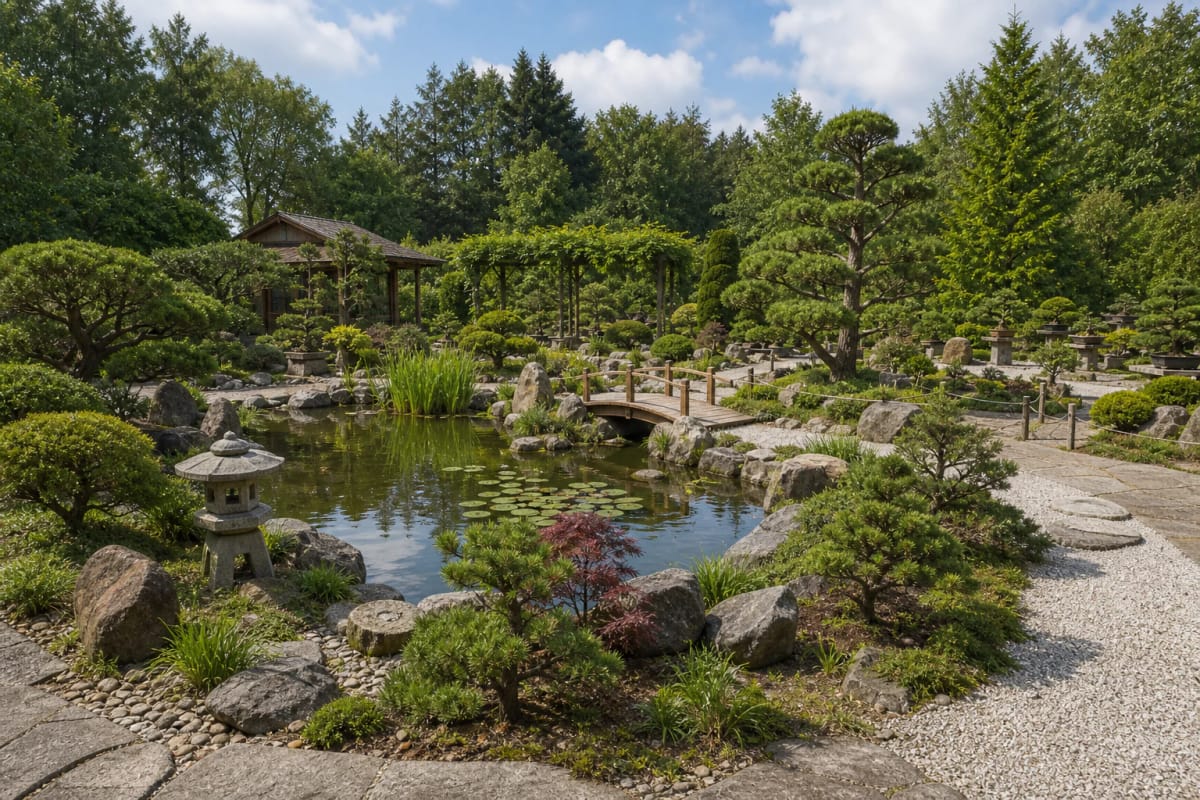
The main elements are ponds, stone compositions, shaped trees, bonsai, a sakura area, paths, and quieter viewing places. This is not a site where one viewpoint 'does' the whole visit; it is best to follow the route and let scenes change.
The stone garden, water, and plant forms should be viewed together. A Japanese-garden principle is not to overload the eye, so the most valuable moments are often small: the position of a stone, a reflection in water, a branch above a path, or a quiet perspective toward a pond.
Sakura, bonsai, and seasons
In spring, sakura and early greenery draw the most attention. In summer, the garden becomes fuller, greener, and better for a longer walk. In autumn, colour and leaf change are the main values, while winter reveals the structure of stones and tree silhouettes more clearly.
Bonsai and shaped trees remind visitors that the garden is not a self-growing park but the result of long-term work. In places like this, maintenance is part of creation, so it is worth noticing not only photographs but also the precision of the human hand.
How to visit the Japanese Garden
Allow at least 1-2 hours. A shorter stop lets you see the main spaces, but the garden suits a slow rhythm: stop by water, stones, and trees, and choose the calmer path rather than the fastest one.
Before travelling, check official opening hours, tickets, and seasonal notices. During spring bloom there may be more visitors, so early morning or a weekday is better for a quieter visit.
What to combine nearby
The Japanese Garden combines well with Kretinga Manor and Winter Garden, Palanga, Darbėnai, or Orvidai Homestead. That route offers strong contrast: Japanese landscape composition, a Samogitian manor, and seaside culture in one day.
If travelling with children, present the garden not simply as a park but as a place to look for details: stones, bridges, water, small trees, and turns in the path. That helps keep attention without excessive explanation.