- Place
- Kretinga District Municipality
- Region
- Samogitia
- Type
- Curonian hillfort with a foot settlement
- Address
- Senoji Įpiltis, Darbėnai Eldership, Kretinga District
- Coordinates
- 56.12320, 21.24650
Įpiltis Hillfort, Pilies kalnas
Senoji Įpiltis Hillfort: a Curonian castle hill
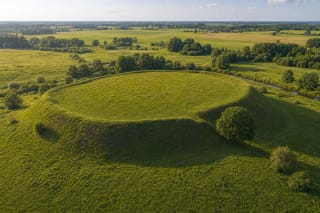
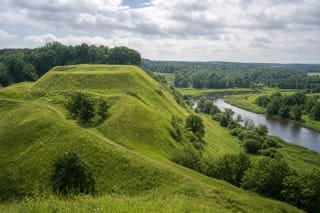
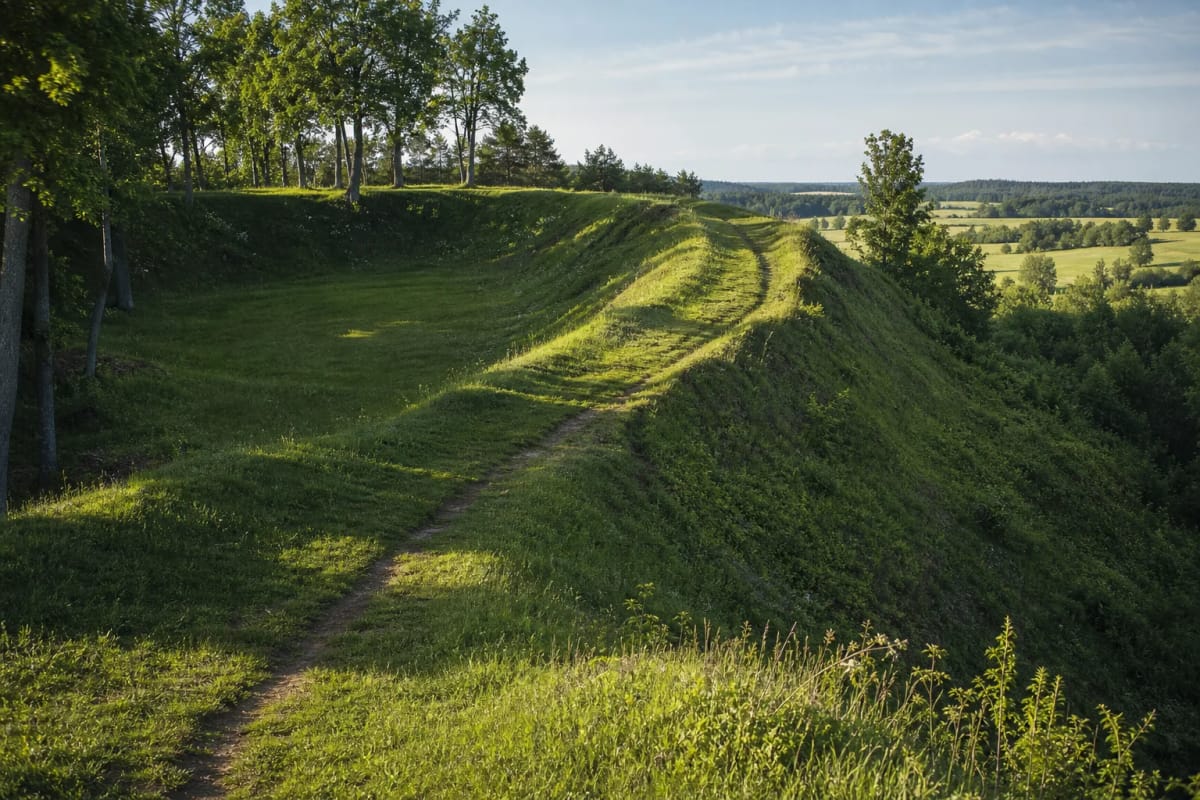
Senoji Įpiltis Hillfort, locally called Pilies kalnas, stands in Kretinga District, Darbėnai Eldership, by the Įpiltis stream. It is one of the most impressive Curonian hillforts in Samogitia, built up and enclosed with wooden fortifications by the Curonians who lived here.
The hillfort platform is oval and elongated, about 60 x 40 m and about 0.5 ha in area. On the landward side it is defended by a powerful rampart reaching 8-10 m high and 36-40 m wide, so the platform resembles a bowl. At the northern foot lay a settlement of about 5 ha, showing that this was not an ordinary site but a significant one.
Castle of Duvzarė land
Įpiltis was an important centre of the Curonian land of Duvzarė, guarding its southern part. In written sources the castle is first mentioned in 1253, when the document of Curonian bishop Heinrich dividing southern Courland assigned Įpiltis to the Livonian Order; it is later mentioned in crusader documents in 1290 and 1291.
Research showed a long and changing life at the site: the Curonians rebuilt and raised the fortifications after each fire. In 1261 the people of Įpiltis rebelled against the Livonian Order, and in 1263 Order troops stormed and burned the castle. After losing its importance, it was eventually abandoned.
Research and finds
The hillfort was investigated in 1933-1934 by an expedition led by General Vladas Nagevičius. About one thousand square metres were examined, including both rampart sections and the gate area. Later, the settlement and platform were surveyed several more times.
Finds included hand-built and wheel-thrown pottery, burnt grains, late Iron Age arrowheads, a silver ingot, and an impressive gate tunnel with oak walls. The finds went to the Vytautas the Great War Museum. Around the hillfort, traces of sacred landscape also survive: Alka Hill and old burial grounds, popularly called Plague or Soldiers' Graves.
How to visit
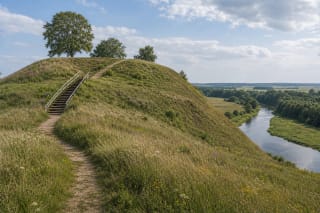
The hillfort is an open, free archaeological monument that can be visited at any time. The easiest way to reach the platform is by the old track between the stream valley and the rampart. Memorial signs around the site recall the Curonian past, and the hill gives views of the Įpiltis valley.
The best season is late spring to autumn, when the slopes are dry. Steep slopes 6-10 m high become slippery after rain. Usually 30-60 minutes is enough; the visit can be combined with the other Senoji Įpiltis hillforts and a Kretinga-region hillfort route.