- Place
- Dabravolė, Vilkaviškis District Municipality
- Region
- Suvalkija
- Type
- a state-protected multi-stem lime and botanical natural heritage object
- Address
- Dabravolė village, Pajevonys Eldership, Vilkaviškis District Municipality, at the foot of Dabravolė Hillfort
- Coordinates
- 54.47909, 22.78409
- Visit duration
- 20-40 minutes to examine the trunk cluster, shared crown, and setting at the foot of the hillfort
- Best time
- late May to September for the dense green crown, or early spring when the separate stems and their shared base are easiest to see
Dabravolės daugiakamienė liepa, Dabravolė Lime Tree, Dabravolė 25-Trunk Lime
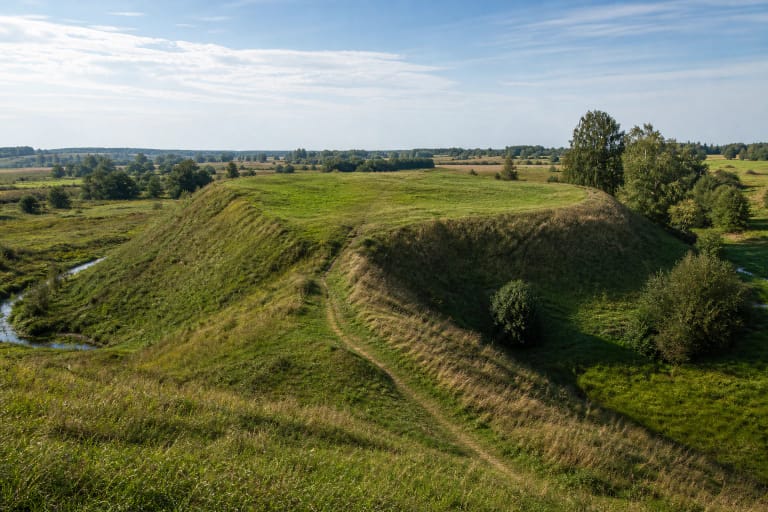
The 25-trunk lime stands at the foot of Dabravolė Hillfort
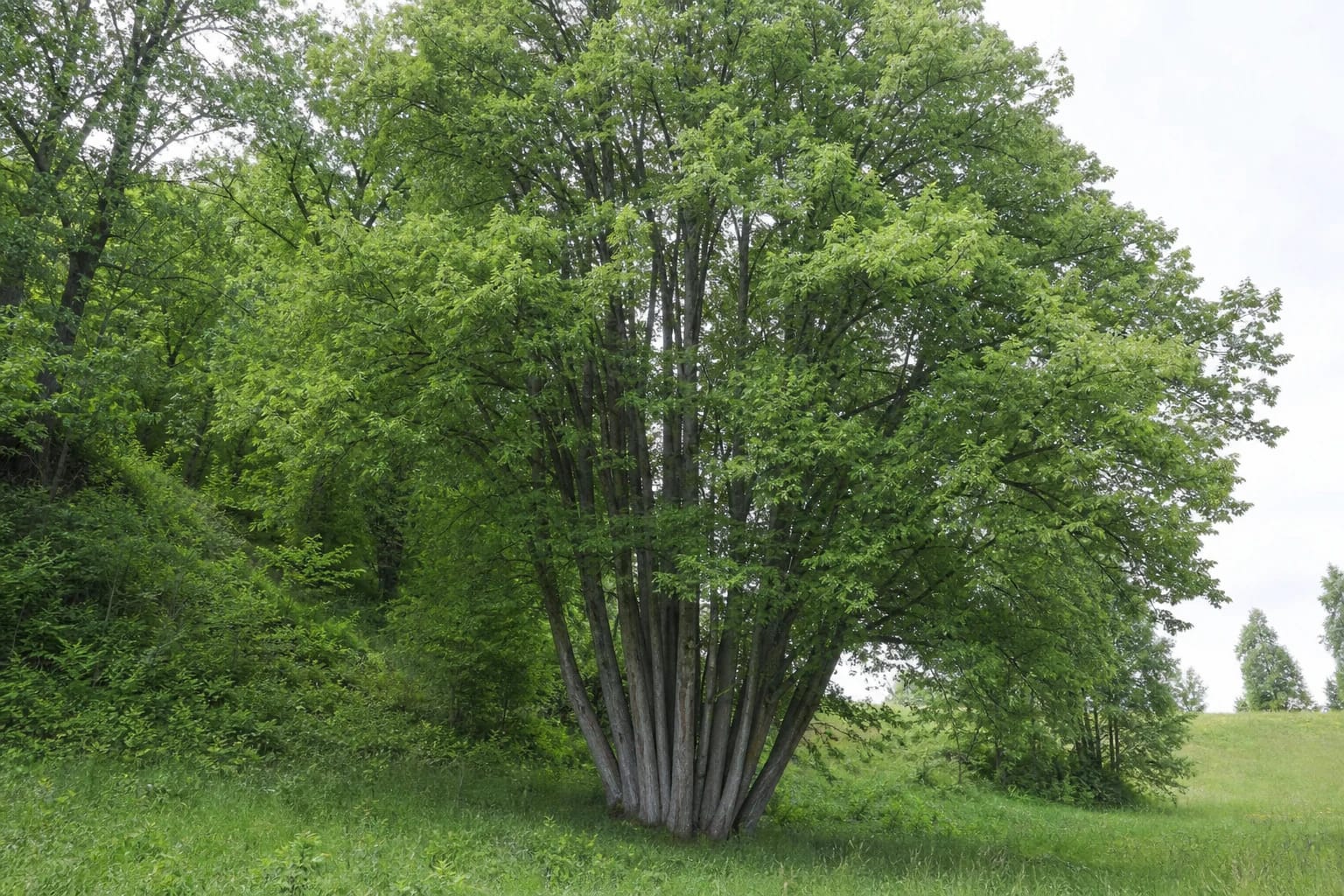
The Dabravolė Multi-Stem Lime grows in Dabravolė village, Pajevonys Eldership, beside a wooded hillfort slope. The protected-areas cadastre describes the setting precisely: the tree stands at the hillfort's foot. Official photographs show not one enormous hollow trunk but a tight group of many straight stems rising from a shared low base into a single dense crown.
The current Saugoma.lt object record gives 25 trunks. The Dzūkija-Suvalkija Protected Areas Directorate repeated that figure in its Vištytis Regional Park itinerary published on 3 July 2025. Twenty-five is therefore the current official number used in this guide, although counting separate living stems can naturally depend on the inspection date and on where an individual trunk is judged to begin.
The exact Google Maps listing Dabravolės daugiakamienė liepa, place ID ChIJK5zRC-w_4UYR0mL7em-QeCM, marks 54.4790935, 22.7840889. On 15 July 2026, it showed 5.0 out of 5, but that average came from only one review. A single rating meets the 4.5-plus selection threshold, yet it is not evidence of a stable reputation or broad visitor agreement and can change with the next review.
An older count of 26 does not explain why the current figure is 25
A State Forest Service article dated 15 June 2023 said that 26 stems branched from the shared stump. This is an older official count, not an error that can simply be rewritten using today's record. None of the sources checked for this guide contains a dated report saying that a particular trunk snapped, died, or was removed.
The one-trunk difference must therefore not be turned into an invented damage story. Current Saugoma.lt data and the Directorate's 2025 article take precedence when stating the public figure today; 26 is retained here only as a clearly dated earlier official description.
Official records register the whole cluster as one named tree and one botanical natural heritage object. The 2023 account describes the stems as branching from a common stump, so the site is not presented as a chance grove of 25 independent limes. No published genetic study was found in the sources checked, and it would be misleading to make a more specific claim about biological origin than the evidence allows.
The 2018 inventory recorded a height of 24 m and a crown 20 m wide
The State Forest Service inspected the Dabravolė lime for its veteran-lime inventory on 10 July 2018. Its table gives an estimated age of 207 years, a height of 24 m, a combined trunk circumference of 7.6 m, a crown width of 20 m, and a branching height of 3 m. These are observations from one dated survey, not immutable present-day dimensions.
The key word in the circumference figure is combined. The 7.6 m measurement does not belong to a single trunk and cannot be compared directly with figures for Lithuania's thickest single-trunk oaks or limes. The inventory also gives no method for the 207-year estimate and no tree-ring date, so it should be described as an age estimate recorded in 2018 rather than an exact planting year.
In 2018 the crown was described as healthy and dense, and every trunk as healthy. That note is useful evidence of the tree's condition then, but it cannot guarantee that every stem remained unchanged eight years later. A veteran multi-stem tree should be approached according to current signs and specialist management, not judged safe by a visitor looking up from below.
Its multi-stem form is rare, while the precise lime species is not officially stated
The State Forest Service notes in its overview of Lithuania's veteran limes that these trees usually develop one trunk and only rarely take a multi-stem form. At Dabravolė, that unusual structure is the central feature: closely spaced stems rise and branch higher up, together carrying a broad crown that appears almost continuous from a distance. The scale makes most sense from two viewpoints - inspect the shared base from a permitted close position, then step back to take in the whole crown.
Official photographs from 2018 and Saugoma.lt show that this is not a burred, single-stem veteran with one huge hollow. Many fairly straight grey-brown trunks are visible at ground level, while the mass of green foliage conceals part of the inner structure. All 25 may not be legible in one photograph, which is no reason to force a way into the cluster or tread over its root zone to count them.
The official object descriptions checked for this guide do not give a Latin species name. A general State Forest Service text explains that the small-leaved lime is the naturally widespread lime in Lithuania, but that alone does not identify this particular tree without a direct record or botanical examination. This page therefore retains the official generic description: a lime tree.
The lime became a state-protected botanical object in 2016
VSTT's legal-record page includes the Dabravolė Multi-Stem Lime among the objects declared state-protected by Environment Minister's Order No. D1-88 of 8 February 2016. The same order approved a boundary plan for the object. The current Saugoma.lt record likewise gives 2016 as the year when protection was declared.
In the current consolidated list of state-protected natural heritage, the tree appears under item 1.5.47 in the botanical section. Its precise legal designation is therefore a state-protected botanical natural heritage object. A 2025 Directorate article uses the everyday phrase natural monument, but this guide gives priority to the category in the current official list.
The foot of the hillfort describes the tree's growing site, while the protected botanical feature is the multi-stem lime and the setting it needs. A visit should not become an attempt to climb through the trunk cluster, carve bark, or expose roots. The structure can be photographed adequately from the publicly accessible meadow and marked approach.
Road 5102 leads towards the tree, but visitor facilities are modest
The 2018 inventory directs drivers along road 5102 between Pajevonys and Vištytis and then towards the hillfort. A sign was present on the approach at the time, and the surveyors described the lime as easy to find. Signs can change, so use the exact tree listing for the final approach rather than navigating only to the centre of Dabravolė. Official rounded coordinates 54.479, 22.784 and the forestry survey point agree with the Google pin to within roughly a few dozen metres.
Google marked the listing open 24 hours on the verification date, but the official object and legal pages publish no ticket, staffed entrance, or formal opening hours. This is not a supervised exhibition. Visit in daylight, recheck the latest listing and local signs before travelling, and leave a vehicle only where it is legal and does not block the road or an access track.
Allow 20-40 minutes for the tree itself. The official sources checked do not confirm a dedicated visitor car park, toilet, or universally accessible path, so do not plan around those facilities being available. Do not squeeze between stems, climb onto the shared base, or touch every trunk while counting; after rain, the meadow edge and foot of the hill can be slippery. If you continue towards the hillfort, budget separate time and stay on established paths.