- Place
- Pajevonys, Vilkaviškis District Municipality
- Region
- Suvalkija
- Type
- Sudovian hillfort with a foothill settlement
- Address
- About 0.8 km from Kunigiškiai village, Pajevonys Eldership, Vilkaviškis District
- Coordinates
- 54.52320, 22.83700
Kunigiškiai Hillfort, Pilies kalnas
Pajevonys Hillfort: a Sudovian stronghold
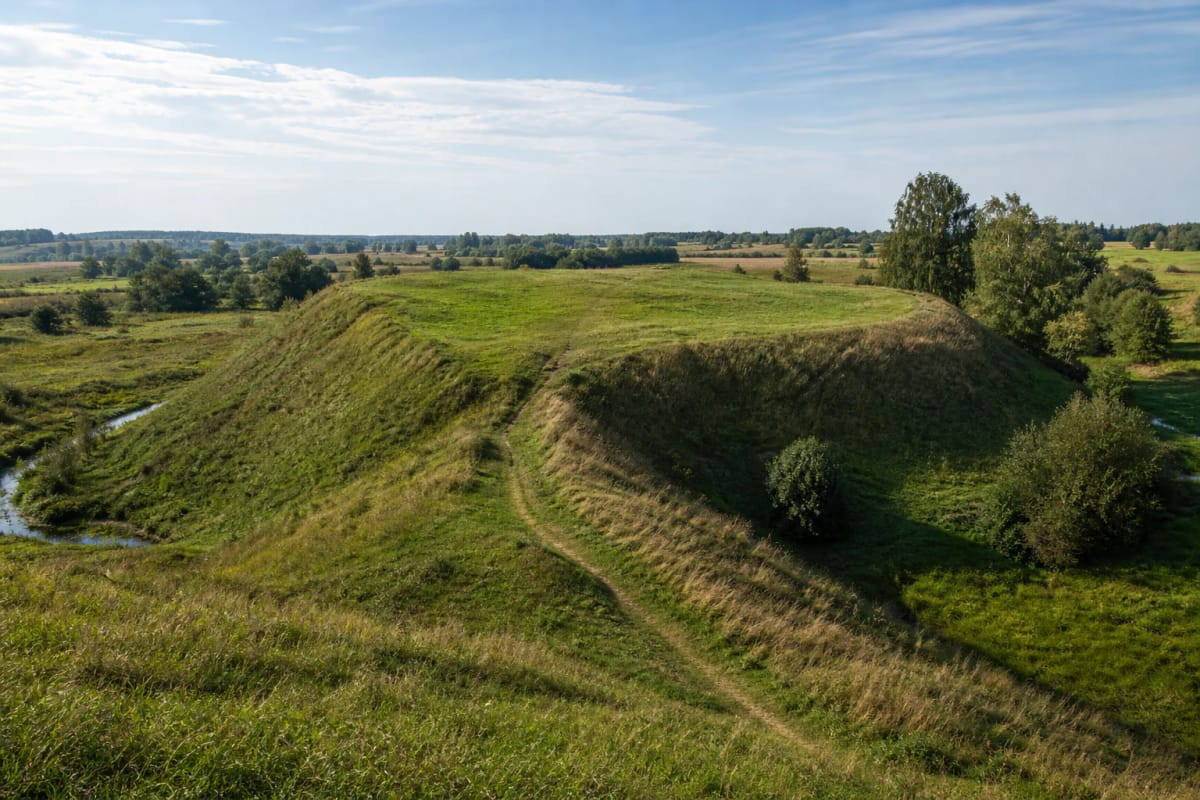
Pajevonys Hillfort rises near Kunigiškiai village in Vilkaviškis District, Suvalkija, on a promontory at the confluence of the Jevonis and Ėglupis streams. It is one of the largest and best-fortified Sudovian, or Jotvingian, hillforts, dated to the 2nd-13th centuries. The widely used name is Pajevonys Hillfort, but the official encyclopedic and heritage-register name is Kunigiškiai Hillfort, because the object lies closer to Kunigiškiai.
The hillfort matters as an archaeological monument of Sūduva. Its size, strong earthworks, and finds show that a significant settlement existed here already in the first centuries AD.
Dimensions and fortifications
The hillfort platform is oval, about 150 x 76 m, with steep slopes up to 10 m high. A rampart surrounds the platform: on the southeastern edge it reaches 4 m high and 24 m wide, while on other sides it is lower. From the southwest, the site was additionally strengthened by another rampart and two ditches.
The entire monument territory covers about 8.9 ha and stretches for roughly 470 m, making it one of the largest hillforts in Užnemunė. Around the hillfort lay an approximately 12 ha foothill settlement, so this was not a single isolated castle site but a large inhabited and defensive complex.
Archaeology and Roman coins
In 1963-1964 the hillfort was investigated by a Vilnius University archaeological expedition led by P. Kulikauskas. On the platform, researchers found a cultural layer up to 0.8 m thick with building remains, iron arrowheads, knives, bronze brooches, ornaments, and hand-built pottery. In the foothill settlement, they found remains of a metal-smelting furnace and iron slag; the finds are kept in the National Museum of Lithuania.
The site is also known for Roman imperial coins. As early as the nineteenth century, according to information from Jonas Basanavičius, coins from the time of Tiberius and Caligula were found near the hillfort; later, a silver coin of Emperor Claudius was found. These finds point to long-distance trade connections associated with the amber route.
Centre of Sūduva: facts and tradition
A striking but cautious local tradition links Pajevonys with the idea that a Sudovian, or Jotvingian, administrative capital and a spiritual centre of priests with temples once stood here. These claims are legends, not archaeologically proven facts, so they are best understood as local memory rather than evidence.
The reliable point is that the hillfort and settlement occupied a large territory, were well fortified, and played an important role in trade. That documented importance, together with the legends, is what makes the place so compelling.
Pajevonys village and how to visit
The hillfort is open and freely accessible. For the hillfort and foothill settlement, 1-1.5 hours is usually enough. After rain the surroundings may be wet, so comfortable footwear is useful.
It is worth extending the visit to Pajevonys church village, where there is a 1928 church, a local museum, and a 1935 monument to Vytautas the Great. Check the museum's exact opening hours in official sources before travelling.