- Place
- Švenčionys District Municipality
- Region
- Aukštaitija
- Type
- late Classicist manor-estate complex and park
- Address
- Liepų al. 1, Cirkliškis village, Švenčionys District
- Coordinates
- 55.11860, 26.13860
Cirkliškis manor estate
Mostovskiai late Classicist manor estate
Cirkliškis Manor is one of the most important manor complexes in the Švenčionys region. KVR registers it as Cirkliškis manor estate, unique code 705, a monument of national significance. Cirkliškis stands by the Vilnius-Švenčionys road, about 3 km southwest of Švenčionys.
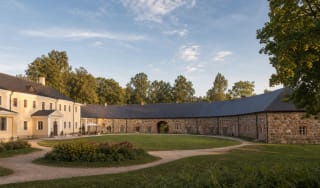
The estate is assigned to the nineteenth and first half of the twentieth century, and KVR lists a large area of more than 53 ha. Cirkliškis should therefore be understood as a whole estate: palace, park, farm buildings, and landscape elements, not only a facade.
Cirkliškis palace and farm buildings
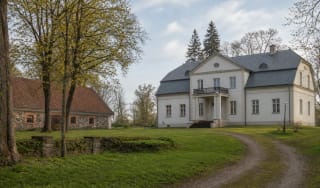
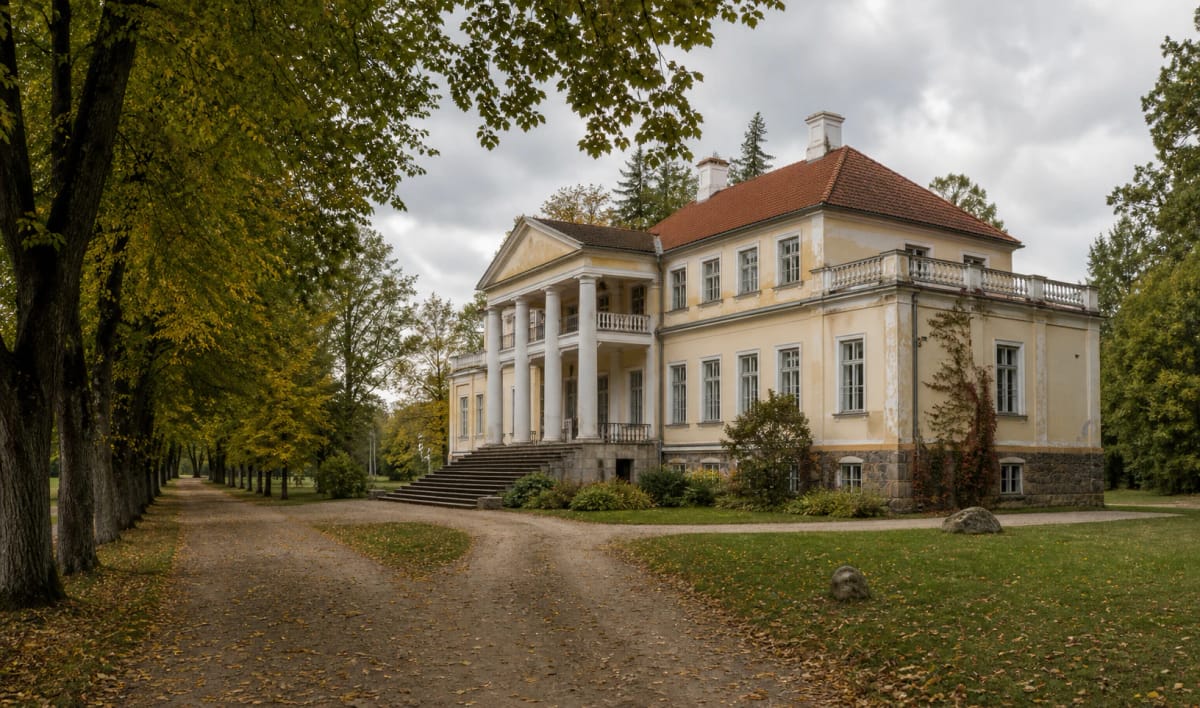
According to VLE, the late Classicist palace was built in 1826 by Domicelė and Edvardas Mostovskiai; the foundation stone bears the date 1823, and historical documents show construction continuing later. The main facade has a six-Doric-column portico. The architect, often linked in sources with a project from Vienna, is not securely named.
The complex includes the palace, a circular early nineteenth-century icehouse with conical roof, a Classicist smithy with a semi-column portal, office building, storehouse, and park. Do not stop only at the palace: the farm buildings help explain the estate's function and scale. Since 1999 the palace facades have been restored, with work continuing until 2008.
Lelewel and cultural traces
Cirkliškis was known for a rich manor library with rare books absent even from Vilnius University. Historian and Vilnius University professor Joachim Lelewel (1786-1861) came from Vilnius to use it. KVR also mentions Leon Borowski and artist Jan Rustem among Cirkliškis guests.
This shows that the manor was not only an economic centre but a place of cultural and intellectual connections. It belongs to the eastern Lithuania manor network where noble life met Vilnius University, education, and political ideas.
Uprising and losses
In the fifteenth century Cirkliškis was owned by the Goštautai, later by the Radziwiłłs. In the nineteenth century it belonged to the Mostovskiai, who supported the 1863 uprising; after it Edvardas Mostovskis was exiled and the manor was punished.
Survival should not be over-romanticised. The Mostovskiai mausoleum chapel from the eighteenth century was blown up in the Soviet period and replaced by a Soviet soldiers' reburial cemetery; sources differ on the exact date, giving 1947 or stating that the chapel stood until 1958. During the Nazi occupation in 1941, a group of Jews was murdered in Cirkliškis, and a memorial marks the killing site.
Park, lake, and Perkūnkalnis
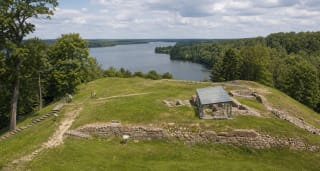
Cirkliškis Manor park covers about 34.5 ha, was created in the early nineteenth century, and has English-park features. Within it are Cirkliškis Hillfort, locally called Perkūnkalnis, and small Lake Cirkliškis of about 1.1 ha. This gives the manor extra landscape depth, where estate planning, park, and older local memory meet.
During research, no reliable stable museum opening hours or ticket were found. Plan Cirkliškis as an exterior heritage and park visit, and check local institutional notices for any interior or event possibilities.