- Place
- Kupiškis District Municipality
- Region
- Aukštaitija
- Type
- Classicist manor estate with a stone granary and park fragments
- Address
- Rožių g. 2A, Antašava, Kupiškis District
- Coordinates
- 55.90872, 24.80625
Antašava manor estate
Antašava Manor estate by the Pyvesa
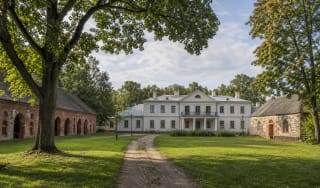
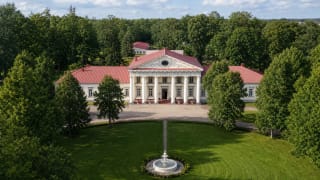
Antašava Manor stands in Kupiškis District, in the eastern part of Antašava, on the right bank of the Pyvesa River. In the Cultural Heritage Register it is listed as Antašava manor estate, unique code 982, a state-protected complex of regional significance consisting of the Classicist palace, stone granary, and park fragments.
Until the late eighteenth century the settlement was called Papyvesys, and the manor is mentioned in written sources from 1595. In 1792 owner Hiacintas Antašauskas built St Hyacinth Church; the present name Antašava derives from his surname. The site is best read as a whole estate, not just a palace facade.
Mykolas Šulcas's Classicist ensemble
The authorship of the manor buildings is associated with architect Mykolas Šulcas. According to KVR data, in 1809-1811 he designed a masonry rectory, palace, and stone granary for owner Hiacintas Antašauskas; the rectory is dated to 1820. This gives the estate a clear single-architect Classicist character.
The palace dating differs between sources: VLE gives 1820, while the KVR dates construction to 1812-1816. The safest formulation is the early nineteenth century, with the difference reflecting distinct construction stages recorded by different sources.
Classicist palace and interior
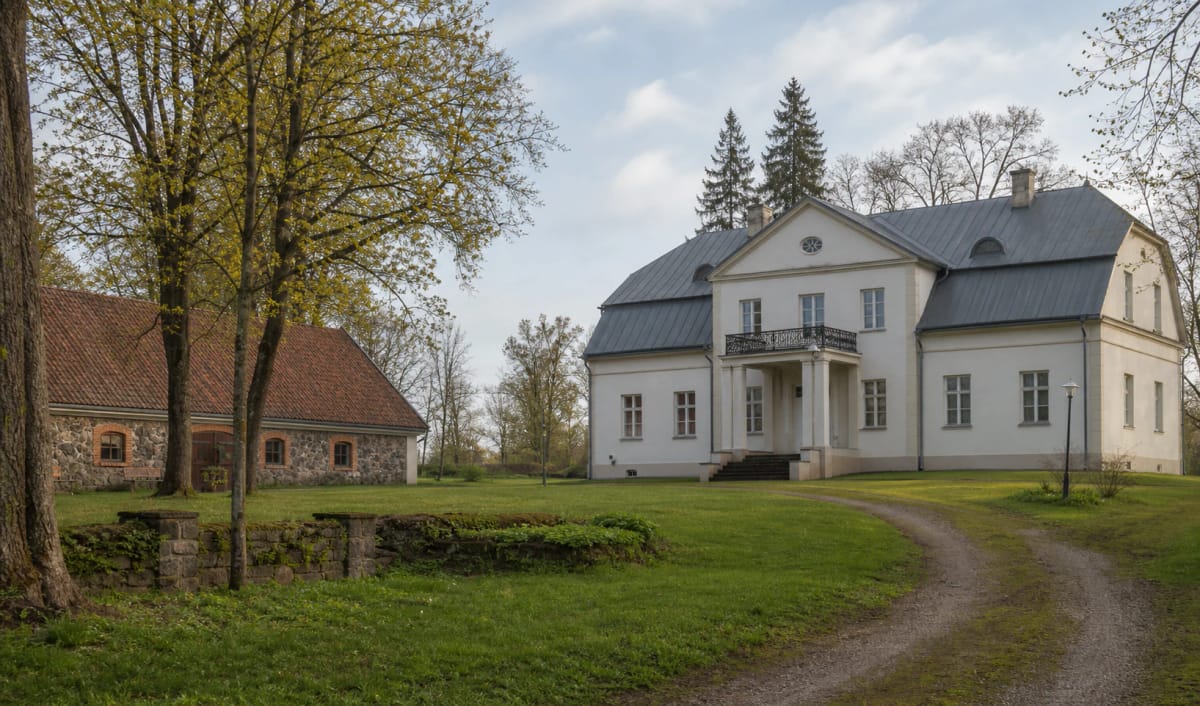
The palace is a two-storey rectangular Classicist building with an ornate entablature decorated by large modillions. In the early twentieth century a two-storey risalit was added to the facade, so the present view includes a later architectural layer.
Inside, VLE notes the best-preserved decorative elements in the bedroom's Ionic-order decor and the ballroom's Doric-order decor, as well as vegetal ceiling motifs and vaulted cellars. These details are valuable, but there is no stable public interior access, so they should not be promised as a guaranteed visitor experience.
Stone granary and manor park
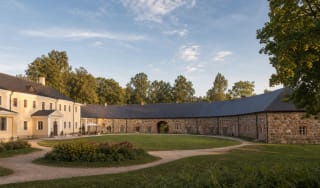
One of the estate's strongest accents is the two-storey fieldstone granary, with characteristic rubble mosaic masonry and plastered window surrounds, dated to the first half of the nineteenth century. At Antašava the farm building is an architectural object in its own right.
The park fragments preserve geometric-plan elements, an avenue, a rectangular pond, and varied plantings. KVR notes 27 tree species, including 12 introduced species, giving the setting dendrological value. Nearby stand a wooden church from 1862 and a nineteenth-century stone bell tower.
Visiting Antašava Manor
During research, no official stable opening hours or ticket for the palace interior were found; the KVR visiting-time field is blank. Antašava is therefore best planned as an exterior and estate-setting visit unless separate local information appears about interior access.
A visit usually takes 30-60 minutes. For Kupiškis-region context, combine the manor with Kupiškis Lagoon and other Aukštaitija manors such as Joniškėlis or Taujėnai.