- Place
- Neringa Municipality
- Region
- Curonian Spit
- Type
- Curonian Lagoon cape and landscape viewpoint
- Coordinates
- 55.32940, 21.04704
Bulvikis, Bulvykis Cape, Bulvikio ragas
Bulvikis Cape - the widest point of the Curonian Spit
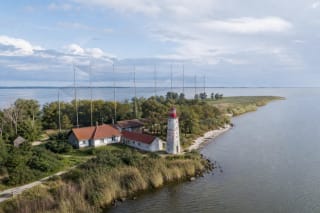
Bulvikis Cape is a Curonian Lagoon promontory between Nida and Preila, about 4 km northeast of Nida. The Universal Lithuanian Encyclopedia places the widest point of the Curonian Spit exactly here, where the sand peninsula reaches 3.8 km across - while at the opposite extreme, near Šarkuva, the spit narrows to only about 380 m.
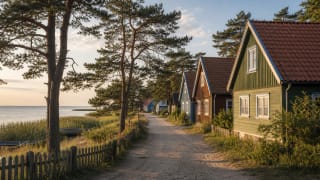
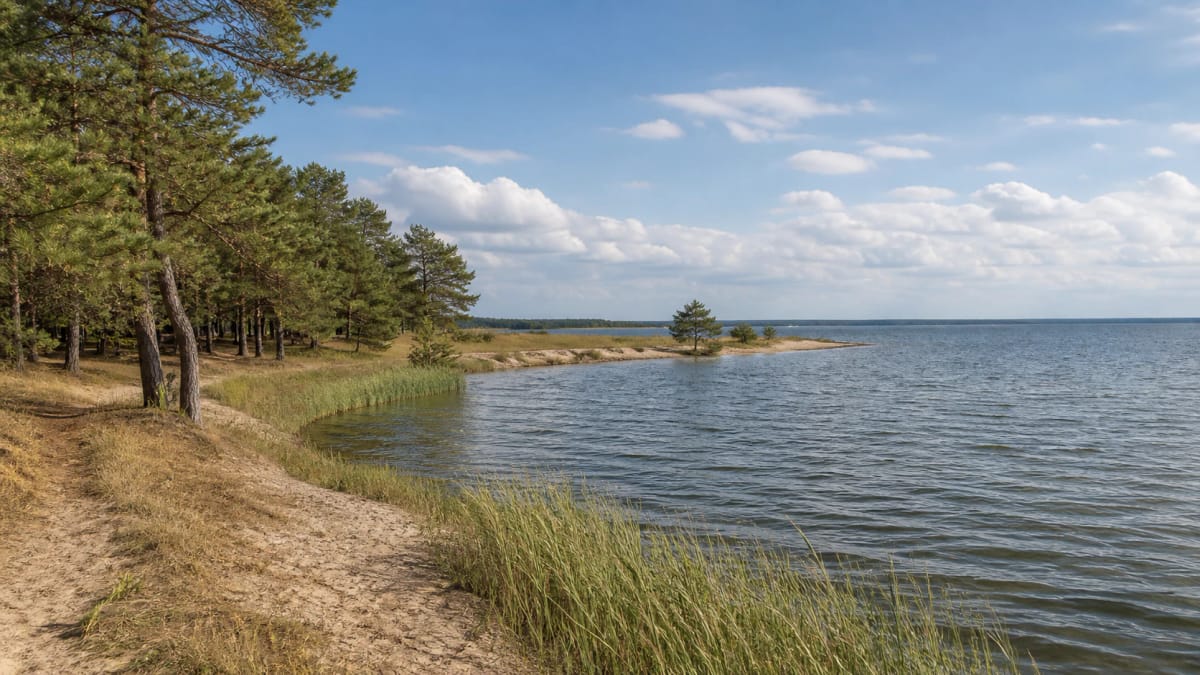
The cape belongs to the Karvaičiai Landscape Reserve and is one of several promontories reaching into the lagoon, alongside the Greater and Lesser Preila, Ožka, Pervalka, Žirgai, and Garbė capes. What matters here is not a building or monument, but the relationship between water, reeds, forest, dunes, and the distant direction of Ventė.
A place on the widest section of the spit
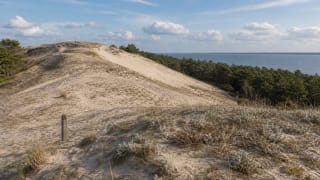
The Curonian Spit is a 98 km long sand peninsula of about 180 km2 that separates the Curonian Lagoon from the Baltic Sea; its northern part belongs to Lithuania. Bulvikis Cape lies in the central, widest section, where all the spit's landscape zones unfold - the sea beach, foredunes, the palvė plain, and the great dune ridge.
The cape itself is lagoon-side palvė - a low shore covered with grass and shrubs, rising only a few metres above the lagoon. Between Bulvikis and Ventė capes the lagoon is more than 8 km wide but only about 3 m deep, so the horizon feels broad, low, and open.
Karvaičiai Landscape Reserve
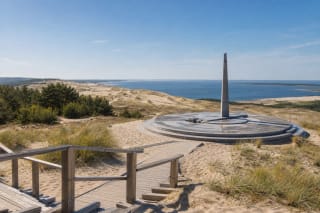
The Karvaičiai Landscape Reserve covers 2,985.28 ha and protects the most scenic complex in the middle of the spit, with the highest dunes on the Lithuanian side. The reserve includes the mountain-pine-covered Giedružė, Preila, Karvaičiai, and Skirpstas dunes (about 60 m high) and the highest dune on the whole spit, Vecekrugas (Old Tavern) dune, at 67.2 m.
The reserve is rich in Lithuanian Red Book species: sea holly, cross-leaved heath, seaside centaury, and spring vetch grow here, and shelduck and even several pairs of white-tailed eagles breed. The Bulvikis viewpoint helps explain why what is protected here is not a single tree or path, but a whole landscape of dunes, palvė plains, and shores.
Origin of the name and the changing shore
The explanations of the name Bulvikis differ: one links it with the Curonian surname Bulvikis, another with the Swedish words bolja (wave) and vik (bay), which would make the name of Swedish origin. Such origin versions should be presented carefully, because place-name explanations are rarely definitive.
Before the great dunes were afforested, the cape grew very fast: between 1837 and 1910 it lengthened by an average of about 7 m per year. Today the process is reversed - lagoon currents erode the cape and it keeps shrinking. It is a good example of how the Curonian Spit landscape is not fixed: water and sand keep rewriting it.
The view over the lagoon and toward Ventė Cape
From Bulvikis Cape and its bay a broad panorama of the Curonian Lagoon shores opens, and on a clear day Ventė Cape is easy to see. In good visibility the far shore looks within reach, but the impression is deceptive - the lagoon here is more than 8 km wide.
The place works best on a calm, clear day. Reeds, water, and the far shore create not the dramatic effect of a dune summit, but a slow, open sense of lagoon-landscape scale you will not find at the narrower parts of the spit.
Planning a Bulvikis Cape visit
Bulvikis Cape is easy to include in a Nida-Preila walking or cycling route. There is no separate ticket, but visitors must follow Curonian Spit National Park rules and avoid damaging shore vegetation and dunes.
Plan 30-60 minutes, or more if you are walking a longer route, and bring water and suitable footwear. On windy days the lagoon shore can feel cold even in summer, so a windproof jacket is worth packing.